Trajan Score Calculator
Project final victory points from action bowl timing, Trajan tiles, forum cards, shipping, military, senate, construction, and bonus tiles.
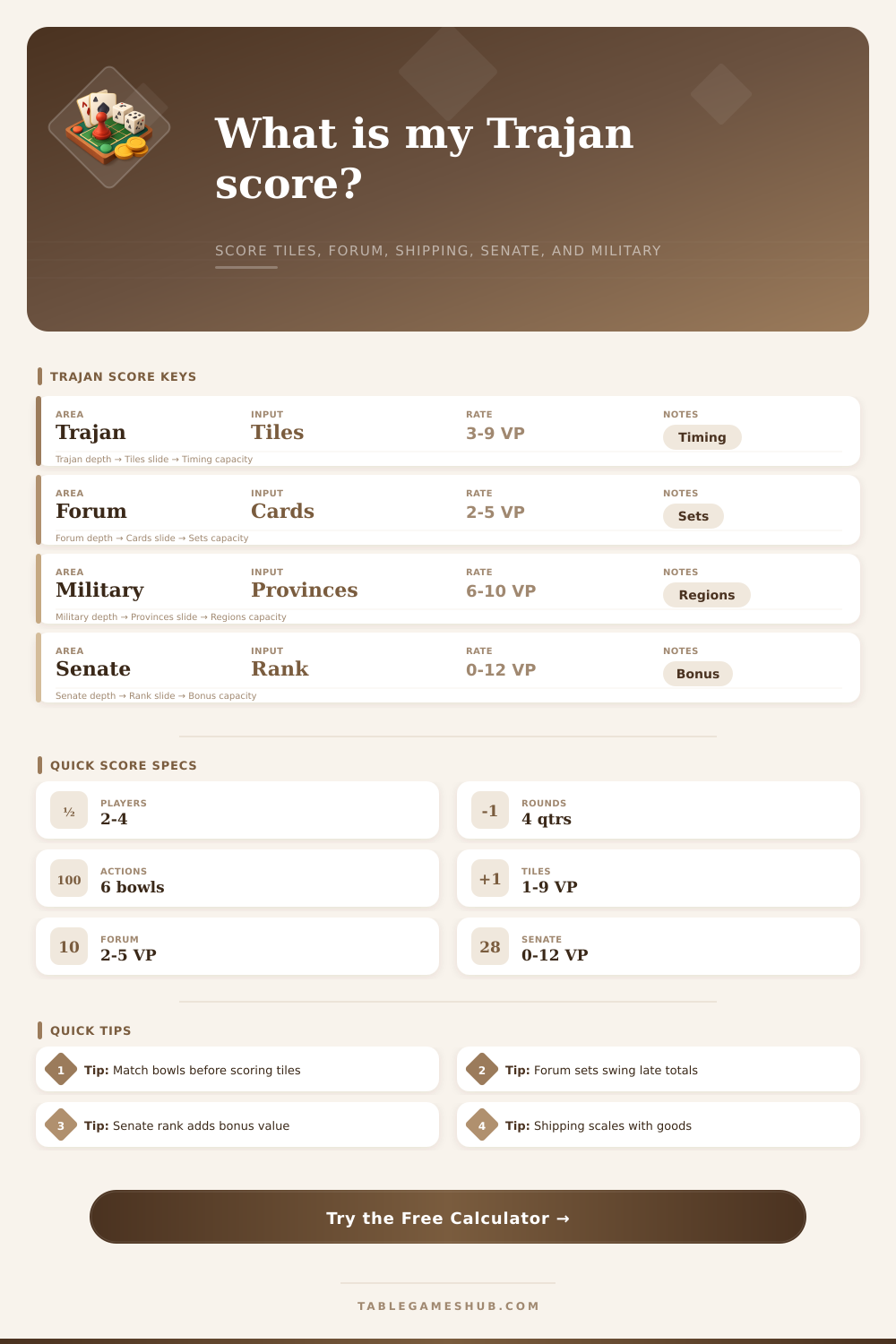
| Scoring Lane | Common Input | Typical VP Range | Calculator Treatment |
|---|---|---|---|
| Trajan tiles | Completed tiles times printed value | 15-60 VP | Tile count times average VP, adjusted by alignment quality |
| Forum cards | Kept card value and complete sets | 10-35 VP | Cards use a base value plus set bonus selected by quality |
| Shipping | Goods delivered through ship action | 8-45 VP | Goods times selected route multiplier |
| Military | Province presence and frontier control | 12-60 VP | Province count times selected presence quality |
| Mancala State | Aligned Bowls | Average Stones | Timing Read |
|---|---|---|---|
| Tight setup | 4-6 | 3-5 | Excellent tile trigger reliability |
| Normal setup | 2-4 | 4-7 | Reliable if actions are sequenced |
| Loose setup | 1-3 | 6-9 | Needs one recovery action before scoring |
| Scramble | 0-2 | 8-12 | Use forum cards or bonus route instead |
| Senate Position | Rank VP | Best Pairing | Risk Flag |
|---|---|---|---|
| Clear majority | 12 VP | Bonus tile burst and forum sets | Protect from last action swing |
| Contested leader | 8 VP | Flexible bonus tile scoring | One opponent can overtake |
| Minority seat | 4 VP | Construction or military backup | May be inefficient late |
| Outside rank | 0 VP | Shipping or tile completion | No senate payoff |
| Preset Scenario | Main Engine | Secondary Engine | Best Use |
|---|---|---|---|
| Forum Senate Majority | Forum sets | Senate bonus | When card sets and rank line up |
| Shipping Goods Sprint | Shipping goods | Bonus tiles | When ship action is already prepared |
| Military Frontier Push | Provinces | Trajan tiles | When province presence is secure |
| Construction Tile Engine | District patterns | Printed VP | When construction tiles are clustered |
Trajan is a game that requires its players to think in layers, as Trajan requires the players to understanding which actions will lead to the best scoring in the game. While one player may choose to collect as many Trajan tiles as possible, another player may choose to focus on building shipping routes for the game. Yet, each player has the potential to win the game based off the timing of there actions.
Each player must understand which part of their position will create the total score for that player. The action bowls are crucial to understanding the timing of the game. Each action bowl contain stones that will determine which round each player’s tile will fire.
How to Use the Trajan Score Calculator
Each color of stone within the action bowl must match the color of the players tile. Action bowls that contain four or five stones will move slow around the game, allowing players to plan their actions that use those slow-moving action bowls. Action bowls that contain eight or more stones will move quickly around the game, forcing players to use a recovery move if they use an action bowl that contains eight or more stones.
The calculator on the page removes the guesswork regarding the actions that a player should take or the timing of those actions. To use the calculator, players must enter the number of their aligned action bowls and the average number of stones within those action bowls. Each forum card contains a value printed on the card.
Yet, forum cards provide additional value for players if they are able to complete sets of forum cards. A set of forum cards can provide more value than a few individual forum cards. Furthermore, a set of forum cards is more valuable if the player has a high senate rank.
The competition for forum cards changes based upon the number of players that are using the game. With four players that are playing, there will be more competition for the best forum cards. The calculator for forum cards treats forum cards differently based upon their quality.
Thus, the forum card calculator include both the number and quality of forum cards in the calculation of each players score. Players score points based upon shipping and military action. Yet, these two types of scores are not the same.
Shipping scores relate to the amount of goods that are delivered and based upon the route chosen by the shipping player. Thus, a late shipping score can provide a player with a high score if the route chosen has a high value of shipping goods. Military score is based upon the number of provinces and the number of military units that are present on the board during scoring.
An early military score is more important than a high score based upon military units. Finally, construction tiles provide additional score for the game. The more construction tiles that a single player constructs in a connected pattern, the higher the value of the construction tiles for that round.
Each scoring lane can provide a high score for each player, yet only one score will provide the total score for each player after penalties are applied to that score. Each player earns a score based upon their senate rank. Each senate rank provides a majority seat for that player’s senate, earning that player twelve points and bonus construction tiles for the game.
If a player does not have a majority seat in their senate, they are vulnerable to another player capturing that majority seat. Thus, each player must consider their senate rank prior to taking any actions in the game. Furthermore, the calculator considers both the senate rank and bonus construction tiles for each player.
The calculator considers these two factors together because both of these factors tend to occur together in each round of the game. A player may be able to avoid using their senate and bonus tiles if they have a high number of bonus tiles. Yet, a player that does not use their senate and bonus tiles may not have a high score in other areas of the game.
Each players score is calculated after subtracting the penalty points for not fulfilling demand for the player. These penalties are subtracted directly from each players total score. The demand calculator on the page keeps track of the number of demand markers that a player will leave behind at the end of the game.
These demand markers are used to calculate each players score. Although many players pay attention to the positive scores that can be earned in the game, they often forget about the penalty points. Yet, paying attention to the penalty points early in the game will allow a player to decide which forum cards to claim and if they should use an action to cover a demand for another players tile.
The reference tables on the page provide example scores for each of the scoring lanes. Furthermore, the reference tables provide information regarding the states of mancala and the timing of the game based upon those states. Players can use these tables to compare their current game to the potential scores that they may earn during the remainder of the game.
Thus, players use the reference tables to avoid simply hoping that they will earn the best-case scenario for their score. Furthermore, the label of the strongest scoring lane indicates the strongest lane for a player, regardless of the players desires for those scoring lanes. Players who race towards the highest score will typically earn a second place score.
The player who can identify which scoring lane will earn the most points for each player will win the game. Furthermore, the winner of the game will be the player that can protect their scoring lane for the remainder of the game. The calculator for score predictions makes the comparison of each of the scoring lanes visible to each player.
Furthermore, this score calculation is made prior to the final quarter of the game.