🃏 Scrabble Bingo Probability Calculator
Estimate seven-tile bingo chances from your rack leave, draw size, remaining bag, blanks, S tiles, vowel balance, target stems, and board openings.
1Bingo Probability Presets
Load a common rack-and-bag state, then adjust the leave, bag counts, target letters, and board lanes for the position in front of you.
2Rack, Bag, and Board Inputs
3Target Letters and Balance Checks
4Formula Cards
Counts unordered tile draws from the remaining bag.
Blank and S chances use the complement of drawing none.
Blanks can cover missing target letters in exact mode.
Repeated draw cycles estimate one or more bingo chances.
5Scrabble Bingo Spec Grid
6Reference Tables
| Tile group | Starting count | Bingo role | Calculator field |
|---|---|---|---|
| Blanks | 2 | Wild tiles that complete stems and fix duplicate letters. | Blanks remaining |
| S tiles | 4 | Hooks, plurals, and common seven-letter endings. | S tiles remaining |
| Vowels A E I O U | 42 | Rack balance and leave flexibility. | Vowels remaining |
| Common consonants R T N L S | 24 | Strong stem support and frequent bingo letters. | Target letters |
| Power tiles J Q X Z | 4 | Often score well but can reduce bingo flexibility. | Rack leave |
| Rack leave shape | Typical draw | Probability pressure | How to model it |
|---|---|---|---|
| Six-letter stem plus one draw | 1 tile | Exact target matters more than broad rack quality. | Use target mode with the desired missing letter set. |
| Five-tile balanced leave | 2 tiles | Blanks, S, and vowel balance create most of the swing. | Use any-bingo heuristic plus target cross-check. |
| Three or four kept tiles | 3-4 tiles | Bag composition matters because more tiles are unknown. | Track vowels and blanks carefully. |
| Full exchange or opening rack | 7 tiles | Model is broad because word knowledge dominates. | Use wide list only if the player knows the words. |
| Bag state | Blanks | S tiles | Vowel note |
|---|---|---|---|
| Full bag | 2 of 100 | 4 of 100 | 42 vowels before any play. |
| Balanced midgame | Usually 0-2 | Usually 0-3 | Compare vowels to total bag size. |
| Vowel-heavy bag | Track exact blanks | S may be scarce | Raises balance odds for consonant leaves. |
| Consonant-heavy bag | Track exact blanks | S may be live | Helps vowel leaves but can clog consonant racks. |
| Late bag | Exact count needed | Exact count needed | Small bags make each unseen tile matter. |
| Scenario | Best model | Useful output | Scorekeeper note |
|---|---|---|---|
| Fishing for RETINA plus S | Target letters | Exact draw chance with blanks included. | Enter RETINAS as the target rack. |
| Need any blank to open rack | Blank model | At least one blank probability. | Check whether a blank is already unseen. |
| Leave has five consonants | Vowel balance | Chance to draw enough vowels. | Set minimum final vowels to two. |
| Closed board | Any bingo heuristic | Board-adjusted practical chance. | Reduce open bingo lanes before calculating. |
7Probability Tips
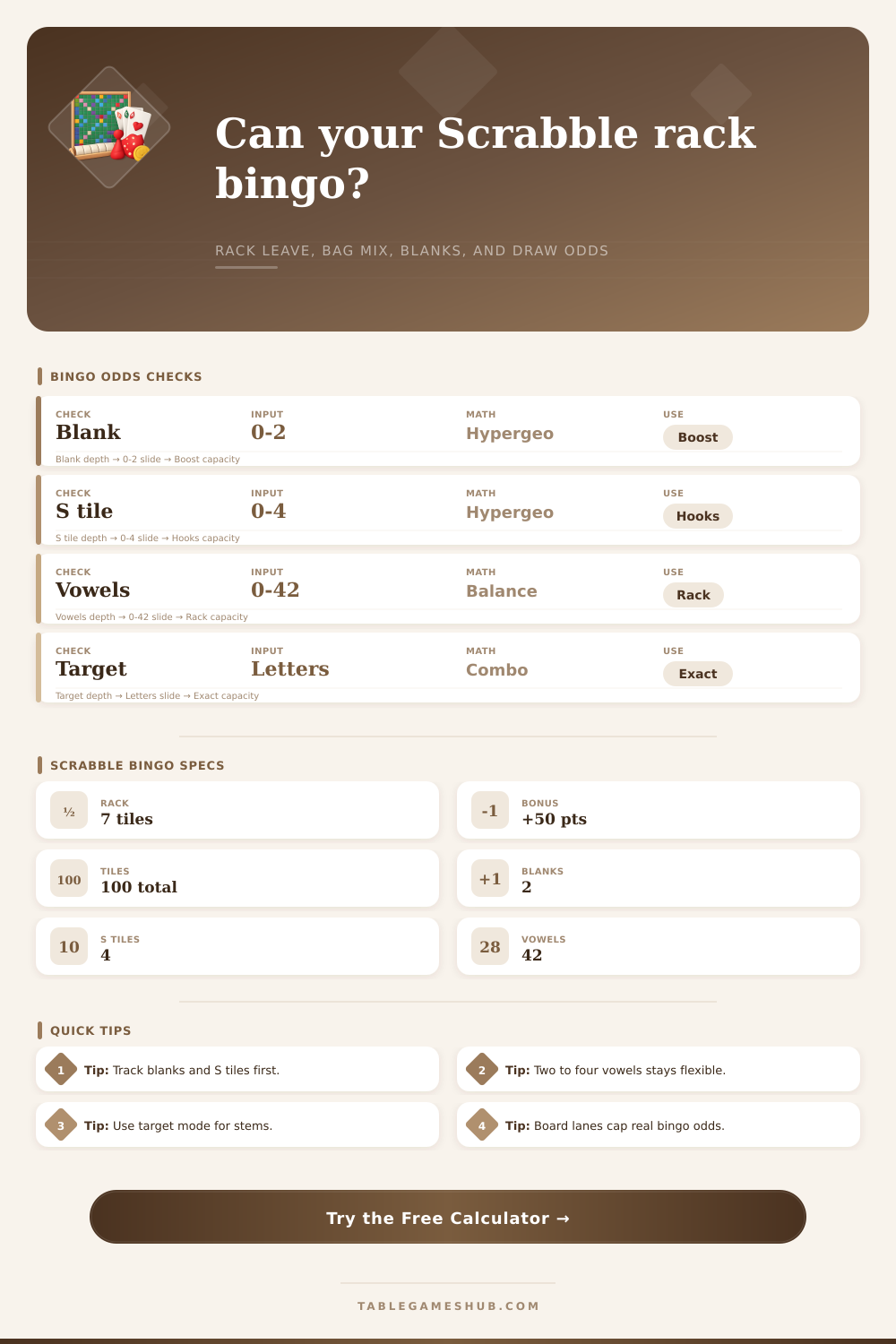
Separate rack odds from board odds. A rack can be bingo-ready while the board has no landing lane, so keep the open-lane input honest.
Use exact mode for known stems. If you are fishing for a specific completion, target-letter probability is more useful than a broad bingo estimate.
In Scrabble, a bingo is worth 50 points, familiar to most players. Fifty points can be enough for victory in a club game or turn the tide of a close tournament match. But then you have one of those racks looking promising and you find yourself hoping against hope. You keep three letters, exchange four … just praying that the bag will cooperate.
At this point, probability stop being abstract math. It becomes a tactical edge. But that is not always the case. When composition of the bag changes, intuition goes out the window.
Understanding Scrabble Odds
In those early moves everyone believes they’re drawing from a complete 100-tile set. All the probabilities is fixed, and computer engines have documented them well. But halfway through the game, tiles dissapears in an un-even manner. Suddenly the statistical map is turned on its ear: maybe you’ve seen three blanks played already; maybe your opponent has hoarded the S tiles for hooks.
At this point you must consider what’s really still available in the bag; not what was present at the beginning. Plug in estimates of how many tiles are remaining in your bag and how many tiles remain on your own rack, and the calculator will do the rest. It will save you from having to guess about whether that particular stem deserves a fish.
Let’s begin with what you have in your rack. If it’s normally a five-tile balanced leave, then you’re looking at drawing two tiles. It is typically the most likely place to start. You are not looking for a miracle combo but something you can manage.
On the other hand, suppose you have six letters, but only require one more. Now, the exact target matters immensely; you’re not looking for balance anymore. You’re on the hunt for a particular letter. And that changes everything. Suddenly that six-letter stem looks secure … right up until you discover it’s missing a Q, or blank, perhaps already out of play.
There are also some particular tiles to watch out for in any probability model… The blanks and the S tiles. Blanks are sort of like wild cards, meaning their presence basically expands the available set of playable tiles for nearly all words. If there are only two blanks left in the bag, it greatly increases your odds of being able to finish off a tough-to-reach stem.
The S tiles work similarly but have a smaller range: they makes it possible to spell many common endings (such as ING or EST) as well as plurals. Keep track of them separately and use this information to guide how you play. If you realize you’re down to one blank and need another for a specific word, don’t waste time chasing that; instead, switch gears and play something easier while leaving the board wide open.
Another key is vowel balance. Five consonants and two vowels might look like a strong rack because of high-scoring letters, but they often lack flexibility. Most words in English need a vowel about every couple of letters. If your bag is vowel-heavy because opponents have played long consonant strings, it becomes more likely that you can pull the vowels needed for most English words. It’s a good idea to hold onto vowels when the bag is dry on vowels.
This is laid out on page in the form of a reference table which shows the effect of different bag profiles on draw chances. All of that theorizing comes back down to the board. You can have a bingo-ready, perfectly-balanced rack, but with just one small lane on the board, your actual chance becomes close to zero. Place doesn’t matter without probability. Before you commit to the fish, always consider how many open lanes there are.
If the board’s tight, play for stability and score over going after the long-shot, unlikely seven-letter word. Bingo math is all about risk. How likely is it that your rack will give you fifty points? And what are the chances you’ll take a calculated risk to chase those points? Each player has a different answer.
Some like to roll the dice; others like to build slowly. There’s no right or wrong answer here, but knowing those odds lets you know whether you’re playing it safe or taking a chance on something big. It’s like, knowing that the odds aren’t on your side doesn’t mean you have to play perfectly, but it will keep you from playing blind.
It makes you realize there are certain situations where you can take calculated risks. That transition into thinking about your game like that, I think, is the difference between being a good player and a great player. You should of begin to understand when you’re earning bingo versus hoping for it.