Scattergories Score Calculator
Total one Scattergories round from accepted unique answers, duplicate matches, challenged answers, invalid lines, optional alliteration bonuses, prior score, and target pace.
1Named Scoring Presets
Load a realistic table state, then adjust the counts after the answer-reading and challenge vote are finished.
2Round Inputs
3Four Formula Cards
Classic Round Score
score = unique valid answers x 1
Each accepted answer that no other player matched scores one point. Matched, blank, and rejected answers add zero.
Duplicate Zero Rule
duplicate points = matched answers x 0
If another player has the same answer on that category line, the calculator leaves that line out of the score.
Challenge Audit
accepted lines = unique + duplicates + invalid
Challenge counts do not create extra points here; they flag how many unique answers survived the vote.
Bonus Variant
bonus = extra key-letter words x value
Use this only when your table allows extra points for proper names or titles with repeated key-letter initials.
4Component and Spec Grid
5Scattergories Reference Tables
| Answer outcome | Classic score | Junior style | Calculator field |
|---|---|---|---|
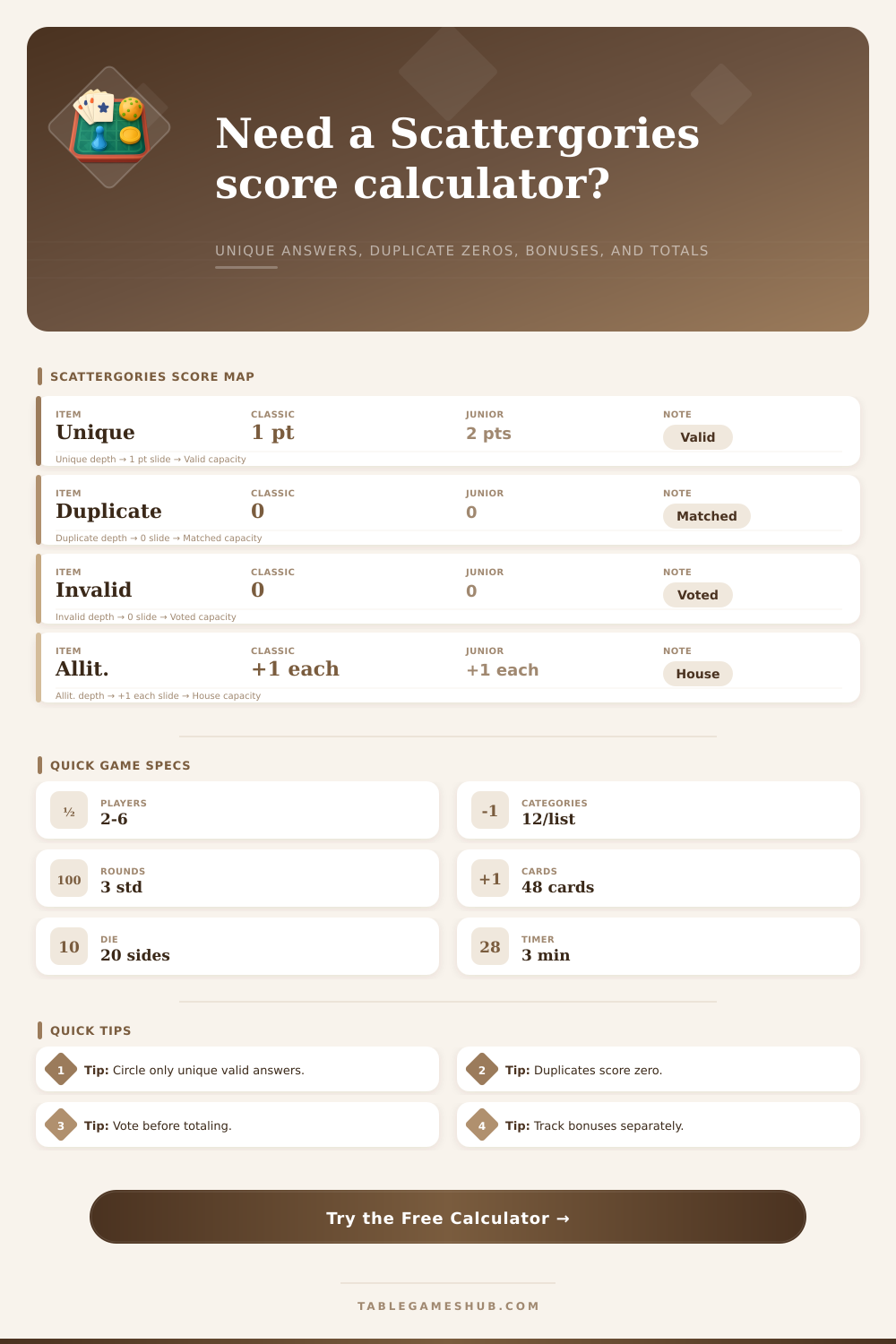
| Accepted and unique answer | 1 point | 2 points when using key-letter style | Accepted unique answers |
| Same answer as another player | 0 points | 0 points | Duplicate or matched answers |
| Blank, wrong letter, or rejected answer | 0 points | 0 points | Invalid, blank, or lost challenge lines |
| Proper-name alliteration variation | Optional extra point per extra key-letter word | Optional house bonus | Alliterative bonus words |
| Table state | Unique | Zero lines | Classic total |
|---|---|---|---|
| Clean early round | 9 accepted unique answers | 3 combined duplicates or blanks | 9 points |
| Challenge-heavy round | 6 accepted unique answers | 6 duplicate, blank, or rejected lines | 6 points |
| Alliteration house variant | 8 accepted unique answers | 4 zero lines plus 2 bonus words | 10 points |
| Junior-friendly scoring | 7 key-letter answers | 5 zero lines | 14 points |
| Component | Typical value | Score relevance | Source basis |
|---|---|---|---|
| Category list | 12 numbered categories | Sets the normal maximum classic round score before bonuses. | Hasbro rules PDF |
| Answer pad | One answer per line | Prevents stacking multiple answers into a single category score. | Hasbro rules PDF |
| Letter die | 20-sided letter die | Determines which first letter must be checked for answer validity. | Hasbro product info |
| Timer | Timed round | Used here only to calculate points per minute, not official score. | Hasbro rules PDF |
| Reference | Used for | Quality note | Link |
|---|---|---|---|
| Hasbro Scattergories instructions PDF | Classic scoring, duplicate zeros, challenges, and acceptable-answer notes | Official publisher rule sheet | Rules PDF |
| Hasbro official product page | Current player range and listed components | Official publisher product data | Product page |
| BoardGameGeek Scattergories page | Component taxonomy and game context cross-check | Board game database | BGG page |
| USC Annenberg Scattergories rules page | Acceptable-answer wording and challenge-vote confirmation | Public rules adaptation quoting common official checks | Rules page |
6Scoring Tip Boxes
Resolve challenges first: Enter the calculator counts only after disputed answers are voted valid or invalid, so each line lands in exactly one scoring bucket.
Keep bonuses separate: Treat proper-name alliteration as a selected variant. Classic totals stay clean when bonus words are tracked as their own line item.
The essence of Scattergories is the creative spark mixed with competitive anxiety. This happens right after the time runs out and you have a blank line next to a musical artist name. That panic… You know the feeling. And that’s why the game has survived for decades. It rewards fast-thinking under pressure, not deep knowledge. The scramble is where the fun is; but the scoring can sometimes feel like an afterthought until somebody contest if your answer counts.
That’s the beauty of old-school rules: they’re easy. Each person get one point for writing down something that begins with right letter and has a reasonable answer, unless someone else already got that answer. It is binary. Either you came up with something unique or you didn’t. And because it’s binary, it creates a dynamic where originality matter more than volume. There’s no advantage to writing out five answers to every question when you’re playing against friends who figured out the easy stuff first.
How to Score Points in Scattergories
Plug in your numbers on the calculator, and it will figure out how many points you’ve earned. No need to fight about whether this means three people getting the same answer results in nobody earning anything, or only some people earning nothing. All of them earn nothing. People seem to forget that. You have to anticipate which categories has common answers where duplicates tend to cluster. For instance, in a four-player game, chances are good that top 10 obvious answers to every category are already gone. If you wait until the last second to come up with an answer, you will end up searching for odd facts. Those facts may or may not fit what others consider to be valid answer.
That’s why keeping track of how many of your answers were duplicates vs. How many was new and unique is so important. Six unique to six duplicates sounds like you lost a round, but when time expired, it was a decent showing. Players greatly over-rate their own quickness and under-rate how often there ideas collide. And that’s where the social negotiation comes in, with an additional wrinkle: people can challenge your answer, and table gets to vote on whether or not it works. Part of your score depend on your knowledge, but it also depends on how well you can argue for why your categorization fits. If you think the category is asking for a generic term, and you instead wrote down a proper noun, and then you can’t convince everyone that your answer should of count as an exception… you could have some problems there. Fortunately, the tool will let you keep track of accepted challenges, making it easier to see how many of your points held up under examination of the group.
The scoring phase becomes a mini-game of persuasion all its own. The game changes colors if house rules differ. For example: Linguistic skill trumps memory if bonus points is awarded for answers that include more than one occurrence of key letter. That gives a leg up to players whose minds process words instead of ideas. Use those variants? Depends on how complicated your group want to get. Basic keeps it going quick, especially if there’s food involved and attention spans are brief.
The calculator also includes another feature, projection, and it’s for an entirely different reason. It helps you know when you can coast to victory and when you should play aggressively in the last few rounds. Can you risk taking a chance with some obscure answer because your running total is well above the leader? Or do you want to stick to more common, less risky terms so that you’ll be able to pick up those points that are out there? If you are trailing, it turns the endgame from a free-for-all into a strategy session where you work to close the gap while avoiding mistakes that give away easy points.
But realy, it’s the game’s joy: laughing together with bad answers and gasping with good ones. It’s about the scores on the sheet, yes, but only as a framework for something more chaotic. Knowing which category you have the most unique hits can help you recognize your own strengths, be they obscure geography or pop culture trivia. But don’t get distracted by them; that’s not the point. Beating the buzzer to get through all twelve categories is an accomplishment in itself. And if you manage to add up those points at the game’s close, consider each unique answer a small win against your friends’ predictability. That’s what brings the game back again and again, night after night.