Left Center Right Dice Calculator
Estimate LCR dice odds, expected token movement, center-pot growth, inactive risk, remaining table rounds, and practical setup space from the current game state.
1Real LCR Presets
Pick a realistic table state, then adjust the token counts or dice model before calculating.
2Dice State Inputs
3Selected Component Specs
4LCR Reference Tables
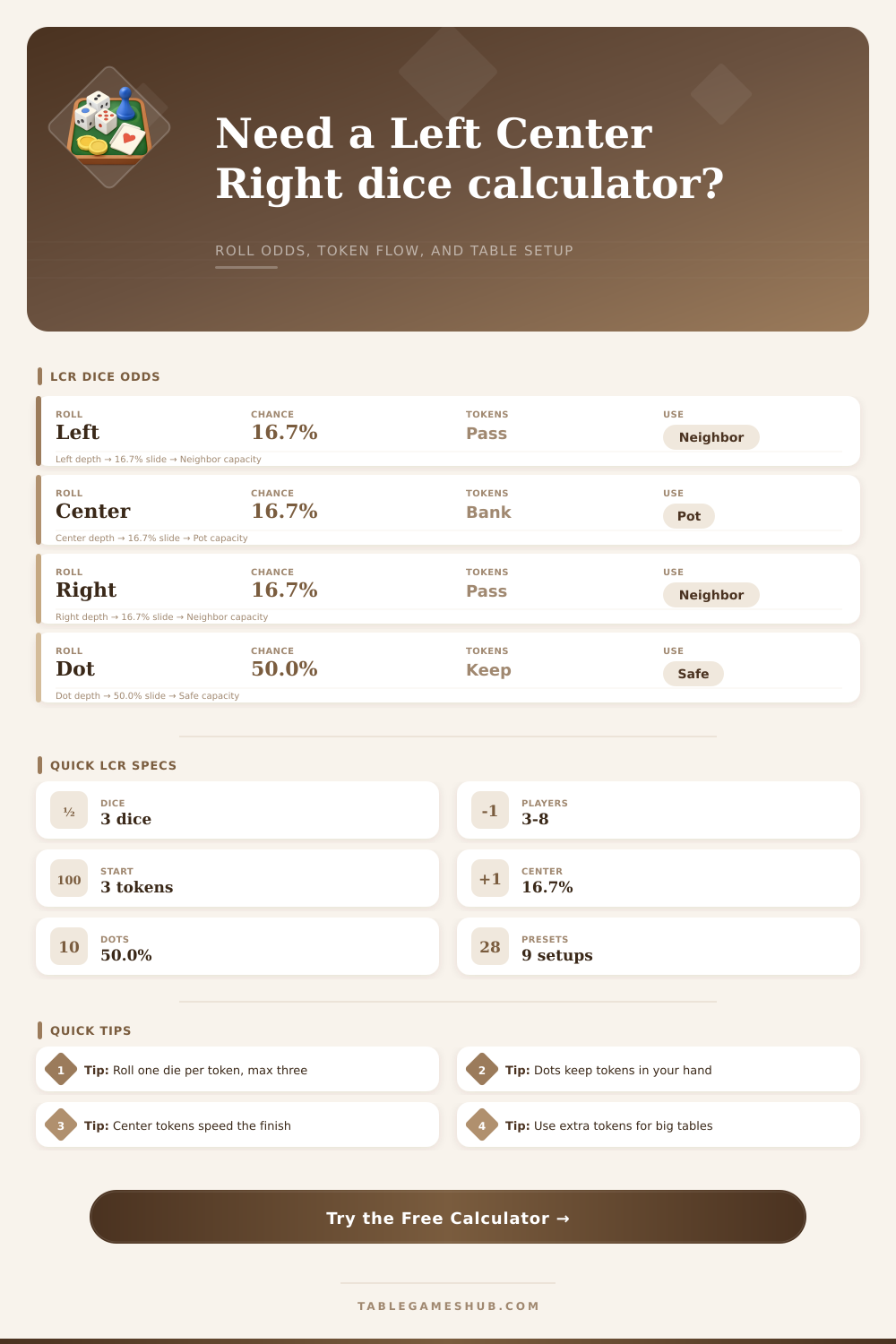
| Die face | Classic chance | Token movement | Calculator effect |
|---|---|---|---|
| L | 1 of 6, or 16.7% | Pass one token left | Reduces your hand and may feed the left neighbor |
| C | 1 of 6, or 16.7% | Move one token to center | Raises the locked pot and speeds the finish |
| R | 1 of 6, or 16.7% | Pass one token right | Reduces your hand and may feed the right neighbor |
| Dot | 3 of 6, or 50.0% | Keep the token | Improves survival and slows center growth |
| Players | Classic tokens | Comfortable table edge | Typical pace note |
|---|---|---|---|
| 3 players | 9 total | 54 to 66 inches around | Fast, swingy, every pass matters |
| 4 players | 12 total | 72 to 88 inches around | Balanced family-table rhythm |
| 6 players | 18 total | 108 to 132 inches around | Center pot builds steadily |
| 8 players | 24 total | 144 to 176 inches around | Use extra token visibility and a clear center cup |
| Component set | Dice | Token supply | Best use |
|---|---|---|---|
| Classic tube | 3 marked dice | 24 chips | Standard 3 to 8 player LCR |
| Standard d6 proxy | 3 ordinary dice | Use coins or chips | Map 1=L, 2=C, 3=R, 4-6=dots |
| Giant foam dice | 3 oversized dice | Large tokens | Visible rolls for parties or classrooms |
| Two-set party table | 6 marked dice | 48 chips | Faster rotation at large tables |
| Current tokens | Dice rolled | Chance no token moves | Chance all rolled tokens move |
|---|---|---|---|
| 1 token | 1 die | 50.0% with classic dots | 50.0% with classic L/C/R |
| 2 tokens | 2 dice | 25.0% with classic dots | 25.0% with classic L/C/R |
| 3 tokens | 3 dice | 12.5% with classic dots | 12.5% with classic L/C/R |
| 4+ tokens | 3 dice max | 12.5% with classic dots | Cannot empty on one classic roll |
5Table Game Calculation Tips
Token flow check: For one turn, expected outgoing tokens equal dice rolled multiplied by the chance of L, C, R, or wild movement. Neighbor returns are estimated from their available dice.
Setup check: Multiply players by starting tokens, then add the buffer before play begins. A small center bowl keeps locked tokens separate from passing tokens.
Left Center Right is quicker then you think. All the players has their chips one minute; then suddenly one person is in control of pot and everyone else are staring at him. It’s chaotic, yet it’s a narrow mathematical funnel. A few basic probabilities compound rapidly. That’s how the game works. Those probabilities makes seemingly random passes transform the game into a swift gathering of tokens. Once you get the pulse of the game, you’ll start to play different; and position the table to help your friends experience something they may not know came over them. With those numbers plugged in to the calculator above, it do all the work for you. No need to guess if you’re in danger or not. Everyone wants to get rid of their chips, but controlling risk per roll is what the game’s really about.
If you have three tokens, then you’ll be throwing three dice. There’s a 50% chance each will land on a dot (keeping whatever chip that represents safe for another round). That sounds pretty good until you remember that there’s just a 12.5% chance that all three will land on a dot. Most of the time at least one of those token goes bye-bye. You’re not attempting to avoid losses here; you’re attempting to manage how fast you lose them. That way you can keep yourself in and everyone else around you can still chuck a bunch right back at ya.
How to Play Better with Math Tips
Most importantly: You should of input your neighbor’s token count. Because if the guy next to you have no dice, he can’t shoot an L back at you. The calculator will adjust for that, so if everyone who has the potential to return fire does, then it’ll make expectation higher to match. That’s why early-game preservation feels different than late-game survival. Early on, tokens go round and round the table in even exchange. Late on, the few remaining players hunkers down with what they’ve got, and center pot becomes overloaded. Everything starts feeling weightier.
The tool takes that dynamic shift into account, projecting how long you’ve got before someone goes bust. It lets you know whether you should push your chips into middle, or whether you should try to slowly bleed them off to the side.
Beyond popping open the box, it’s good to think ahead to setting up for a party. Eight players fit easy in a standard setup; larger parties requires extras. Using these prevents running out if somebody gets lucky with their first few rolls. Also, leaving plenty of breathing room around table makes sense. Tokens are small enough that they tend to bounce around. You don’t want to spend the next half hour hunting for chip underneath the couch as a result of an especially enthusiastic roll.
Depending on how many people will be playing, the calculator calculates physical footprint required. That way everybody can get into the action without stepping all over each other. While that might seem like a minor detail, people gets confused about who scores what and fumble passes when tables becomes too cramped. With eighteen to twenty-two inches per person at either end, things flow nicely and the party stays fun.
How do you know when to be cautious and when to attack? Experience will tell you there’s a sweet spot for both. When I see new players has a single token remaining, it usually causes them to panic. They feel like they need to protect it with their life. If they hang on to a single chip, then they’re only going to roll one die, so they’ve got nothing to play with. They have no way to build momentum and no way to pass around tokens to make things happen. In some cases, it is better to let those chips fly free rather than try to pin them down.
The page has a couple of reference tables that show just how statistically likely you are to empty your hand based off how many dice you’ve got left. You’ll want to get into the danger zone while still having plenty of room to back up if you get dealt a crappy hand. All in all, what makes Left Center Right beautiful is how accessible it is. There’s no need for a math whiz to master this game, but understanding the odds makes you play smarter. Tokens dissapears into the center pot like a sinkhole. Typically, whoever leaves the center pot rich does so because they timed their exit well, not because they played aggressively against everyone. Stay aware of the flow and pay some attention to the probability of the dot. Savor the chaos now because sooner or later the circle closes and next time someone else will be standing on the sidelines watching.