Glen More II Calculator
Total scoring-round VP, final territory penalties, coins, landmarks, overbuild notes, goods tie strength, and optional Chronicle scoring.
🎲Scoring Presets
🏰Score Inputs
📊Board State Grid
📐Comparison Scoring Table
| Difference Above Lowest | VP Awarded | Applies To | Calculator Treatment |
|---|---|---|---|
| 0 | 0 VP | Any comparison category | No lead over table minimum |
| 1 | 1 VP | Home Castle, landmarks, whisky, persons | Small lead |
| 2 | 2 VP | Home Castle, landmarks, whisky, persons | Moderate lead |
| 3 | 3 VP | Home Castle, landmarks, whisky, persons | Strong lead |
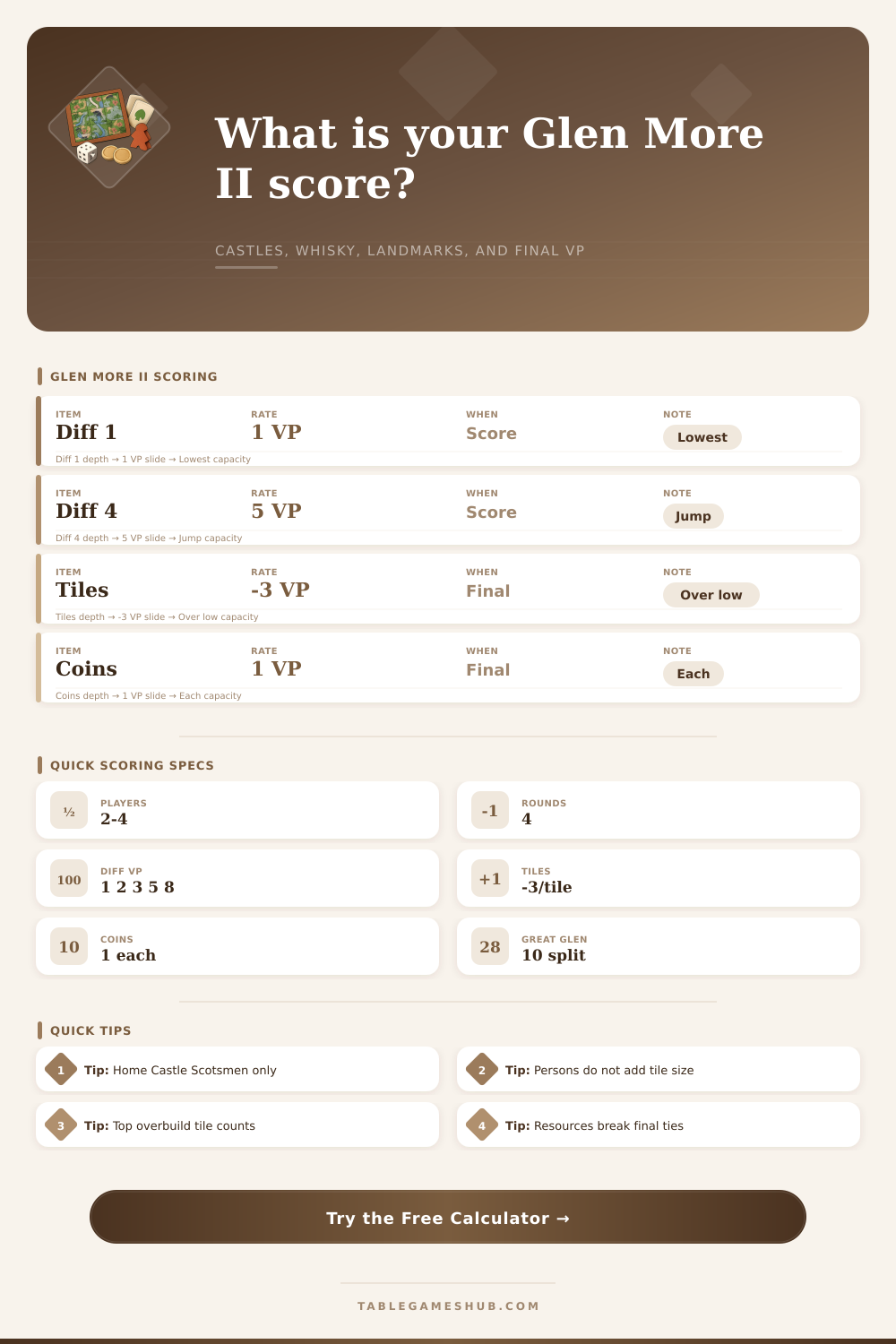
| 4 | 5 VP | Home Castle, landmarks, whisky, persons | First scoring jump |
| 5 or more | 8 VP | Home Castle, landmarks, whisky, persons | Maximum category award |
🧾Final Scoring References
| Score Source | Count It As | VP Rule | Notes |
|---|---|---|---|
| Normal scoring | 4 comparison categories | Use 1, 2, 3, 5, 8 table | Final scoring includes this round |
| Territory size | Visible placed tiles | -3 VP per tile above smallest territory | Persons do not count as territory tiles |
| Coins | Coins held | 1 VP per coin | Landmarks may alter this |
| Landmark cards | End-game card text | Enter total printed/card VP | Includes castles, lochs, and monuments |
| Overbuild stacks | Top tile for size | Enter any clan or card VP separately | Covered tiles no longer score as tiles |
| Goods and resources | Resource tokens held | No base VP unless a card says so | Use as tie strength or Chronicle input |
🗺Chronicle and Module Table
| Module / Area | Useful Inputs | Typical VP Entry | Calculator Field |
|---|---|---|---|
| Dragon Boat Races | Race placement, returned boats, rewards | 15 / 10 / 5 or penalties | Chronicle VP |
| Haggis | Face-up token count and total pips | Token count times pip sum | Chronicle VP |
| Great Glen cards | Goods, squares, castles, sets, distance | 10 VP, split on ties | Chronicle VP |
| Penny Mobs | Mobster penalties, penny faces | Positive pennies minus penalties | Chronicle VP |
| Overbuild clan effects | Overbuild stacks and clan field text | Often 5 or 8 VP | Overbuild / clan field VP |
💡Scoring Tips
In most games, the last few minutes feel like strategy, but in Glen More II it’s more of a matter of accounting panic. In Glen More II it’s more of a matter of accounting panic. You spend three rounds moving Scotsmen around, stacking wood, and amassing piles of whisky casks. Finally, it comes down to counting your castles, villages, and landmark against what your opponents have. A simple arithmetic error can cost you the victory by a single point.
With this page, we’ve eliminated that worry so you can focus on the state of the board without having to do any head-math.
Why This Score Calculator Helps You Win
Scoring in Glen More II is comparative rather than absolute, which changes how you view your progress during the game. The source doesn’t actualy mention how Glen More I works, only that scoring in Glen More II are comparative rather than absolute. In Glen More II, you only get points for owning more than everyone else. That makes a play that looks good in isolation; “I should build up my territories!”, now look bad compared to someone who’s been outproducing you in Whisky (for example).
It visualizes this gap by asking what your numbers are right now, and then what the lowest numbers at the table are. If you enter “9” for your Scottishmen in your Home Castle and the system sees that there is no less than “3” at the table, it will apply the 1,2,3,5,8 scoring curve to that gap. So you’re getting six points! Awesome. The system does the lookup logic for you; you don’t need to remember if you get five points for being ahead by four, or six. In short, knowing where you stand against others is important for making decisions during the game. By having this information readily available, you’ll be able to make informed decisions about how best to proceed.
This is where things get tricky for many players. Up until this last round of scoring, there are four primary areas: 1) wood; 2) bricks; 3) lumber; and 4) stone. During the end game, however, we throw in coin tokens, landmark cards, and Chronicle bonuses. While coins are easy (one point per), landmarks will help sway the tide, depending on which monuments you’ve amassed. You’ll note that the calculator gives you the ability to input these end-game adders individually so that your final score includes raw materials as well as strategic goals. Additional points from any expansion modules played; Penny Mobs or Dragon Boat Races, is also logged in their respective fields, leaving the overall score clear.
Many players don’t know how much their territory size is costing them points. Beyond the smallest territory on the table, every visible tile you have cost you an additional 3 points. This means that sprawl isn’t rewarded; you want to settle tightly to maximize village placement. The more empty space, the worse it is for you. After you put in your smallest territory per player (including yourself), and enter your total number of visible tiles, the tool will tally up that penalty for you automaticly.
Efficiency matter. Growing into a big kingdom isn’t enough. If you grow too thin, it won’t pay off for you. The addition of building creates extra complexity which needs to be monitored with precision. If you build upon existing buildings, then the original tiles is not counted towards your own territory when calculating penalties. Other effects might apply based on the cards being played. To accommodate this, the calculator tracks both the overbuilds as separate entries and the territory tiles that remain uncovered. Because the stack could be very tall while covering a small footprint, it enables you to have high production while avoiding the end-game penalty. It encourages long-term thinking: planning multiple turns into the future.
Other sources of points come from Chronicle cards and other module effects which can be quite diverse based on your setup. There are cards which provide points for completing sets, holding certain types of goods, and being far away from things. They’re typically one-off calculations and don’t follow traditional comparative scoring system. The app includes a separate input field for Chronicle VP so you can enter these random bonus points without cluttering your primary interface. It maintains the flow regardless of the breaking of the ruleset as expansions get added.
Does that mean you don’t have to know how it all works? No, definitely not. This is just a tool for moving the mindless math to free up some brainpower for strategy. Do I go for the whisky lead and risk running out, or do I play safe by sticking to castles? That’s something you’ll still have to figure out yourself. But at least when making that choice, you’ll be able to see exactly what it will cost. You’ll know if you’re in the right place to take a calculated risk in the final round. You won’t be going into it blind and just hoping for victory.
Part of board gaming is making better decisions when it matters. Half the battle is getting accurate information. Knowing exactly how many points you have; down to the final digit, allows you to confidently make moves without hoping something works out in your favor. The calculator above does the math for you, reducing that crazy card and token mess into a single number. Having that level of clarity makes a great game different than just another good one.