New York Zoo Calculator
Track enclosure coverage, attraction tiles, animal breeding, species counts, board fill, and finish timing for a New York Zoo board state.
Calculation Breakdown
Board Fill Grid
| Species | Box count reference | Breeding check | Calculator input to watch |
|---|---|---|---|
| Meerkats | 28 animal tokens | Breed on meerkat line if eligible | Ready pens and open cells |
| Flamingos | 26 animal tokens | Breed on flamingo line if eligible | House bonus and near-full pens |
| Tree kangaroos | 24 animal tokens | Breed on kangaroo line if eligible | Open cells before claiming tiles |
| Penguins | 24 animal tokens | Breed on penguin line if eligible | Two ready pens can add fast |
| Arctic foxes | 24 animal tokens | Breed on fox line if eligible | Check if any enclosure has 2+ |
| Tile or phase | Typical size or limit | Why it matters | Projection use |
|---|---|---|---|
| Small attraction | 1 to 3 spaces | Closes narrow holes | Add to reserved fillers |
| Large attraction | 4, 6, or 8 spaces | Can end the game after a full enclosure | Limit by placeable capacity |
| Enclosure tile | 4 to 7 spaces | Main board coverage source | Use as next enclosure size |
| Animal acquisition | 2 shown animals or 1 choice | Feeds future completions | Raises species counts |
| Breeding line | 1 offspring in up to 2 pens | Can complete pens outside the active turn | Feeds breeding swing card |
| Game state | Fill percentage | Animal priority | Timing note |
|---|---|---|---|
| Opening zoo | 0% to 40% | Spread species into usable enclosures | Favor big enclosures while space is open |
| Midgame zoo | 40% to 75% | Prepare two breeding-ready pens | Track which gaps need attractions |
| Patch phase | 75% to 90% | Complete enclosures for attraction choice | Net coverage matters more than tile size |
| Finish race | 90% to 100% | Keep tiebreak animals if breeding can end it | Compare open spaces against rival board |
New York Zoo can be a stressful game during those last few laps. You realize that your board has more fractured spaces instead of a carefully selected set of enclosures. Attraction tiles aren’t going anywhere. Animals is sitting in their houses. Your enclosures are everywhere.
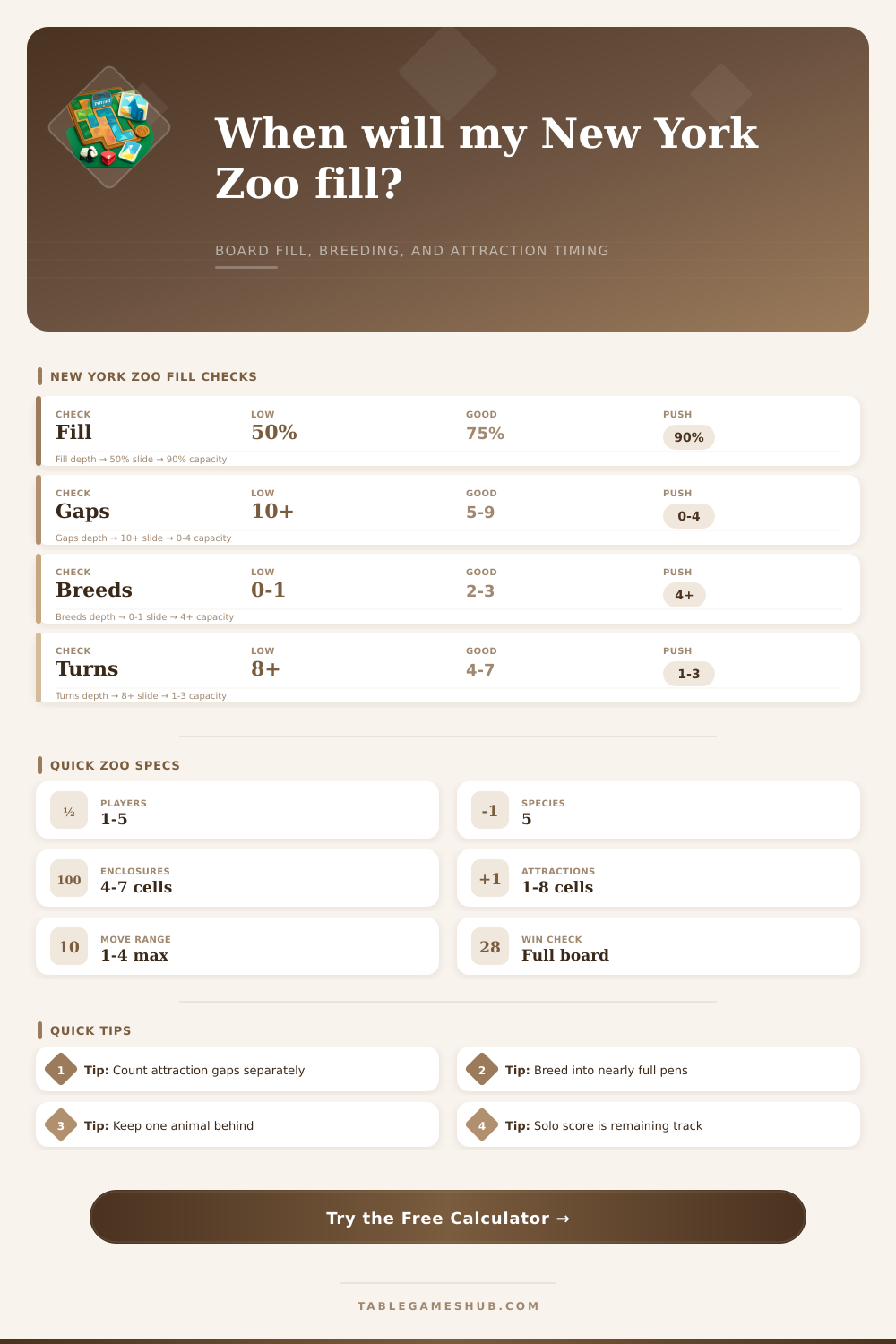
The calculator can shows you how much of your board is filled out and which attractions are covered. It shows how many swings you’re breeding for and how many species there are. It can even give you an idea of how far along you are. It lets you make smart decisions on which elephant move to make now.
How to Use the Calculator in New York Zoo
The basic conflict is filling space versus time. On one hand, you’re racing yourself on the action track; on the other, the hole-patching part is seemingly rigged to piss you off. Although it’s often viewed by many players as just a percent issue for board fill, it’s also a parity-and-polyominoes puzzle. Different phases has different priorities, which can be seen in the ref table.
Early on, you want to spread out your species into enclosures where they could be useful later even if their placement isn’t ideal. Most folks gets stuck in the breeding trap. Having an offspring is great, but if it has no place to go, you haven’t actualy made any progress. You don’t gain any board coverage by breeding if your pens are filled or near capacity. Breeding may cost you board coverage (i.e., give away space without covering). Entering the number of animals that can goes into a pen today helps distinguish actual gains from theoretical ones.
Finally, end game depends on the attraction tiles. Early on, everyone remembers where they place their big enclosures. But those won’t do anything if you’ve got three solitary space spread out over the board. That’s where you want little tiles. And the calculator wants you to count how many attraction cells there are. But just for the ones that can still fit in your remaining holes. If you’ve got a one-wide gap as your largest opening, an attraction with four spaces won’t help you at all. It’s this difference between capacity to use vs. Inventory to collect that catches players who only collect, without also paying attention to how they fit them together, by surprise.
It’s also a matter of mechanics. How much do you expect your elephant to move? That has a lot to do with player count. In a two- or four-player game, players gets up to four moves per turn. In a three- or five-player game, they only get to move three. This results in fewer turns but a faster pace. This also affects how long you have to plan because 3 or 5 players move fewer spaces which slows the pace. If you are playing in a multiplayer race, you have to make different assumptions different than if you are just racing against the track, such as how far the finish line is from your starting point. Relative to the track, your race is determined by how far you are from the starting line. How fast do you normaly move? The calculator adjusts for that.
This is the number of turns left until it either runs out of space or you complete a lap. A few odd spots will tempt you with hopes of being filled later on. The ones that don’t are usually not. The little attractions have limited numbers and those individual spaces need something special to fill them up. Save too many big attraction tiles for big finishes and suddenly you’re out of space to cover the tiny holes that would seal your game.
Another sneaky yet effective trick: keep an animal back just in case. A tiebreaker is a powerful thing. With multiple players, leftover empty spaces come before animals for breaking ties. That last reserve can mean the difference between a loss and a win without having to even fill anything on the board.
There’s a breakdown of species token counts and breeding checks. Remember that they all do their thing at different rates. Foxes may be slower than penguins depending on whether you have ready pens or empty enclosures. Knowing the rhythm of each species tells you who is going to cross next, and where to put the few precious spaces you have in your home. When the breeding line does cross, you want to have similar animals in houses so that you can drop them directly into an available cell.
New York Zoo is really about learning to think of the board as a whole instead of individual actions. The screen shows the raw data from the calculator: how many turns are left before you’re full and how much space you have. But gameplay is figuring out the connections between those dots. You must balance short-term needs, like the instant reward of dropping down an enclosure, against long-term goals, such as leaving enough room for attractions later. It’s a race against time and patience. And if you track all this stuff closely then that last second panic is a well-calculated end. That last bit is where knowing what’s even being measured comes in. Once you really know how many turns you have left, and what counts as a gap that will kill you, the mess starts to come together into something obvious.