Paladins of the West Kingdom Calculator
Total final VP from attribute tracks, King’s Orders, workshops, monks, outposts, garrisons, absolves, paid and unpaid debts, favors, converts, walls, and leftover resources.
⚔Scoring Presets
📜King’s Orders and Table State
🛡Attributes and Board Development
💰Debts, Favors, Converts, and Resources
🏰Game Component Grid
📊Paladins Scoring Tables
| Score Line | Input | Calculator Rule | Endgame Note |
|---|---|---|---|
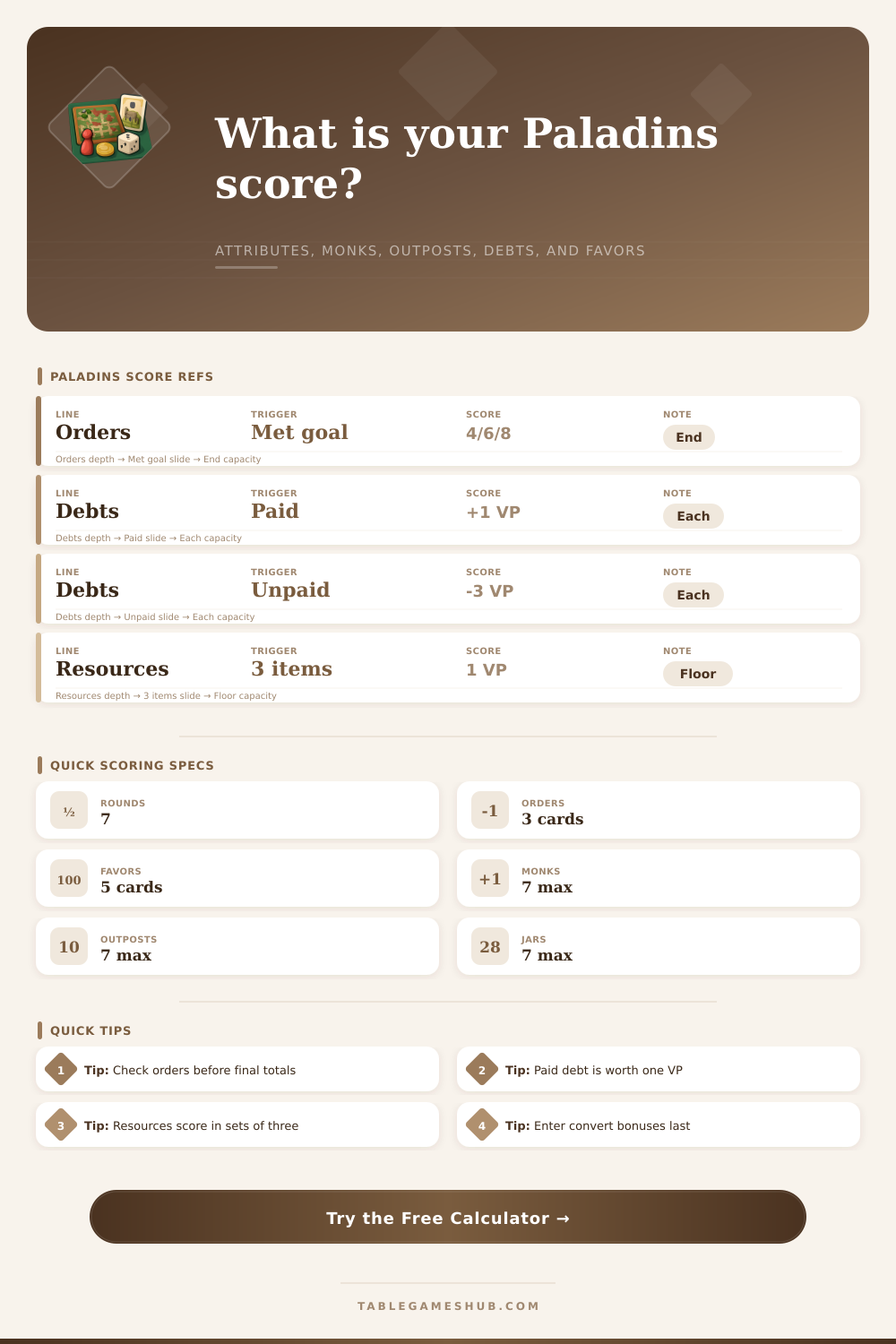
| King’s Orders | Three public order cards | 4, 6, and 8 VP when met | First tiebreaker is order VP |
| Attributes | Strength, Faith, Influence | Track lookup plus manual adjustment | Temporary Paladin boosts do not persist |
| Develop | Workshops placed | Scores from 6+ developments | Eight workshops is the full board |
| Commission | Monks placed | Scores from 5+ commissions | Monks compete for main-board spaces |
| Garrison | Outposts placed | Scores from 5+ garrisons | Outposts share spaces with monks |
| Absolve | Jars moved | Scores from 5+ absolves | Also helps clean suspicion and debt |
| Fortify | Walls built | Track VP plus printed Wall VP | Enter printed wall points separately |
| Debts | Paid and unpaid cards | +1 paid, -3 unpaid | Destroyed debts are not counted |
| Resources | Silver plus provisions | 1 VP per full set of 3 | Remainders do not score |
| Converts | Faceup Outsider cards | Manual VP total | Use card text and attacked Outsider counts |
🧮Milestone Reference
| Track | Low Finish | Scoring Start | Strong Finish |
|---|---|---|---|
| Develop workshops | 0 to 5: no track VP | 6 workshops | 8 workshops |
| Commission monks | 0 to 4: no track VP | 5 monks | 7 monks |
| Garrison outposts | 0 to 4: no track VP | 5 outposts | 7 outposts |
| Absolve jars | 0 to 4: no track VP | 5 jars | 7 jars |
| Fortify walls | 0 to 4: printed VP only | 5 walls | 7 walls |
| Attributes | 0 to 4: low VP | 7+ is meaningful | 12 reaches the top |
💡Scoring Tips
Paladins of the West Kingdom isn’t about adding up numbers; it’s like auditing a medieval estate. There are stacks of suspicious cards, outposts guarded by your garrisons, strength markers, and faith tracks. All of these vies for your attention at the same time. And when the game ends after only seven rounds, there’s not much time to get everything in order before time runs out. You’re left with incomplete projects and broken promises littering the table.
Having something to clear away some of the uncertainty makes a big difference during the game based off mid-game projections. It also helps afterward with post-game analysis. Knowing exactly how you got ahead (or where your advantage went) can make a world of differnce.
Why You Should Use the Calculator
On the surface, the scoring system in this game is deceptively simple, but it’s punishing if you pay no attention to its fine print. By far, most players obsess over advancing their attribute markers along Influence, Faith, and Strength tracks. They do so because those tracks rewards them with a steady flow of victory points, particularly after reaching the seven-mark threshold when the returns become meaningful. But it’s the binary outcomes occurring outside those smooth curves that represent the real danger.
King’s Orders are all-or-nothing affairs. You either complete the public requirements for four, six, or eight points, or you get nothing at all. The calculator helps by separating order checkboxes from your attribute totals. That way, you’re not tempted to double-count a bonus or forget to subtract the penalty for an unfinished goal.
Your intuitions about handling money are also wrong in terms of debt. You think of credit card balances as just some kind of annoying thing. Why should they hurts my score? Turns out every unpaid card costs you three victory points, more than you’d guess, and it adds up quickly. When you pay a card down, it’s worth a point. That’s a four-point swing for each card.
Enter both paid and unpaid cards into the tool. This helps give you a clear sense of how much your finances are costing you by providing a clear net total of both paid and unpaid cards. Then look at that debt line if you are wondering why having a high faith score did not lead to success.
You also need patience as you develop boards. Workshops, monks, outposts, and walls all sits on shared spaces or parallel tracks, creating competition for space and attention. Workshops, monks, outposts, and walls all sit on shared spaces or parallel tracks, creating competition for space and attention. Some of these are threshold effects, which is really highlighted by the calculator’s built-in milestone table. You don’t see much track point benefit from having fewer than 6 workshops, so you are wasting resources without much immediate reward. Knowing that helps you determine if you want to go for a fifth workshop…or save your silver for something else. It’s a tiny thing, but it alters your perspective on each action phase.
Lastly, it’s easy to forget about resources until the end of the game. Silver and other provisions has a scoring multiplier of 3; anything leftover is wasted. With this rule, you must budget your resources by multiples, instead of just having enough to play the next card. Fear not: The calculator will divide things for you. Without needing to do any mental math as you shuffle through cards, it converts your stacks of raw resources into VPs.
And then there’s the human side: the favor and the suspicion. They weigh the game in terms of story, but also make for some tricky final scores. The suspicion cards don’t necessarily remove points. They just let others block your path or steal your spots. The favors help you know who has spent what and how much movement they have bought for the endgame. Step away from the table, and those numbers tell a story that your raw memory could never get.
Of course, it’s not about the numbers. It’s about knowing where you came from.” Did you win through smart debt-clearing? Did you knock down walls and overwhelm the board with fortifications? The calculator will provide the forensics. It’ll translate what felt like an unruly endgame into a spreadsheet of decisions taken and results delivered. When you see the breakdown while reviewing your own play or discussing another player’s with friends, you can’t help but admire the strategy that produced the score. Because ultimately, point-counting isn’t so much the game as it is the gateway to understanding it.
You should of checked the math earlier. It would of helped to see the results more naturaly.