Paperback Score Calculator
Total your fame, completed paperbacks, wild-letter support, deck shape, and genre bonuses for a clean final score estimate.
Score Breakdown
| Genre | Best deck signal | Match value | Book bonus | Letter angle |
|---|---|---|---|---|
| Mystery | Flexible clues and mid-length words | 2.2 each | 1.5 per book | R, S, T pressure |
| Romance | Vowel stability and repeated builds | 2.0 each | 2.0 per book | Vowels matter most |
| Sci-Fi | Wild cards and rare-letter turns | 2.5 each | 1.2 per book | X, Z, Q spikes |
| Fantasy | Longest word ceiling and wilds | 2.3 each | 1.7 per book | Y and H support |
| Western | Lean deck with fast cycling | 1.9 each | 1.4 per book | Hard consonants |
| Literary | Balanced deck and steady paperbacks | 2.1 each | 1.8 per book | Even vowel ratio |
| Humor | Action chains and odd letter saves | 1.8 each | 1.6 per book | Wild rescue turns |
| Adventure | Long words, tempo, and buying reach | 2.2 each | 1.6 per book | Broad consonants |
| Deck profile | Typical final deck | Useful vowels | Flexible letters | Risk to watch |
|---|---|---|---|---|
| Balanced publisher | 30-38 cards | 8-11 | 3-5 | May lack a big final score spike |
| Vowel-rich word maker | 32-42 cards | 11-15 | 2-4 | Can buy slowly without consonants |
| Consonant-heavy buyer | 30-40 cards | 6-9 | 2-5 | Short words if vowels disappear |
| Wild-letter engine | 28-36 cards | 7-10 | 6-10 | Great words, sometimes low printed fame |
| Fame-card stack | 34-48 cards | 8-12 | 2-5 | High score but lower word control |
| Lean edited deck | 22-30 cards | 6-9 | 3-6 | Needs enough raw fame to convert |
| Letter grade | Table game score | Solo target score | Deck read | Endgame note |
|---|---|---|---|---|
| A+ | 90+ | 105+ | Published bestseller | Fame, books, and genre all landed |
| A | 78-89 | 92-104 | Clean award shelf | Strong points with few weak cards |
| B | 64-77 | 76-91 | Solid paperback run | One engine piece may be missing |
| C | 48-63 | 58-75 | Playable but uneven | Deck likely carried starter clutter |
| D | 32-47 | 40-57 | Draft needs edits | Too little fame or too few books |
| F | 0-31 | 0-39 | Unpublished manuscript | Scoring cards did not arrive |
| Scenario | Players | Deck aim | Score aim | Best input to tune |
|---|---|---|---|---|
| Fast two-stack finish | 2-3 | Lean, high fame density | 55-70 | Empty stacks and turns played |
| Full table market race | 4-5 | More cards, more completed books | 65-85 | Completed paperbacks |
| Long word showcase | Any | Wild support and vowels | 70-95 | Average and longest word |
| Fame-card closer | Any | Printed fame above 50 | 75-100 | Printed fame in deck |
| Solo publisher target | 1 | Efficient deck with book pace | 80-110 | Score format and adjustment |
Paperback scoring involve managing the cards and composing words, and paperback scoring is difficult because paperback scoring involve balancing two different goal. One is scoring printed fame, and the other is completing novels. You must choose between cards that build word versus printed fame, and it isnt always possible to do both goal at the same time.
A card that is useful for building word might not provide printed fame, and vice versa. Thus, you need to understand how your cards affect your total score. The composition of your deck in the beginning of the game is important because it will determine the number of letter that you have in your deck.
How to Get a High Score in Paperback
A deck with many vowel will enable you to create long words, but it might not have enough consonant. A deck with many consonants will allow you to cycle through your cards quick, but you might stall out if you do not have enough vowels in your deck. Having wild card will provide you with flexibility in terms of the letter in your deck, but you will not get the same benefits as having a deck that contain many vowels or consonants.
Using a calculator will allow you to determine the number of points that your letter will be worth, and this will allow you to avoid guesswork in the game. Choosing a genre is also important. Each genre reward different type of word and letter mixed in.
The mystery genre reward mid-length word, while the fantasy genre reward the longest word that you can create. Romance deck reward vowels, and science fiction reward using rare letter that can be unlocked by using wild card in your deck. You must choose your cards according to your chosen genre, as this will act as a multiplier for your novel and printed fame.
Your deck might excel in your current genre, but it might become a weak deck if the genre change. Starter clutter is a problem that many player underappreciate. Starter clutter occur when players place cards from the beginning of the game into their deck.
These cards take up the space for other, more valuable card in their deck, but they do not add to the players printed fame or word quality. By removing these starter deck cards, players can increase their average word length and have more draw throughout the game. Furthermore, using a deck that is cluttered with these initial game card will cause players to finish fewer novel with their opponents.
By finishing fewer novel, players will not be able to recieve the genre bonus that they could of earned from completing novel of the same genre. By keeping the deck as lean as possible, players will find that their lean deck will score more novel than their cluttered deck. The pace at which player play will have a considerable impact on a player’s total score.
Players who score an average number of novels in games that last for a long time could score a competitive total score in shorter game of Uno. However, the reverse may be true for players who score highly in short game but score an average total in long game of Uno. The format in which players choose to compete will have a considerable impact on the total score that a player aim for.
The same deck may score differently in games with different length and goal. The reference table contain information regarding the different genre and the number of novel that may be completed with each genre combination. While these table may seem like a great replacement for the numbers that a player calculate for themselves, the reference table provide information regarding whether or not a players selected genre are within the normal range for the game.
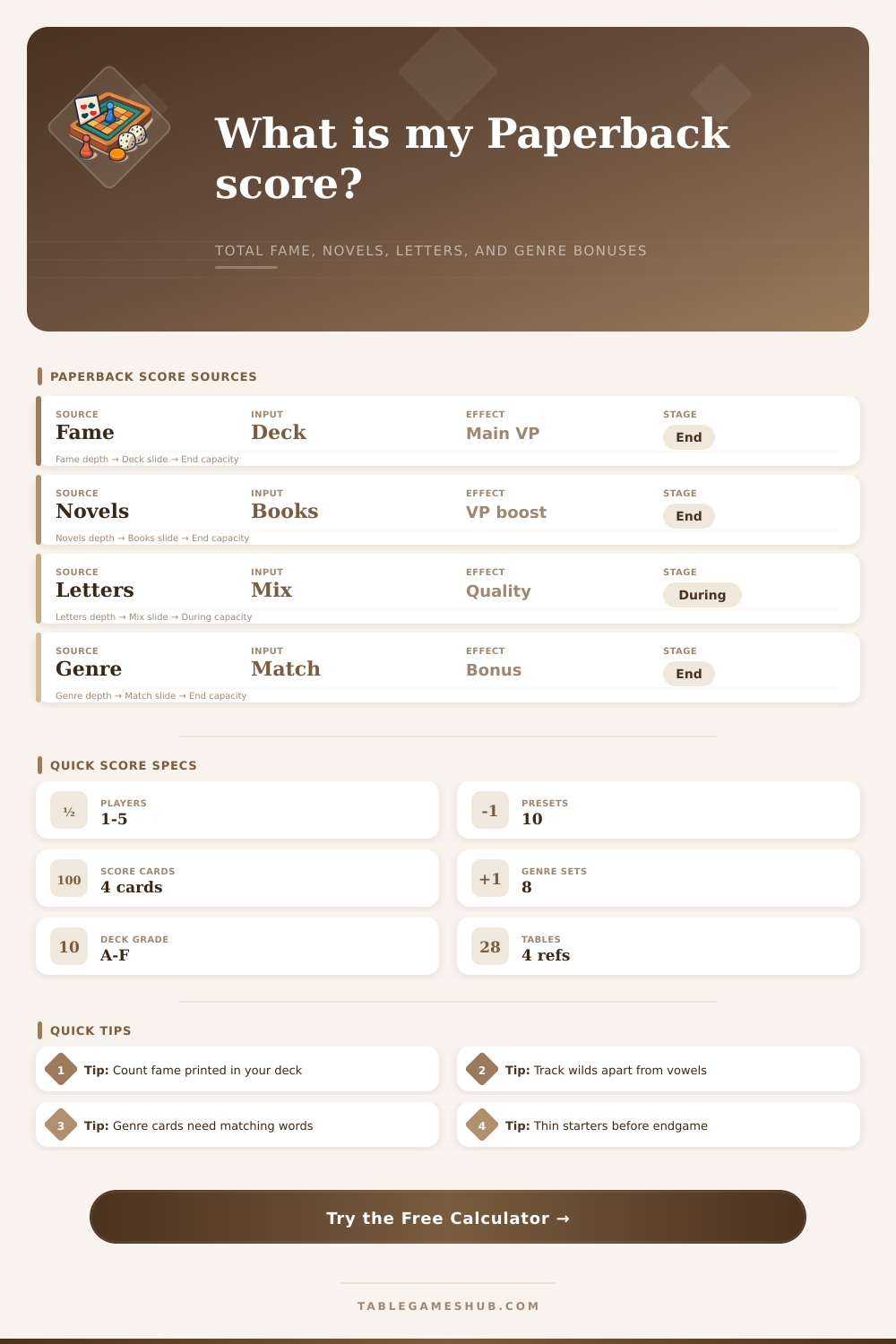
If a player’s density for printed fame is low in relation to the selected profile, their grade will be low in the end. When all the games are over, players will have a number representing their total score for the game played. This calculator will separate a player’s printed fame from other contributing factor to their score.
While printed fame is easy to read from the game, other factor such as the number of wild card that are played and the average length of the word played in games can be difficult for players to calculate in there head. By running the number through this calculator, players will have a clear idea of their strategy and their success in implementing their strategy.