Mombasa Score Calculator
Estimate final Mombasa victory points from company share tracks, final company values, bookkeeper progress, diamonds, coins, bonus tiles, trading posts, and card-row planning.
| Company Area | Score Input | Calculator Formula | Endgame Check |
|---|---|---|---|
| Mombasa Company | Certificates and final value | Shares x final value | Use the final revealed company value after posts. |
| Cape Town Company | Certificates and final value | Shares x final value | Good for mixed share routes and secondary positions. |
| Saint-Louis Company | Certificates and final value | Shares x final value | Track often rewards selective investment timing. |
| Cairo Company | Certificates and final value | Shares x final value | Enter zero if a company track was ignored. |
| Scoring Area | Typical Input | Score Treatment | Audit Note |
|---|---|---|---|
| Bookkeeper track | Printed VP space reached | Add exact printed VP | Do not multiply by books; books are pacing context. |
| Diamond track | Printed VP space reached | Add exact printed VP | Diamonds collected help check if the marker is plausible. |
| Coins | Coins held at game end | Coins x 1 VP | Coins are entered as direct victory points. |
| Bonus tiles | Visible tile or objective VP | Add entered VP | Keep bonus points separate to avoid double counting. |
| Board Element | What to Count | Where It Appears | Calculator Role |
|---|---|---|---|
| Trading posts | Your posts placed on map | Company regions | Context plus optional direct bonus VP field. |
| Company expansion | Revealed company value | Company boards | Entered as each final value per share. |
| Card rows | Kept cards and row scoring | Player display | Entered as Card Row Endgame Value. |
| Reserved cards | Unused or congested cards | Player area | Efficiency note; not subtracted automatically. |
| Final Total | Likely Shape | Strongest Source | Review Prompt |
|---|---|---|---|
| Under 120 VP | Teaching or blocked game | Usually coins or one track | Check missed company value and unscored bonuses. |
| 120 to 160 VP | Competitive midrange finish | Shares plus one track | Look for one weak company or low coin conversion. |
| 160 to 200 VP | Strong complete engine | Two companies or tracks | Confirm no double-counted bonus tile scoring. |
| Over 200 VP | High-score table result | Shares, tracks, and coins | Audit final company values carefully. |
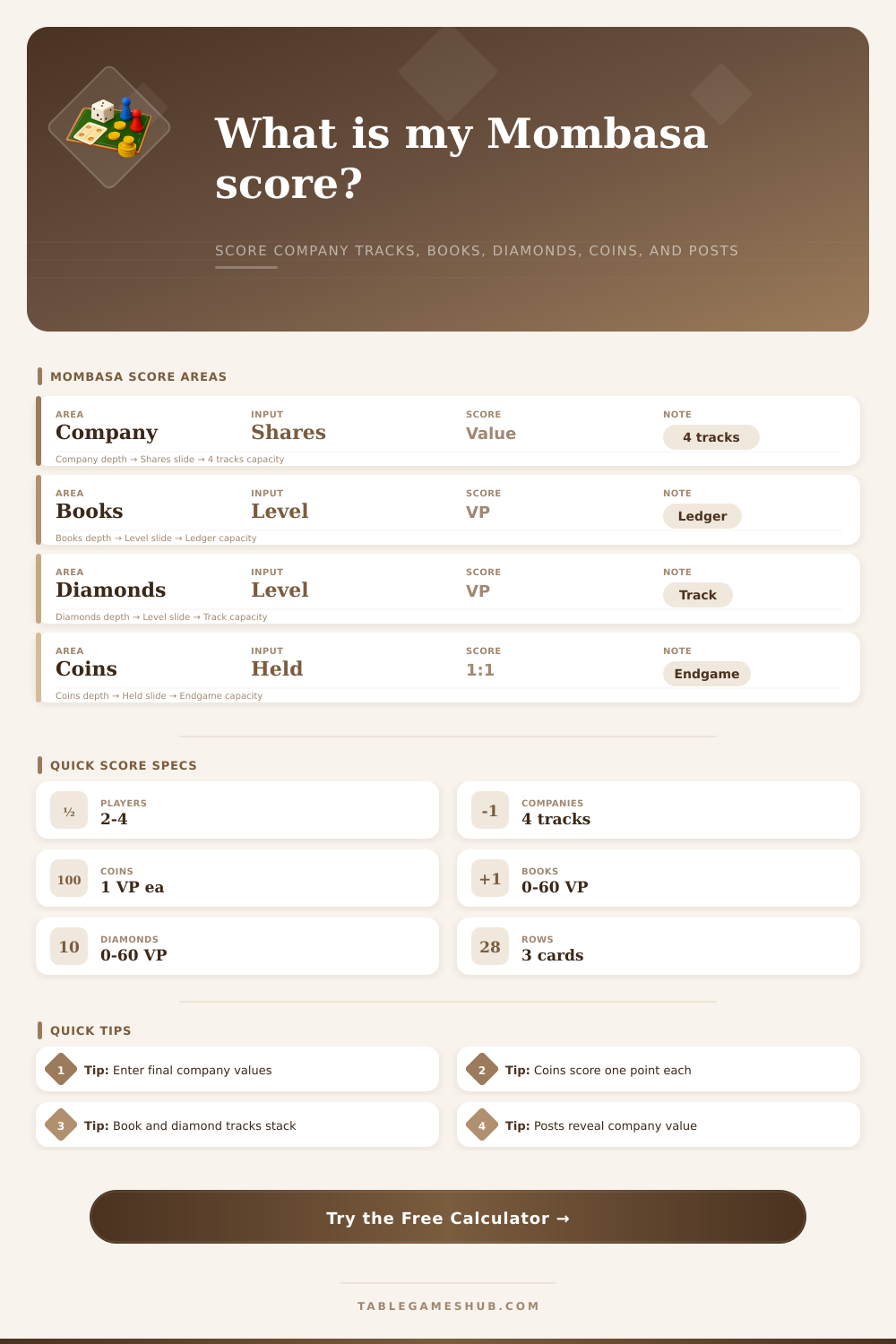
The Mombasa scoring calculator is a tool that can help you calculate your final score in the game of Mombasa. The Mombasa scoring calculator help you to understand, in addition, how each of the different scoring elements interact with each other to create your total score. Scoring in Mombasa come from a variety of different sources.
These include the shares you own in various company, the bookkeeper track, the diamond track, the coins you hold, the trading posts, bonus tiles, and the value of your cards. Because many of these element interact with one another, it is likely that you will find it difficult to determine your total score without the use of a calculator. The calculator will ask for your final board state, after which it will calculate your score for you by multiplying the number of shares you own by the company value of those shares, and by converting your coin into points.
How to Use the Mombasa Scoring Calculator
The value of the companies are an important part of your score. However, the trading posts are not established by the board until after they are placed on the board. Thus, you must enter the value of each share into the calculator, as this value is more important than the total number of certificate of shares that you control.
It is possible that you have many certificates of shares in companies that has relatively low values. However, it is also possible that you have fewer certificates of shares in companies with high values. Thus, the calculator can help to provide an indication of how valuable your shares are to your total score.
Similarly, the bookkeeper track and diamond track both provides values to your score. However, they do not use a simple calculation of the number of spaces that you have travelled along the track. Instead, each of the tracks include printed victory point values, which you must enter into the calculator, as well as the number of books or diamonds that you collected during your game.
The number of books or diamonds indicates that the efficiency of your use of those tracks. The value of the coins that you hold is a relatively simple element of your score. Each coin that you hold can be converted to a point at a rate of one for one, which the calculator will use for you.
However, you can also use your coin to purchase cards or trading posts. Thus, you must decide during the game whether you wish to hold your coins as resources or as scoring point. The calculator will treat your coins as points, but will not calculate whether it is efficient to hold coins that you did not use during the game.
The trading posts that you hold can create complex scoring elements due to the fact that they can be used to determine the values of the companies that you create shares of, as well as can provide bonuses to your score. Additionally, bonus tiles can score the same action that you took that you have already scored in other parts of the game. Thus, you could potentially double count the points that you score by simply adding up each of the visible number on the game board.
The calculator, however, asks for both trading posts and bonus tiles separately, which helps to ensure that you do not double count your score. The value of the cards that you hold at the end of the game can provide points to your total score. You can enter the scored value of your cards into the calculator, as well as the number of reserved card.
Reserved cards are those that you held throughout the game but did not play during your turn. By entering both sets of value, you can use the calculator to determine whether your use of your cards throughout the game was efficient. Finally, you should not only look at your total score, but you should also analyze the balance of each of the scoring element of your total score.
For instance, if one or few companies almost entirely derived your score, your score may be more fragile compared to a balance of scores from a variety of different sources. The calculator allows you to view the individual score from each of these elements, which can help you to understand the success of each of the elements of your game strategy. Thus, by using the calculator to determine your score, you can learn which decisions to make during the game that will provide the bestest outcome for your total score.