Power Grid City Connection Calculator
Plan city expansion, connection spend, step occupancy limits, power plant capacity, powered-city income, and network efficiency in one focused worksheet.
Use current network cities, planned new cities, route links, plant capacity, and powered-city targets to see whether the expansion fits the Power Grid step limit and improves income efficiently.
| Powered Cities | Income Elektro | Added vs Previous | Planning Read |
|---|---|---|---|
| 0 | 10 | Base amount | Emergency income only |
| 1 | 22 | +12 | First plant matters most |
| 2 | 33 | +11 | Early growth remains strong |
| 3 | 44 | +11 | Solid early position |
| 4 | 54 | +10 | Income curve starts flattening |
| 5 | 64 | +10 | Useful midgame threshold |
| 6 | 73 | +9 | Expansion still pays quickly |
| 7 | 82 | +9 | Good plant utilization mark |
| 8 | 90 | +8 | Check route length carefully |
| 9 | 98 | +8 | Capacity starts to define value |
| 10 | 105 | +7 | Common late Step 2 target |
| 11 | 112 | +7 | Fine if connection is short |
| 12 | 118 | +6 | Long routes need caution |
| 13 | 124 | +6 | Usually capacity constrained |
| 14 | 129 | +5 | Late game efficiency drops |
| 15 | 134 | +5 | Watch final turn timing |
| 16 | 138 | +4 | Mostly endgame positioning |
| 17 | 142 | +4 | Common 4 player finish line |
| 18 | 145 | +3 | Only worth short builds |
| 19 | 148 | +3 | Very flat income gain |
| 20+ | 150 | +2 cap | Income ceiling reached |
| Game Step | City Occupancy | Network Effect | Connection Note |
|---|---|---|---|
| Step 1 | 1 house per city | Fresh cities only | Route denial is strongest |
| Step 2 | 2 houses per city | Second access opens | Cheaper infill appears |
| Step 3 | 3 houses per city | Most cities reopen | Final turn reach matters |
| Final build | Ending target check | Capacity decides tie quality | Do not outbuild plants blindly |
| Efficiency Band | Income Gain Ratio | Expansion Quality | Best Use |
|---|---|---|---|
| Under 15% | Low return | Route is likely too long | Only for final city race |
| 15% to 25% | Acceptable | Works with plant timing | Steady midgame growth |
| 25% to 40% | Strong | Income backs the build | Preferred expansion window |
| Over 40% | Excellent | Short links or big income jump | Take before map fills |
| Players | Typical End Trigger | Network Tempo | Calculator Use |
|---|---|---|---|
| 2 | 21 cities | Wide board, high reach | Test long route plans |
| 3 | 17 cities | Moderate pressure | Balance capacity and growth |
| 4 | 17 cities | Classic race pressure | Watch the 10 to 14 city jump |
| 5 | 15 cities | Congested expansion | Reserve for blocked routes |
| 6 | 14 cities | Fast closeout threat | Check final turn timing |
| Plan Type | Main Constraint | Best Input to Tune | Warning Sign |
|---|---|---|---|
| Infill Build | Step occupancy | Current game step | City is not open yet |
| Bridge Build | Link elektro | Average link amount | Income gain cannot repay route |
| Capacity Build | Plant supply | Total plant capacity | New houses sit unpowered |
| Final Build | End trigger | Player count and target cities | Network passes plant output |
When expanding a network in Power Grid, there is several constraints to consider simultaniously, as they will impact whether the network expansions is successful. These constraint include the length of the route that is to be built, the limits on the steps that a network expansion can take, the capacity of the plant, and the income curve that players will earn from there city. If a player does not consider these constraints prior to building the route that will expand their network, a player can end up spending more elektro in building that route than the route will earn for the player.
A calculator can help a player to account for these various constraints and determine whether or not an expansion is a profitable move for a player. One of the constraints on the expansion of a player’s network is the capacity of the plant. Many player tend to focus on finding the next new city to power, but if the player does not have enough plant capacity to power that new city, it does not matter how many new city are found.
Use a calculator to check limits before expanding your Power Grid
For instance, if a player establish a route to three new cities, but their plant can only provide power to two new cities, the third city will remain unpowered. In this scenario, the elektro that is spent to establish the route to the third city dont provide any return on that investment for the player. This constraint can be accounted for in the calculator, which compare the total number of cities that are powered to the player’s current plant capacity.
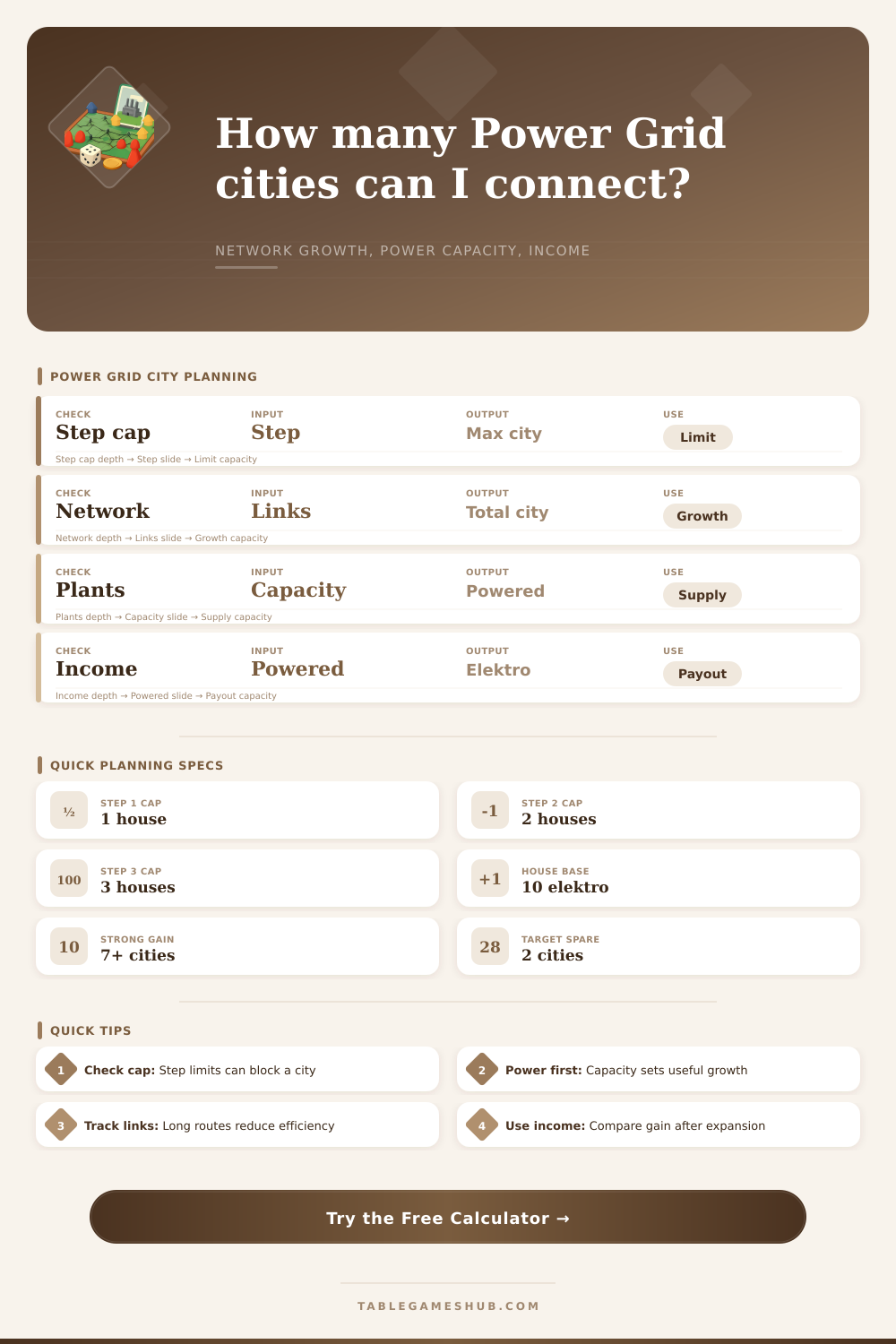
Another constraint on the expansion of a player’s network is the concept of step occupancy. At Step 1 of the game, each city will only accept one house. At Step 2, each city will accept a second house, and at Step 3, each city will accept a third house.
Thus, a route that is legal at Step 3 will be illegal at Step 1. A player must input the current game step into the network expansion calculator to determine which cities will be able to be connect to a player’s network. A third factor to consider when planning to expand a network is the growth of the income that a player will earn from their cities.
In the initial step of the game, each new city that is powered will earn a player approximately ten elektro. After a player has eight or nine cities, however, each new city will earn the player less elektro. Thus, if a player calculate the elektro that they will spend to build a route to power new cities, it is possible that the elektro will be more than the cities will earn for the player.
The network expansion calculator will compare the current number of cities that a player have powered to the total number of powered cities that they will have after the expansion. If the efficiency ratio is below 15%, the route too expensive for the player. If the ratio is above 30%, the route will be efficient and earn enough elektro for the player to cover the cost of the route.
A fourth factor to consider when planning an expansion for a player’s network is the cost of the route. Beyond the link values of the route, there are other cost to consider. For instance, if a player intends to use paths that are already contested by other player, that player will have to account for the cost of building an alternative (backup) route to provide power to the city that they are attempting to connect.
Furthermore, the player will have to reserve some elektro to account for these alternate cost. Thus, it is to a player’s benefit to include a reserve amount of elektro within their calculation for the cost of their planned route. The last constraint to consider for expansion of a player’s network is the number of remaining city in the game.
This constraint is dependent upon the number of players that is playing the game. For example, if there are four player in the game, the game will typically end when there are seventeen cities still in the game. If there are six player in the game, however, the game will end when there are fourteen cities in the game.
Thus, the value of each city decrease as the number of remaining cities decreases. It is to a player’s benefit to ensure that the player accounts for the number of remaining cities in the game in comparison to their planned expansion. Many players tend to make mistake in establishing an expansion plan for their network.
For instance, they may establish cheap routes for their networks, but they do not consider if they have enough plant capacity to support the number of new cities that they are attempting to connect. Furthermore, they may count the number of cities that they can reach for their network, but they do not consider the current game step to determine if they have the steps required to build the route that they have envisioned. These types of mistake can be avoided by utilizing the network expansion calculator for Power Grid.
By placing each of the constraints on a route next to one another on the calculator, a player can determine if the expansion to their network is a good idea. If all of the constraints are satisfied, then the expansion to their network is a good idea. If not, then the best action for the player is to avoid expansion altogether and to focus on powering the cities that they already have established for their network.