Splendor Prestige Calculator
Total prestige from development cards and nobles, then estimate how gem discounts, reserved cards, tokens, and tie-breakers shape the race to 15 points.
| Source | Prestige Value | How It Scores | Calculator Treatment |
|---|---|---|---|
| Level 1 development | Usually 0 or 1 | Printed point after purchase | Included in owned card prestige |
| Level 2 development | Often 1 to 3 | Mid-game scoring card | Strong for efficiency score |
| Level 3 development | Commonly 3 to 5 | Late-game scoring card | Added through reserve projection |
| Noble tile | 3 prestige | Visits when discounts satisfy pattern | Claimed plus reachable noble value |
| Noble Shape | Discount Demand | Typical Timing | Planning Note |
|---|---|---|---|
| Two-color heavy | 4 and 4 | Middle to late | Best when engine is focused |
| Three-color balanced | 3, 3, and 3 | Middle game | Rewards broad card buying |
| Mixed five-color | Usually 3 colors shown | Varies by table | Check weakest color first |
| Near-claim noble | One card short | Next turn threat | Worth 3 projected prestige |
| Item | Standard Count | Use in Formula | Limit Check |
|---|---|---|---|
| Colored gems, 2 players | 4 per color | Colored token reach | 10 total tokens held |
| Colored gems, 3 players | 5 per color | Wider token access | 10 total tokens held |
| Colored gems, 4 players | 7 per color | Full market supply | 10 total tokens held |
| Reserved cards | 3 card limit | Projected prestige source | Gold offsets shortfall |
| Game State | Main Input | Prestige Path | Risk Check |
|---|---|---|---|
| Engine build | High discounts | Cheaper future points | May trail visible prestige |
| Noble race | Color requirements | 3-point jumps | Opponent can claim first |
| Reserve finish | Gold and shortfall | Hidden point burst | Three-card reserve limit |
| Tie-break line | Purchased card count | Same prestige, fewer cards | Extra low cards can hurt ties |
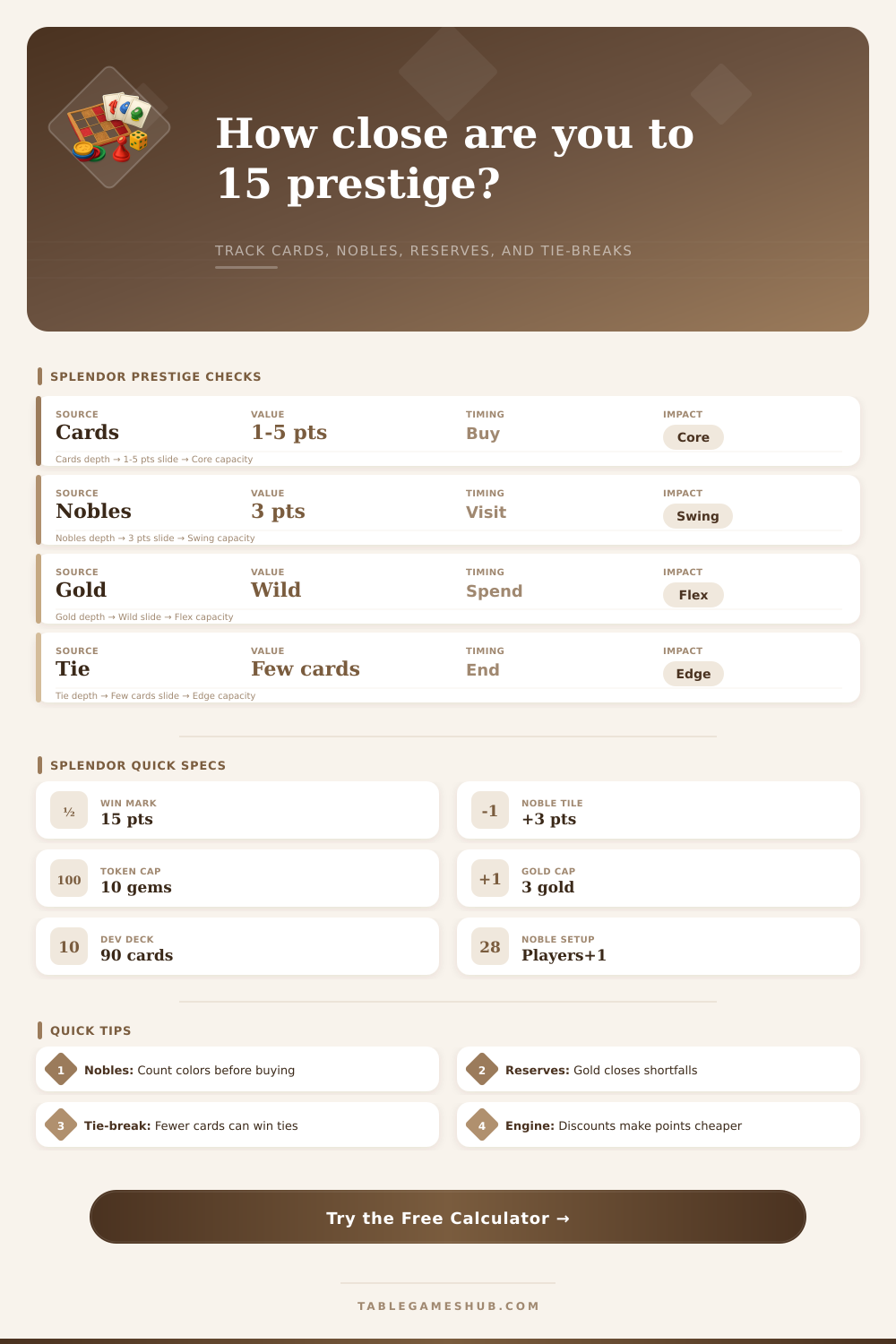
Prestige are a value that determines how close a person comes to winning a game of Splendor. There are two source of prestige in the game of Splendor, both of which come from development cards and noble tiles. When a person purchase a development card, they immediately gain prestige.
Additionally, if a person gains claim to a noble tile, they earn three points of prestige as soon as they meet the requirements of that noble tile. Since a person can only claim a noble tile once during a game, the timing of these purchases are important to those that wish to win the game. For example, a player may wish to purchase a development card with zero points for the sake of obtaining the requirements needed to claim one of there noble tiles for three points of prestige.
How to use the Splendor prestige calculator
The calculator is a tool that will assist a player in tracking their prestige in the game of Splendor, as well as help the player to manage the tie-break rule. The tie-break rule states that should two or more players reach fifteen points of prestige, the player with the least number of cards will be the winner. Thus, when calculating ones prestige, it is important to consider how many cards of each type a person currently has.
The calculator will ask for the player’s development card points, the number of claimed noble tiles, any noble tiles that can be reached with one more purchase, as well as the number of reserved cards and the number of gold tokens that the player currently control. Each of these values may assist in the projection of the total prestige that may be obtained by a player during that game of Splendor. Discounts are provide to each player as a means of reducing the number of tokens that they have to spend to purchase development cards.
Any permanent discount reduces the cost of other development cards that are purchased in the future. These discounts assist a player in the acquisition of noble tiles prior to others can claim them. The calculator is able to track the number of discount that a player has earned for each color of development card.
The calculator can also use these discounts to determine whether or not a player has a balanced engine. A strong engine will have a high number of discounts, as well as a low number of development cards that have been purchased. Players will want to ensure that their engine is balanced during the game to maximize the number of points that they can earn.
Reserved cards provide prestige to a player, but only if the player is able to purchase the reserved cards. The calculator will estimate the number of points that a player may earn from reserved cards by calculating the shortfall of the player’s available gem and gold tokens. For instance, if a player reserves a high value tier-three development card, they will only earn the prestige from that development card if they can afford to purchase it.
Thus, the calculator helps a player to determine whether or not their reserved cards will eventually provide prestige to them prior to the end of the game. The number of players that are playing Splendor will affect the number of tokens that are available in the game, as well as affect the way in which the calculator may be used. For instance, if a person selects that there are many players for the game, then there will be more gems of each color available in the game.
Additionally, each player will still have a limit of ten tokens during their game. The calculator can be adjusted for the number of players that are playing the game, so that the players prestige projection is accurate according to their game state. The spending of tokens efficient during a game can help players reach fifteen points, as there is a limit of ten tokens for each player in the game.
Most games of Splendor are decided during the last three rounds of play for each player. During these last three rounds, players will claim their last noble tiles and will purchase their last reserved cards. During these rounds, players should of use the calculator to determine if they will have to make one more purchase to reach their goal of fifteen points of prestige, or if they have earned enough prestige with their current development cards and noble tiles.
Additionally, the calculator will help players determine if they have enough discounts on their development cards to claim additional noble tiles during their next few turns. Thus, the calculator helps remove the guesswork in the determination of prestige and cards that a player has during their last rounds of play.