Caverna Scoring Calculator
Total a final Caverna: The Cave Farmers score with dwarves, rooms, fields, pastures, animals, mines, rubies, gold, open spaces, and bonus room multipliers.
| Category | How to Count | Formula Used | Score Impact |
|---|---|---|---|
| Dwarves | Final dwarves in dwellings | Dwarves x 1 | Positive direct points |
| Furnished Rooms | Printed VP on room tiles | Entered room points | Main engine scoring |
| Animals | Sheep, donkeys, boars, cattle, dogs | Total animals - missing type penalties | Strong farm scoring |
| Gold and Rubies | Remaining counters | Gold + rubies | Direct counter score |
| Unused Spaces | Empty farm and cave spaces | Unused spaces x -1 | End-game penalty |
| Animal Type | Typical Board Source | Calculator Input | Final Check |
|---|---|---|---|
| Sheep | Pastures and dog-supported fields | Sheep Count | 0 sheep creates one missing-type penalty |
| Donkeys | Mines, pastures, and stables | Donkey Count | 0 donkeys creates one missing-type penalty |
| Wild Boars | Pastures after acquisition and breeding | Wild Boar Count | 0 boars creates one missing-type penalty |
| Cattle | Large pasture plans and breeding | Cattle Count | 0 cattle creates one missing-type penalty |
| Dogs | Action spaces and dog rooms | Dog Count | 0 dogs creates one missing-type penalty |
| Bonus Pattern | Input Used | Modeled Formula | Best Fit |
|---|---|---|---|
| Animal Room | Total animals | Floor(animals / 3) | Wide ranch boards with many species |
| Mining Room | Ore and ruby mines | Mines x 2 | Deep cave plans with many mine tiles |
| Farm Room | Fields, pastures, meadows, tunnels | Developed spaces x 1 | Full board plans with few blanks |
| Ruby Room | Rubies remaining | Rubies x 2 | Ruby banking and late conversion plans |
| Dwelling Room | Dwarves above the third dwarf | Max(0, dwarves - 3) x 3 | Family growth and room expansion plans |
| Profile | Score Shape | Risk Area | Calculator Signal |
|---|---|---|---|
| Balanced Farm and Cave | Rooms, animals, counters, few blanks | Missing one animal type | Solid if penalty is under 5 points |
| Animal Heavy Farm | Large animal score and pasture pieces | Unused cave spaces | Strong if animal score beats room score |
| Deep Mine Economy | Mines, rubies, gold, bonus rooms | Low field coverage | Strong if counter score is over 15 |
| Furnishing Room Engine | Printed rooms and multipliers | Too few dwarves or animals | Strong if bonus rooms exceed penalties |
| Lean Family Growth | Fast dwarves and basic board coverage | Low room value | Needs clean penalty control |
The process of scoring in Caverna requires a transition from the game itself to calculating the score, and this transition can be dificult for the players due to the importance of each of the small detail of the game. Each player may have spent much of the game constructing the home and breeding animal, but the score are based upon each of the items on the board. Each of the small details of the game, such as empty space, animals on the board, and bonus room all contribute to the player’s score, and that score will determine the winner of the game.
It is easy for each player to lose track of these details during the transition from playing the game to calculating the score of each player. The calculator on this page can assist each player in calculating their score after setting up their home board. The calculator separates the components of the game that contribute to the player’s score from the components that can cost the player point.
How to Count Your Score in Caverna
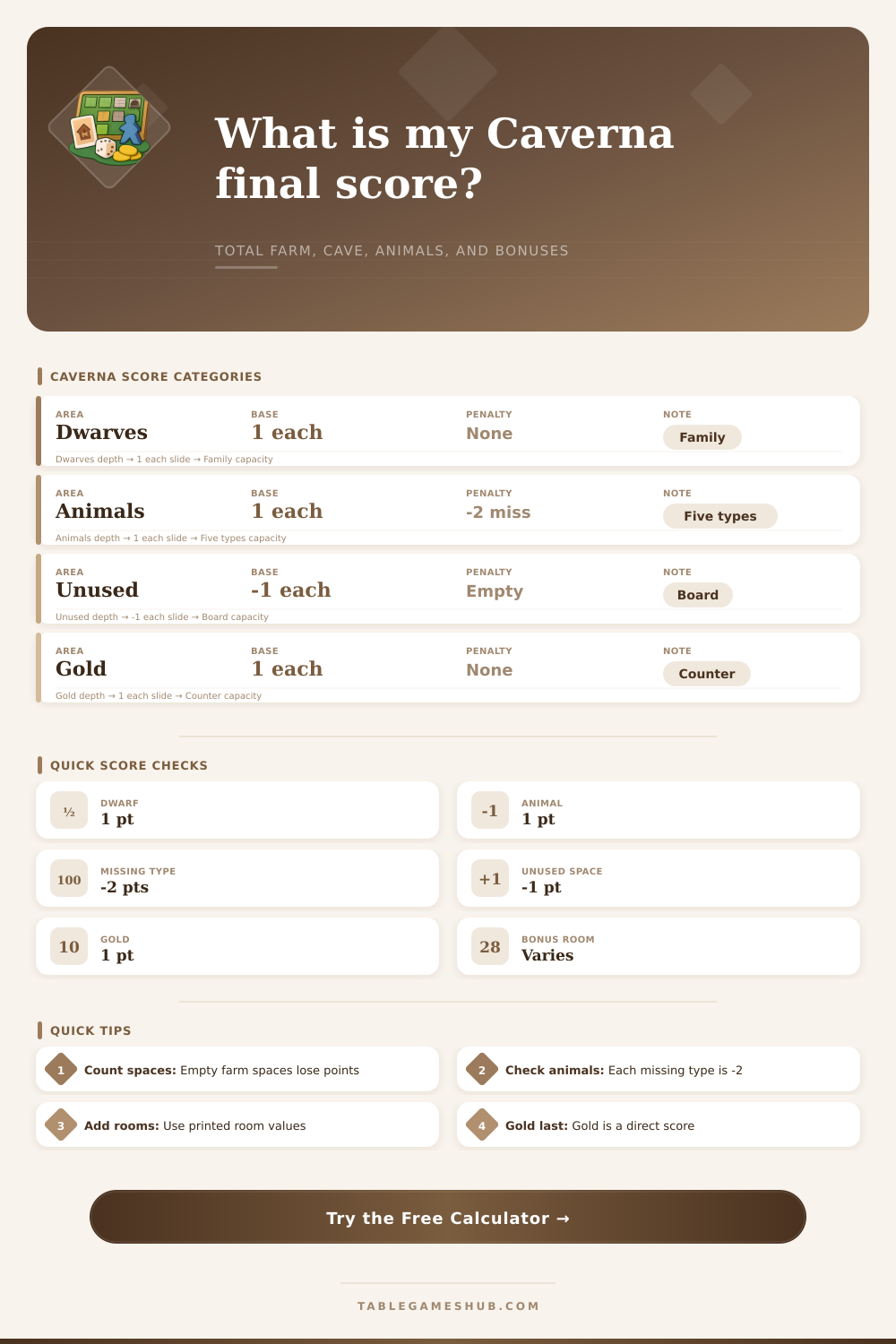
For instance, each of the dwarves on the board will contribute to the score of the player, as will each of the animals on the board. However, the animals only contribute to the score of the player after the calculator determines whether the player have five types of animals on their board; each type of animal that is missing will cost the player two points. Additionally, each of the spaces that are left unused on the board will cost the player one point each, each room with furnishings will contribute its value to the score of the player, and bonus rooms can also contribute to the score.
This calculator makes visible to each player the relationship of each component of the game to the total score. For instance, a player that constructed many room in their home may still lose to another player that filled their home and collected each of the animal type on the board. Similarly, a player that leaves spaces empty in their home will lose points each space left empty.
These reference tables make clear each of the components of scoring and the way in which they contribute to the total score of each player, an aspect that is helpful for players that is deciding between two player whose scores are close together. One of the easiest components of scoring to perform incorrectly is the check for the animal types. For instance, it is easy to remember to place sheep, cattle, and goats in the home for scoring, but it is easy to forget to place dog or donkeys.
The same can be said for the empty spaces; it is easy to construct a tunnel or meadow that players may have needed for construction during the game, but which will cost the player points if left empty. The calculator performs each of these calculation automatically, which also helps to reduce the potential for any arguments between players over the score of the game. The scoring system for Caverna is based both upon gaining certain component of the game, but also in the avoidance of losing points for missing some of those components.
For instance, while players may focus upon constructing their home, they will lose points if they do not have animals in their home. Similarly, while players may focus upon constructing their home and using all of the spaces in their home, they will lose points if they leave spaces in their home empty. Thus, while the calculator does not provide any strategy for players for how to play the game, it does make visible to each player the relationship of the components of the game to the total score for each player.
This information can help players to adjust their strategy for future games of Caverna. Overall, the players whose homes are filled with tiles and who have collected each of the animal type will have a higher total score than other players. Though these players may have constructed fewer room with lower values, they have avoided the penalties for their scores.
Overall, then, the calculator makes it more easier for each player to understand their total score.