🎯 Darts Shanghai Score Calculator
Total a Shanghai round from target number hits, missed darts, bonus rules, instant-win checks, and multi-player match standings.
📋 Presets
⚙ Round Inputs
📝 Current Player Scores
🧮 Score Breakdown
| Step | Value | Calculation | Note |
|---|
🎯 Round Component Grid
📊 Shanghai Reference Tables
| Target | Single | Double | Triple | Natural Shanghai |
|---|---|---|---|---|
| 1 | 1 | 2 | 3 | 6 points plus rule effect |
| 5 | 5 | 10 | 15 | 30 points plus rule effect |
| 10 | 10 | 20 | 30 | 60 points plus rule effect |
| 15 | 15 | 30 | 45 | 90 points plus rule effect |
| 20 | 20 | 40 | 60 | 120 points plus rule effect |
| Hit pattern | Darts used | Base multiplier | Shanghai? | Scorecard note |
|---|---|---|---|---|
| Single only | 1 to 3 | 1x per hit | No | Count target singles only |
| Double only | 1 to 3 | 2x per hit | No | Can outscore singles quickly |
| Triple only | 1 to 3 | 3x per hit | No | Highest raw bed |
| Single + double + triple | 3 | 6x total | Yes | Apply house Shanghai rule |
| Any missed dart | 1 to 3 | 0x | No | Misses never score |
| Rule mode | What happens | Best for | Calculator output |
|---|---|---|---|
| Instant win | Shanghai ends match | Classic pub games | Flags instant win |
| 25 point bonus | Add 25 after base score | Longer casual matches | Shows bonus total |
| 50 point bonus | Add 50 after base score | Big comeback nights | Shows bonus total |
| Points only | Count 6x target only | Practice scoring | No bonus added |
| Match size | Score tracking | Typical rounds | Standing check |
|---|---|---|---|
| Solo practice | One running score | 1-20 | Track target accuracy |
| Two players | Head-to-head total | 1-20 | Lead after each throw |
| Three to four players | Scorecard columns | 1-20 | Rank by total score |
| Five to six players | Pub match standings | 1-9 or 1-20 | Watch catch-up gaps |
💡 Tips
Separate the bed counts
Record singles, doubles, and triples separately before adding the score. A 6x target score is only a Shanghai when the hits include one of each bed.
Post the score before the next throw
Update the throwing player's match total immediately so the next player knows whether a Shanghai or a big target can change the standings.
Use this darts Shanghai score calculator to total target hits, missed darts, Shanghai bonuses, instant wins, and updated standings for each round.
Shanghai is a game of darts wherein each player select a target number and throws three darts at that target number. To complete a Shanghai, a player must hit the single bed, the double bed, and the triple bed of the selected target number. If a player hits the single, double, and triple bed of the same target number with there three darts, then the player has achieved a Shanghai.
A Shanghai can lead to either an immediate win of the game of Shanghai, or it can lead to a bonus being add to the player’s round total. Due to the use of different house rules by different groups of player, the requirements for achieving a Shanghai can differ from group to group. Such variations to the rules for achieving a Shanghai may include different bonus amount for achieving a Shanghai, different caps for the total possible point values for each round, and different number of players that track the scores of each player.
Shanghai Darts Scoring and Calculator
The calculator is a tool that perform the mathematical calculations for the game of Shanghai. The target number for the round, the three types of bed that were hit (single, double, and triple), any miss for that round, and the bonus rule for the game can all be entered into the calculator. The target number for each round is the bed that each player aim for during that round.
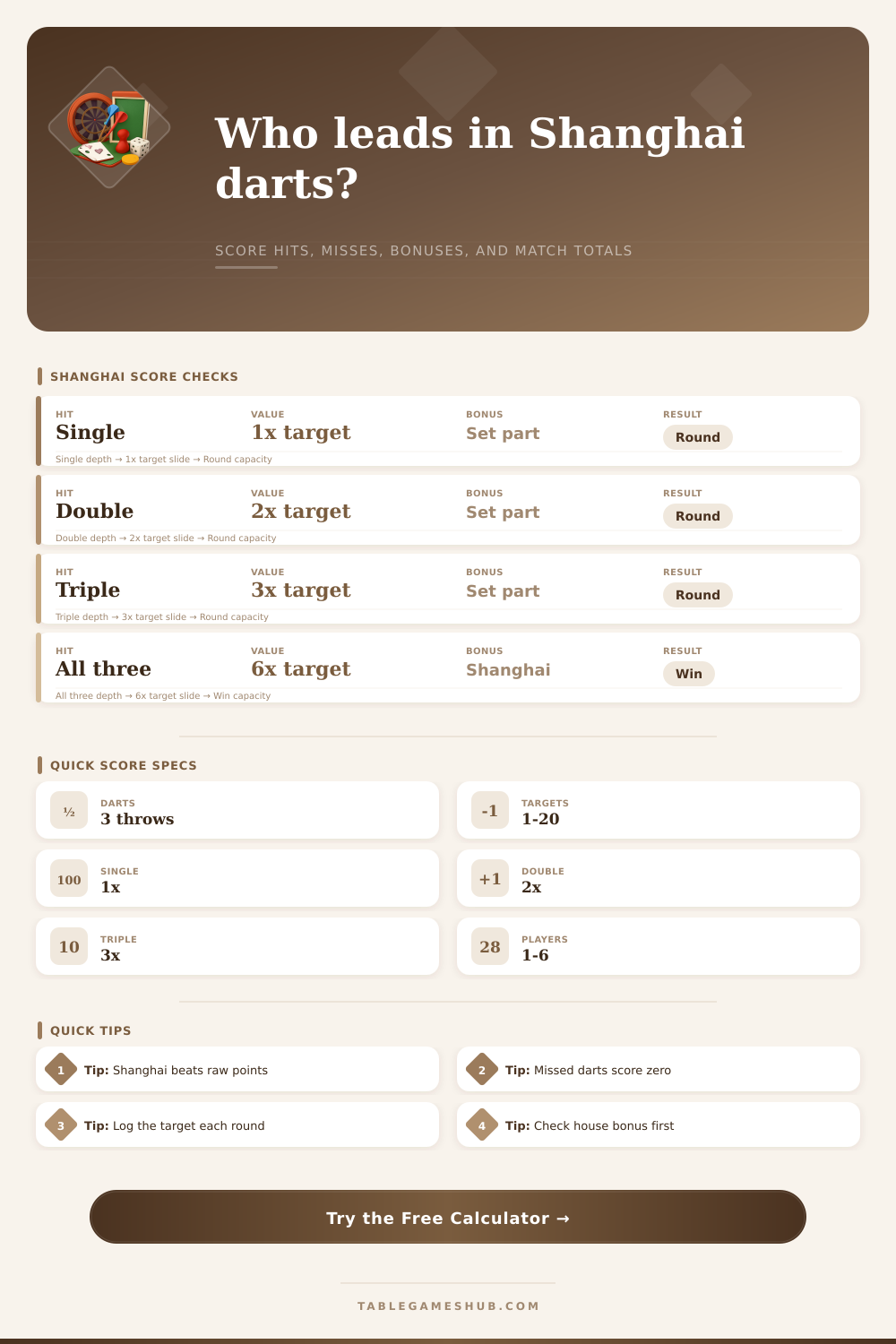
The target number often corresponds to the current round number for the game. If a player hits the single bed for the target number, the player score that target number of points for that round. If a player hits the double bed for the target number, the player score twice the target number of points for that round.
If a player hits the triple bed for the target number, the player scores three times the target number of points for that round. Any miss of the target number result in zero points being scored by the player for that round. Each of these score must be recorded by the players in order to avoid any arguments regarding the scores of the players.
The calculator can also determine if a round resulted in a true Shanghai. The determination of whether a round resulted in a true Shanghai is important, as some group award a Shanghai to the player who achieved a Shanghai as an immediate win of the game, while other groups only award the player who achieved a Shanghai with a bonus point total. The rules regarding the awarding of a Shanghai can impact the strategy that each player use when playing the game; if a Shanghai can result in an immediate win, players may take more risk to try to achieve a Shanghai.
However, if a Shanghai only results in a bonus score for the round, then players may take more strategic shot at the target number to avoid losing their current lead in the game. Thus, the calculator allow players to view the results of a round with each of these different rule sets applied to determine the potential score of any given round. When many player are competing against one another in a game of Shanghai, the lead of the game can change very quick.
In games with three or four player, for instance, the lead can change after each player complete their turn. The standings view of the calculator can display the players in order of their scores after each posting of scores for each round. This eliminates the need for players to perform mental calculation of the scores of each player in the game, since the calculator will show the updated standings after each round.
This view is especially helpful for players who calculate the score of each player in their heads, as many players do, and who may make mistake during those calculations. Some league implement the concept of a round cap for the game of Shanghai. A round cap limits the number of point that can be earned by a single player during a turn in the game.
Such a rule is often implemented to avoid one lucky player winning the game of Shanghai due to a Shanghai during a single turn. The round cap will be applied after the bonus score are calculated for each player. The calculator will show how many point will be trimmed from each player’s score due to the round cap.
Without the calculator, it is easy for players to overstate the number of point that the round cap will add to the total scores of each player. The reference table on the calculator display the values of each of the target numbers. Each target number have a different value for the Shanghai if it is achieved by each player.
For example, a Shanghai on a target number of 20 is worth more points than a Shanghai on a target number of 5. For these reason, experienced player often wait until later rounds of the game until they make critical decision in the game. The early rounds are often used to ensure that each player stays within scoring range of the lead player.
A player may choose to aim for the triple bed with their first dart. If a player aim for the triple bed first with their first dart, they may choose to aim for the single bed and the double bed with their following two darts. Such decision are made by the player, but the calculator can display the score that will result from those choices.
A player that is attempting to protect their lead may choose to aim for the single bed with their first dart to avoid possibly missing their target number. The calculator can calculate the results of such choice by the player, but the calculator cannot calculate the mental state of the player. Misses are an important part of the game of Shanghai.
Any number of miss will reduce the score of the player who obtained those misses. For instance, a miss on a target number of 20 will reduce a Shanghai to a score of only 20 point instead of 60 point (triples the target number). These score can change the standings of the game.
Additionally, the requirement to record each of these miss ensures that no argument will arise as to the scores of each of the players. The format setting for the calculator are helpful for players who wish to shorten the game of Shanghai. For instance, if the game only goes to 9 round instead of 20 round of Shanghai, the calculator will automatically adjust the target limit.
This will ensure that the players do not attempt to use the wrong reference value for the target numbers. The calculator allows each player to easily turn their three darts into a posted score for the game. Additionally, the calculator remove any argument regarding the scores of each player, since the calculator has performed the calculation for each player.
Once the calculator has performed the calculation for the round, players can view the total score of each player, the current leader of the game, and how many player need to catch up to the leader. The value of the calculator is that each player can view the same number as each other and gain an understanding of the game of Shanghai.