🐎 Horseshoe Score Calculator
Score one inning with ringers, leaners, closest shoes, cancellation or count-all scoring, and the race target your match uses.
| Measure | Team A | Team B | How it was scored |
|---|
| Shoe result | Default value | Input field | Scoring note |
|---|---|---|---|
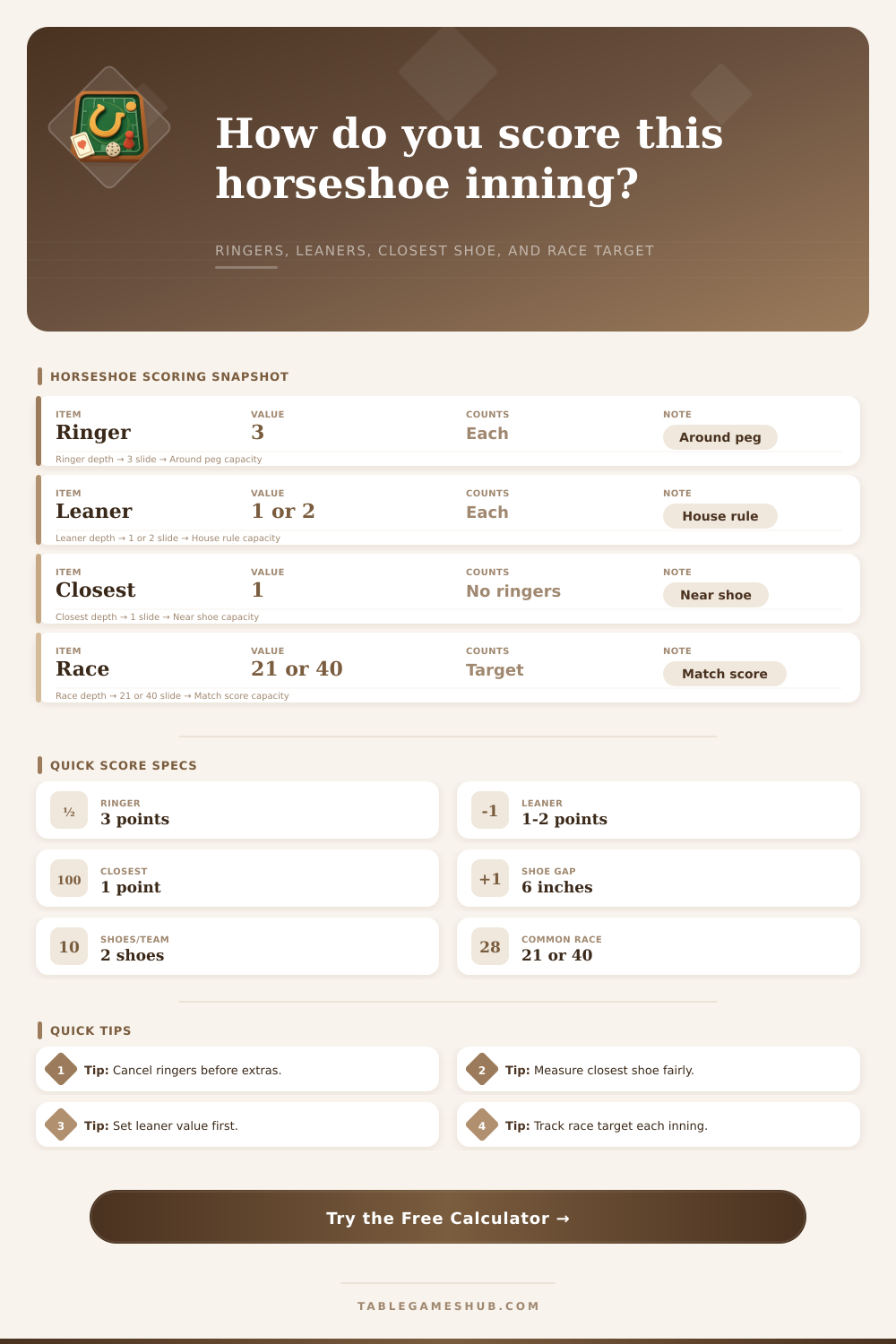
| Ringer | 3 points | Ringers | Shoe surrounds the stake; opposing ringers may cancel. |
| Leaner | 0, 1, or 2 | Leaners | House rules decide whether leaners score and how much. |
| Closest shoe | 1 point | Distance | Usually awarded when no ringers are made in the inning. |
| Outside range | 0 points | Range limit | A shoe farther than the set limit does not claim closest. |
| Scoring mode | How it scores | Best use | Example |
|---|---|---|---|
| Cancellation | Subtract lower raw score from higher raw score | Common competitive and casual play | 5 vs 3 gives only 2 points to the higher side. |
| Ringer cancellation | Matching ringers offset first in the breakdown | Clearer scorekeeping | One ringer each cancels before leaners and closest are read. |
| Count-all | Both teams add their raw inning totals | House-rule or practice score sheets | 5 vs 3 means both scores increase. |
| Wash inning | No net points after cancellation | Equal raw totals | Four points each keeps the scoreboard unchanged. |
| Closest condition | Calculator rule | When it applies | Result |
|---|---|---|---|
| No ringers | Closest only if both sides have zero ringers | Traditional casual scoring | Nearest legal shoe gets the closest value. |
| Always | Closest can add even with ringers | Custom score sheets | Nearest shoe within range receives the point. |
| Off | Distance is ignored | Ringer-only or leaner-only variants | No closest-shoe point is awarded. |
| Tie distance | Equal nearest shoes cancel | Measured dead heat | No closest point unless your group breaks ties. |
| Match setup | Target | Typical pace | Scorekeeping note |
|---|---|---|---|
| Backyard short game | 15 or 21 | Fast | Great for rotating players quickly. |
| Standard casual race | 21 | Medium | Check whether exact target is required. |
| League or long race | 40 | Long | Track washes and low net innings for pace. |
| Win-by-2 finish | 21 plus lead | Variable | A tied target score keeps the match open. |
Score ringers before distance
Ringers control most innings. Count and cancel them first, then add leaners and closest-shoe points according to the selected house rule.
Use one closest-shoe standard
Measure from the stake to the nearest edge of the shoe and keep the same range limit for both teams throughout the match.
Horseshoe scoring can became complicated, and horseshoe scoring can become complicated because the players may not agree on the calculation of the points for each player’s total. One player may throw a ringer, while the other player may toss a leaner, resulting in an argument as to whether the points cancel or add to the total score for each players. A dedicated scoring tool will help each player to avoid these arguments by perform the arithmetic for the players, and by applying the rules that each group of horseshoe players decide to use.
A ringer is threw if a player’s shoe lands on the stake, and a ringer earns a player three points. However, if both players lands a ringer on the opposite sides of the stake, the points from each of these ringers will cancel each other out. A scoring tool will calculate the number of points for each player, and will automatically cancel any points from ringers from opposite side of the stake.
How to Score Horseshoes
Each player can choose the value of a ringer, and whether leaner score any points. Leaners is shoes that land in the middle ground between ringers and dead shoes. Some groups award one point to a leaner, some award two points to a leaner, and others award zero point for a leaner.
The value of a leaner must be entered into the scoring tool at the beginning of the game, as any entries for leaners after the beginning of the game may result in inconsistently scoring for each player during the game. The scoring tool will prevent either player from awarding too many points for any leaners, and will prevent score creep by capping the number of shoes that can score in any single inning. The closest shoe rule is a rule that many horseshoe players apply inconsistently.
Some groups only award a point for the closest shoe if no ringers is scored by either player, while other groups allow a point for the closest shoe regardless of whether any ringers are scored. The scoring tool will allow the player to set this rule before the game begins, and will ensure that the same rule is applied to each of the innings during the game. Other settings for the scoring tool allow the player to set a limit to how far the closest shoe can be from the player’s point, such as six inches.
Any shoes that come within this distance of the opponent’s shoe will earn the player a point. In addition to setting each of the rules for scoring, the scoring tool can help to calculate the points scored during each player’s inning. For example, in cancellation scoring, the scoring tool calculates the number of points earned by each player for that inning, and the lower score is subtract from the higher score.
This type of scoring rewards the best consistency between each player’s throws. Count-all scoring calculates the total points for each player by adding the raw points scored to the player’s total score on the scoreboard. Count-all scoring results in each player’s score increase with each inning.
These two scoring modes can be selected on the scoring tool, and the tool will calculate the score for each of the innings according to the selected mode. Race targets can be set for each game using a scoring tool. Most groups will target twenty-one points in their game, but other leagues and teams score their games with a target of forty points.
Additionally, the rules for how the game is won can be set with the scoring tool. Most groups require an exact score to win the game, while others will allow the game to be won by scoring to any amount that is at or above the target score. The scoring tool will apply the rules that is selected by the players, and will show how many points each player needs to win the game.
Additionally, the scoring tool will track the points that are earned in each game, which can provide an estimation as to how many innings remain until the target score is achieved. Each of the settings for the scoring tool can be adjusted to match the preferences of the players. For instance, if the value of leaners is change, the total number of points earned by each player will change.
Additionally, if the players change the mode for scoring from cancellation scoring to count-all scoring, the players will reach the target score more quickly. Additionally, if the rule for the closest shoe is adjusted, the game may become a contest between the two players for the number of ringers that they can score. These adjustments will allow the players to view the results of each of the different scoring rules.
Some of the most common mistakes in scoring with horseshoes may happen due to the inconsistency in the players. For example, some players might measure the distance of the closest shoe from the heel, while others may use the toe of the shoe. Additionally, some players will forget to score for leaners, while others may score for ringers after the player has throw his shoes.
These types of mistakes will be revealed by the scoring tool, as the numbers will not match the score that each player recorded for the inning. The scoring tool can show the difference between the raw points for each player, and the applied points to each player’s total score. For example, a player may score four raw points for that inning, but if cancellation scoring is used, that total is reduced to one applied point for that player.
The scoring tool will display these two sets of scores in each side-by-side format. Each of the small scoring decisions for horseshoes will have an impact on the remainder of the game. For instance, a single point for the closest shoe may impact the number of ringers that must be scored in order to win the game.
Additionally, the value of leaners can impact the number of innings that are scored in the game. While the scoring tool does not choose the values for any of these settings, it will ensure that the values are consistent throughout the game. Thus, the players are able to focus on their shoe throws, rather than on their scorebook and scorekeeping.