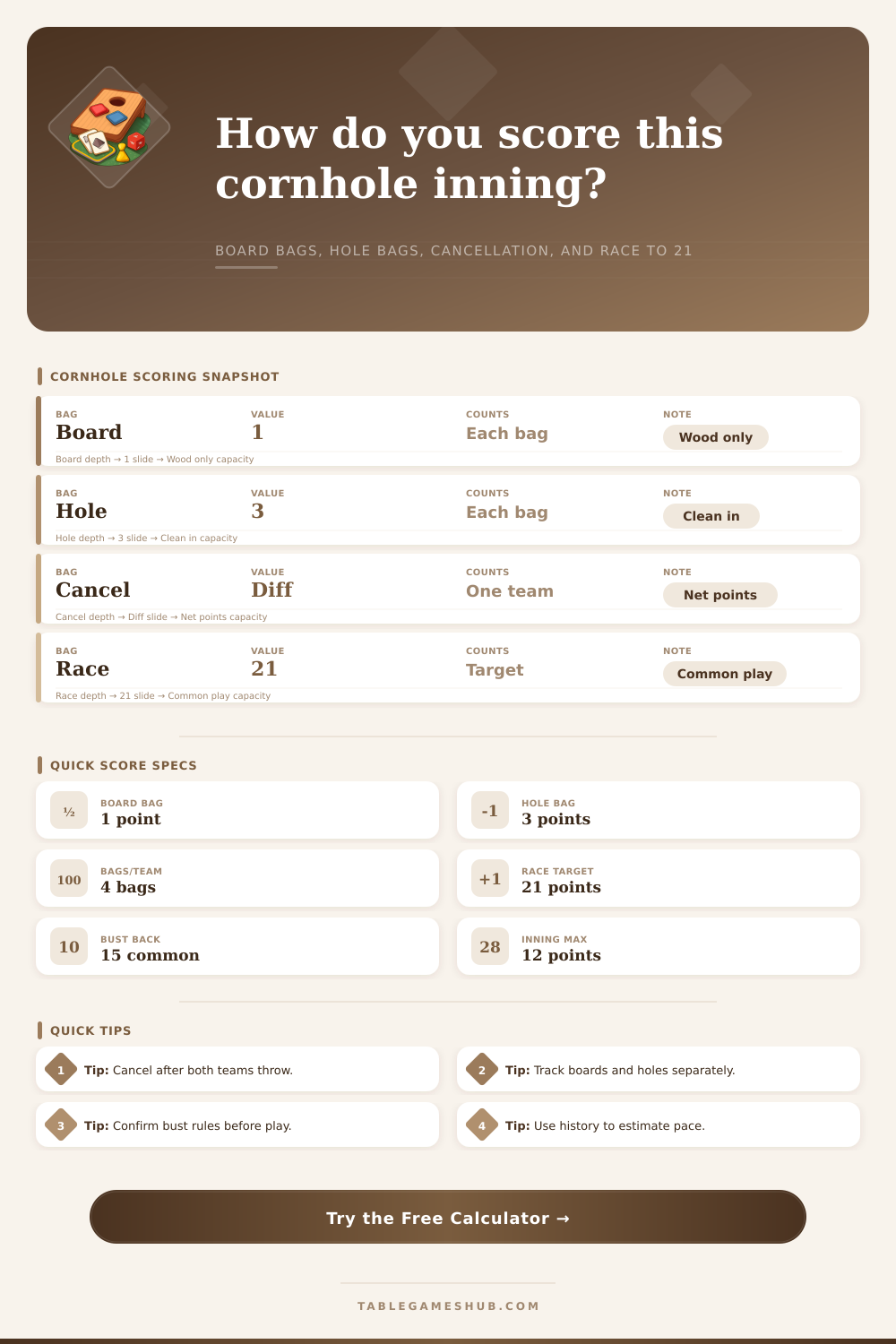
🎯 Cornhole Score Calculator
Score a single inning, cancel the points, apply race-to-21 house rules, and estimate the match pace from recent round history.
| Measure | Value | Formula | Read |
|---|
| Bag result | Point value | Input field | Scoring note |
|---|---|---|---|
| On the board | 1 point | Bags on board | Counts only if still supported by the board at inning end. |
| In the hole | 3 points | Bags in hole | Counts if it entered directly or was knocked in later. |
| Off board | 0 points | Not entered | Grounded, short, or foul bags do not add raw points. |
| Four holes | 12 points | Hole count 4 | Maximum raw value for one team in a single inning. |
| Cancellation mode | How it scores | Best use | Example |
|---|---|---|---|
| Standard total | Raw A minus raw B | Most cornhole scoring | 7 raw vs 4 raw gives Team A 3. |
| Separate board/hole | Cancel boards and holes separately | House score sheets | Boards cancel, holes cancel, then net totals. |
| No cancellation | Both teams keep raw points | Practice or custom play | 7 raw and 4 raw both add to the scoreboard. |
| Wash inning | Net result is zero | Equal raw totals | 5 raw vs 5 raw keeps the same match score. |
| Finish rule | Target behavior | Calculator action | House-rule note |
|---|---|---|---|
| First to target | Target or higher wins | Adds net points normally | Fastest and simplest race rule. |
| Exact target | Over target is a bust | Uses the custom bust-back score | Common casual rule for 21 exactly. |
| Bust back | Over target resets score | Back to 15 or 11 preset | Choose the score your group uses. |
| Win by 2 | Target plus lead margin | Checks target and margin together | Useful for tournament-style endings. |
| Match pace | Recent net pattern | Estimate meaning | Read |
|---|---|---|---|
| Slow grind | 0, 1, 0, 1 | One point or wash-heavy rounds | Expect several more innings. |
| Balanced pace | 2, 0, 3, 1 | Moderate net scoring | Lead changes stay possible. |
| Hot side | 4, 3, 0, 5 | One team is creating big net swings | The target can arrive quickly. |
| Finish window | Score within 1 to 4 | Any strong inning can end it | Check exact or bust rules carefully. |
Count every bag location first
Write down board bags and hole bags for both teams before doing cancellation. It prevents a three-point hole bag from being treated like a one-point board bag.
Confirm the finish rule early
Exact-21 and bust-back games can reverse a winning-looking inning, so agree on the house rule before either team reaches the finish window.
Jump to the reference tables and use this cornhole score calculator to total board bags, hole bags, cancellation points, race status, bust rules, and recent inning pace.
Cornhole game scoring involve keeping track of an number of points that each player score from the bag that land on the board or those that fall through the hole in the board. Each player throw four bag in each inning, and there are a total of eight bags thrown in each inning. Bags that land on the board score one point for the player, and bags that fall through the hole score three point for the player.
These point value are fixed for each bag, but a group can vary the method used to calculate the final score based off the rules chosen. Most groups use a scoring method that involve the cancellation of scores. With this method, the lower score is subtracted from the higher score to calculate the net number of points earned by the players for that inning.
How to Score in Cornhole
Some groups can cancel the scores for the bags that land on the board and the bags that fall through the hole separately, but others use the standard method of cancelling all point earned by all player before calculating the difference between the higher and lower score. Some groups dont use any form of cancellation of scores, and in this case, each player keeps all of their scored points. Because there are different rules within groups for the calculation of the score, players must agree on the rules for scoring before they begin to play cornhole.
The target score for player in a game of cornhole is often twenty-one points. However, the rules for scoring to twenty-one points can differ between group. Some groups score to twenty-one points, meaning that the first player or team to reach twenty-one points has won the game.
In other groups, players must score exact twenty-one points to win the game. In this case, if any player or team score more than twenty-one points in an exact target game, they are usualy penalized to a lower score, such as fifteen points. These scoring rules impact how each player plays the game, as they determine the risk each player take in the game when they are close to the target score for winning the game.
In order to make it easier to manage the scoring of the game, players can use a cornhole calculator. The cornhole calculator require a player to input the current score, the target score, and the finish rule that is to be used in the game of cornhole. The calculator will display the results of one inning for the players to review to determine if the inning will end the game.
By utilizing the cornhole calculator, players can ensure that the scores are calculated correct and efficiently, thus preventing any error in scoring the game of cornhole. The history of the cornhole game can help to indicate how long the game is likely to last. If the scores created by each team in the previous rounds of the game have been low, the game is likely to take place over a long period of time to reach the target score.
In contrast, if the scores in each round of the game have been high, the game will likely be over in a short period of time. Each of these score can be entered into the history field of the cornhole calculator, and the fields will provide an estimate of the number of remaining inning for the game. While this estimate is not a guarantee of the number of innings that will remain in the game, it can provide players with an idea of the length of the game.
In order to score correct in a game of cornhole, players must ensure that they remove any bag that is touching the ground before the next players turn to toss the bag into the hole. Any bag that is touching the ground is not counted towards the player score. Any bag that another players toss knocks into the hole, however, still counts as three points for the player that knocked it into the hole.
Players must also make sure that the total number of bag entered into each side of the cornhole game is not more than four bag per player per inning. Errors occur in scoring games of cornhole to players potential ignorance of the proper order of operation for scoring. For instance, players may add the points scored in the hole before cancelling any point for a round, or players may fail to account for the fact that a “wash” inning will score zero point for each team.
A “wash” inning occur when each team score the same amount of point during a round. By reviewing the breakdown of scores after each inning, players can avoid these type of errors.