Billiards Diamond System Calculator
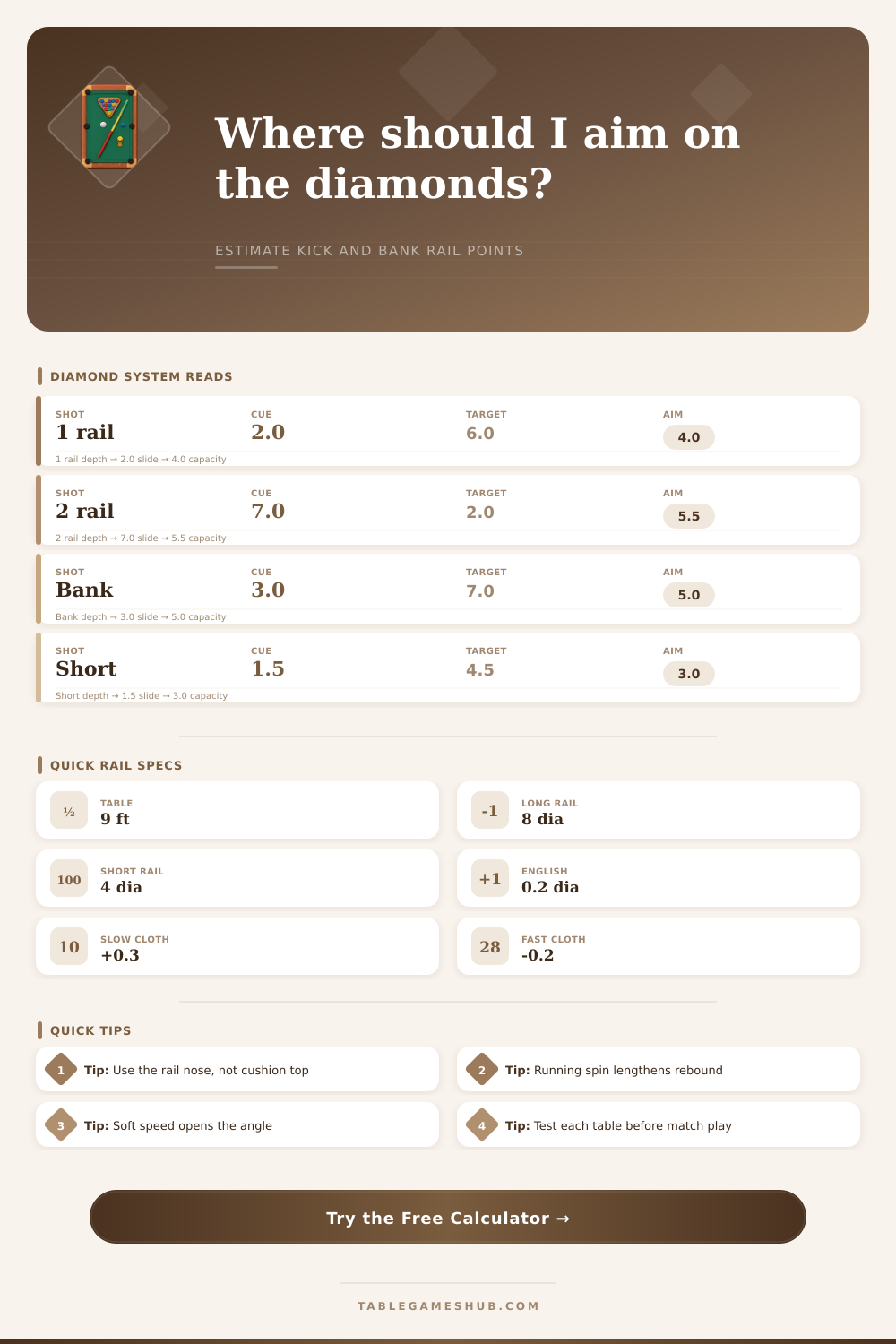
Estimate a practical kick or bank aim point from cue ball diamond, object or target diamond, rail count, table size, running english, speed, and cloth response.
Use diamonds as measured along the rail nose: long rails usually read 0 to 8 and short rails 0 to 4. The result is a starting read, then the adjustment line shows how much the table conditions moved it.
| Table size | Playing area | Long-rail diamonds | Short-rail diamonds | Inches per long diamond |
|---|---|---|---|---|
| 7 ft | 39 x 78 in | 8 | 4 | 9.75 in |
| 8 ft | 44 x 88 in | 8 | 4 | 11.00 in |
| 9 ft | 50 x 100 in | 8 | 4 | 12.50 in |
| 10 ft | 56 x 112 in | 8 | 4 | 14.00 in |
| Rail count | Base read | Typical use | Correction size | Practice focus |
|---|---|---|---|---|
| 1 rail | Midpoint mirror | Direct kicks and banks | Small | Contact point |
| 2 rails | Compressed midpoint | Escapes and position | Medium | Second-rail angle |
| 3 rails | System plus offset | Open-table routes | Large | Speed control |
| Bank | Object mirror | Cross-side and cross-corner | Medium | Pocket speed |
| Adjustment | Effect on path | Calculator shift | Best use | Watch for |
|---|---|---|---|---|
| 1 tip running | Lengthens | +0.18 diamond | Opening the rebound | Over-spin |
| 1 tip holding | Shortens | -0.18 diamond | Holding a narrow line | Cushion grab |
| Soft speed | Opens | +0.10 diamond | Touch kicks | Rail roll-off |
| Very firm | Shortens | -0.28 diamond | Power escapes | Rail compression |
| Cloth or rail read | Common sign | Starting correction | Window change | Retest after |
|---|---|---|---|---|
| Normal cloth | Predictable rebound | 0.00 | Standard | Warmup rack |
| Slow cloth | Ball dies early | +0.22 | Wider | Chalk marks |
| Fast cloth | Ball slides long | -0.18 | Narrower | Speed change |
| Dead rails | Rebound checks up | +0.32 | Widest | Every route |
The diamond system use mathematics to calculate in what direction a cue ball will rebound when it come in contact with the rails of the billiards table. The billiard ball will not always take a perfect angle off of the billiard table due to the effect of various physical variable upon the ball. These variables include the speed of the cloth of the billiards table, the liveliness of the billiard table’s rails, the amount of english placed upon the ball, and the size of the billiards table.
These variables have the potential to alter the path of the ball away from the angle that geometry would suggest the ball should travel. The calculator allow for these variables to be accounted for in the calculation of the aim point of the object ball that is to be pocketed, thus saving the player from having to guess the way in which each of these variables may affect the contact point of the cue ball. The diamonds are mark that is made along the rail nose of the billiard table.
How to Aim Pool Shots with the Diamond System
The diamonds are not marks made upon the cushion of the table, nor are they marks made upon the inlay of the billiard table. Upon the standard nine-foot billiard table, there are eight diamonds along each of the long rails of the table, and there are four diamonds along each of the short rails of the billiard table. Each diamond is spaced apart from each of the other diamonds according to the size of the billiard table.
For instance, cue ball positioned upon a ten-foot billiard table will result in a different read of where the ball should enter the first rail of the billiard table compared to cue ball positioned upon a seven-foot billiard table. The difference in the spacing of the diamonds is relatively small when the cue ball travels along only one rail of the billiard table, but the difference in spacing become more pronounced with cue balls that travel along two or three rails. The amount of english that is applied to the ball will alter the angle of the rebound of the cue ball from the billiard table’s rails.
English that is applied in a “running” direction will lengthen the cue ball’s rebound off of the rail, but english that is applied in a “held” direction will shorten the cue ball’s rebound. The amount of english that is applied to the ball can change the angle of the ball by various amounts depending upon the number of rails upon which the ball will travel, as well as the firmness with which the ball is struck with the cue stick. For instance, running english along the ball may add a fifth of a diamond to the aim point of the cue ball along a two-rail kick, but the same amount of running english on the ball will add more to the cue ball’s aim point along a three-rail kick because the ball remain on the billiard table’s playing surface longer.
The speed at which you hit the cue ball will also affect the angle of the ball’s rebound off of the rails. Soft speeds upon the cue ball will result in the ball not compressing against the rail as deep as firm speeds upon the ball. Thus, soft speeds will create a different angle than firm speeds.
Each of these adjustments to the ball’s aim point is relatively small on its own, but the cumulative effect of each of these variables are the cause of many billiard players missing their kicks. Finally, each of the variables of the billiard table itself, such as the speed of the cloth of the table and the liveliness of the billiard table’s rails, may also significantly impact the movement of the cue ball. If the cloth of the billiard table is moving slow and the rails are lively, the cue ball will travel a greater distance along the rail than if the billiard table has fast cloth and tight rails.
These variables can be adjusted with the calculator to take into account the particular characteristic of each billiard table. The reference tables on the page will show the typical sizes of corrections for each count of rails on the billiard table. These tables will allow you to understand if the kick you are attempting is typical or extreme for that route.
Different types of billiards shots will require different mathematical considerations to calculate the necessary corrections. For instance, one-rail kicks are the easiest to execute because a one-rail kick is basically a mirror shot from the midpoint of the billiard table. Two-rail routes are more complex than one-rail kicks due to the introduction of a compression factor with the use of a second rail.
Three-rail routes are even more complex due to the introduction of an offset factor into the equation. Bank shots are complex due to the requirement of the object ball to arrive at the pocket at a specific speed. The calculator distinguish between these types of shots to ensure that the output of the calculator is the actual goal of the shot that is to be made.
Another way to increase your consistency in the game of billiards is to test the known route that you are going to use for a specific match on the new billiard table. Find a simple route from one diamond to the opposite diamond on the table, and shoot the cue ball once. Note on which rail the cue ball contacted the rail; this will provide you with the correction value for that table.
You can remember this value for the remainder of the day, or you can use the calculator to adjust the cloth or speed of the billiard table until the calculator outputs the same value that you observed with the cue ball. The size of the billiard table will affect the calculations of the diamond system. For tables with smaller pockets, the angles between each pocket are steeper than they would be on a large billiard table.
The sensitivity factor in the calculations allow for these different table sizes to be accounted for in the calculations. A soft-speed setting on a seven-foot billiard table will result in the cue ball traveling further than the same speed on a nine-foot table. Finally, the type of English that is used for the billiard ball will affect the size of the aim window that is provided by the calculator.
If the pocket that is to be targeted is a tight pocket, the aim window will be provided as a wider range of angles; however, the angle provided is not a guarantee that the ball will enter the pocket; it is only a range in which the player will make the practice. If the aim window is wider than half of a diamond, then the route that is to be taken by the cue ball is too likely to drift from the point of aim, and, therefore, it may be better to take a different route with the balls on the billiard table.