BattleTech To-Hit Calculator
Add gunnery, attacker movement, target movement modifier, range, terrain, heat, cover, and other modifiers to find the 2d6 target number and hit probability.
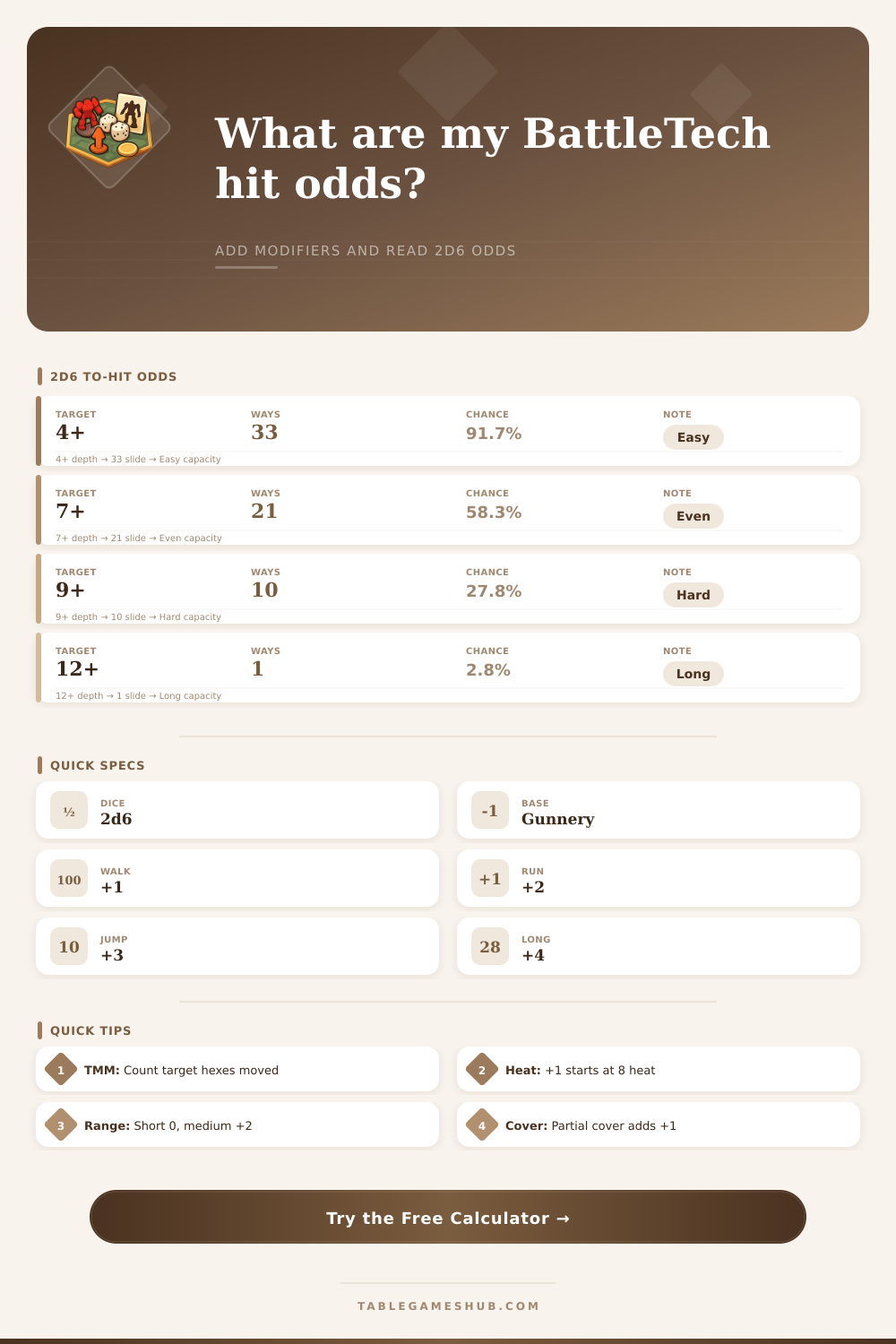
| Adjustment | Target number | Hit chance | 2d6 winning rolls | Practical read |
|---|---|---|---|---|
| -2 easier | 5+ | 83.3% | 30 of 36 | Strong shot |
| Current | 7+ | 58.3% | 21 of 36 | Coin-flip plus |
| +2 harder | 9+ | 27.8% | 10 of 36 | Low odds |
| Target number | Ways to hit | Hit probability | Miss probability | Odds band |
|---|---|---|---|---|
| 2+ | 36 of 36 | 100.0% | 0.0% | Automatic on standard 2d6 |
| 3+ | 35 of 36 | 97.2% | 2.8% | Nearly certain |
| 4+ | 33 of 36 | 91.7% | 8.3% | Very strong |
| 5+ | 30 of 36 | 83.3% | 16.7% | Strong |
| 6+ | 26 of 36 | 72.2% | 27.8% | Good |
| 7+ | 21 of 36 | 58.3% | 41.7% | Fair |
| 8+ | 15 of 36 | 41.7% | 58.3% | Unfavorable |
| 9+ | 10 of 36 | 27.8% | 72.2% | Difficult |
| 10+ | 6 of 36 | 16.7% | 83.3% | Long shot |
| 11+ | 3 of 36 | 8.3% | 91.7% | Very long shot |
| 12+ | 1 of 36 | 2.8% | 97.2% | Boxcars only |
| 13+ | 0 of 36 | 0.0% | 100.0% | Impossible on 2d6 |
| Target hexes moved | TMM | If target jumped | Typical feel |
|---|---|---|---|
| 0-2 hexes | +0 | +1 if jumped | Easy tracking |
| 3-4 hexes | +1 | +2 if jumped | Light movement |
| 5-6 hexes | +2 | +3 if jumped | Common fast walk |
| 7-9 hexes | +3 | +4 if jumped | Fast target |
| 10-17 hexes | +4 | +5 if jumped | Very fast target |
| 18-24 hexes | +5 | +6 if jumped | Extreme movement |
| 25+ hexes | +6 | +7 if jumped | Maximum bracket |
| Modifier source | Input used | Modifier | Calculator note |
|---|---|---|---|
| Range bracket | Short / medium / long / extreme | +0 / +2 / +4 / +6 | Use the weapon range bracket for the target hex range. |
| Light woods | Number of intervening hexes | +1 each | Stacks with other line of sight modifiers. |
| Heavy woods | Number of intervening hexes | +2 each | Two heavy woods often block line of sight in standard play. |
| Heat level | Current heat | +1 at 8, +2 at 13, +3 at 17, +4 at 24 | The attack penalty is calculated from the heat level input. |
| Partial cover | Cover dropdown | +1 | Also changes hit location rules at the table; this calculator only adds the to-hit modifier. |
| Immobile target | Cover dropdown | -2 | Use when the attack rules grant the immobile target modifier. |
A to-hit calculator is a tool that a person use to determine the probability that an attack will hit its target in the game of BattleTech. A to-hit calculator take several different variable related to the attack and converts those value into a target number. This target number can then be compared to the results of two six-sided dice roll.
Because the results of two six-sided dice produce a bell curve that favors the number seven, the target number can tell a player how likely that a specific attack will succeed. One of the variables that feeds into the to-hit calculator is the gunnery score of the attacker. The gunnery score is a value that belongs to the attacker and represents the pilot’s skill with the weapon.
How a To-Hit Calculator Works
The next two variables to consider are the movement of the attacker and the movement of the target. The movement of the attacker represents how much the attacker has moved during the attack which could impact the aim of the attacker. The movement of the target is also fed into the to-hit calculator as it represent how much the target have moved during the attack.
The target movement have the potential to make it more difficult for the attacker to hit the target. Therefore, the calculation of the attack’s target number must add the target movement to ensure accuracy of that number. Another variable that a player must input into a to-hit calculator is the range between the attacking unit and the target.
The range between the two units will determine how many penalty are applied to the attacker. If the attacker is within the short range of the target, they will have an advantage in that the target is within the range at which the weapon are most effective. If the attacker is within medium, long, or extreme range of the target, they will have penalties applied to their attack.
Each range comes with a modifier in the to-hit calculator that will change the final target number of the attack. If the range between the attacker and the target is change, the target number will change. Consequently, the probability of success of the attack will change.
The terrain between the attacker and the target is another variable that must be entered into the to-hit calculator. The terrain between the two units may include several object between the attacker and the target. If the terrain includes light woods, the attacker will suffer a penalty due to the fact that the woods can disrupt the attackers aim.
If the terrain includes heavy woods, the penalty will be higher than the woods of light woods, as they have the potential to completely block the attackers field of view. If the terrain includes cover the target will have an advantage if they are taking cover behind a building or in prone position. If the target is immobile, the attacker has an advantage in that they do not have to take movement into account, thus lowering the target number for the attacker.
Another variable that must be tracked during an attack is the heat of the weapons of the attacking unit. Heat is a value that increase with each shot that is fired from a unit. The higher the heat value of a unit the more disadvantageous the attacks of the unit will be.
A to-hit calculator will read the heat value of the unit’s weapons and apply the proper modifier to the target number that the player must remember regarding the heat of the weapon. Additionally, a player must decide whether or not the fire of a weapon is worth the increasing heat of that weapon. The result of a to-hit calculator is a target number.
This number, when compared to the result of two six-sided dice will determine the likelihood of the success of the attack. Because the dice create a bell-curve the probability of an attack with a target number of seven to succeed will be more higher than an attack with a target number of eight. The same change in target number from seven to eight will have a higher impact on the likelihood of success than a change in target number from ten to eleven.
A to-hit calculator will help a player understand whether or not an attack is worth the risk. There are a few common mistake with a to-hit calculator. One common mistake is to undercount the movement of the target.
If the movement of the target is undercounted the target number will be too low. Another common mistake is to treat the value of heat as a fixed number. The value of heat is a running total that change with every shot fired from a unit.
If a player makes these mistakes, that player will believe that an attack is safer than the attack is actualy. A to-hit calculator is a tool that determines the probability of an attack. The long-term goal for a BattleTech player is to develop intuition regarding the probabilities of an attack.
In order to do this a player must become familiar with the variables that impact the target number. A to-hit calculator is an important tool for new players to learn these variables and for experienced players to retain the knowledge of these variable.