Warhammer 40k Battleshock Calculator
Calculate 2d6 Leadership pass and fail odds, below-half-strength triggers, modifiers, rerolls, Objective Control loss, and objective swing risk.
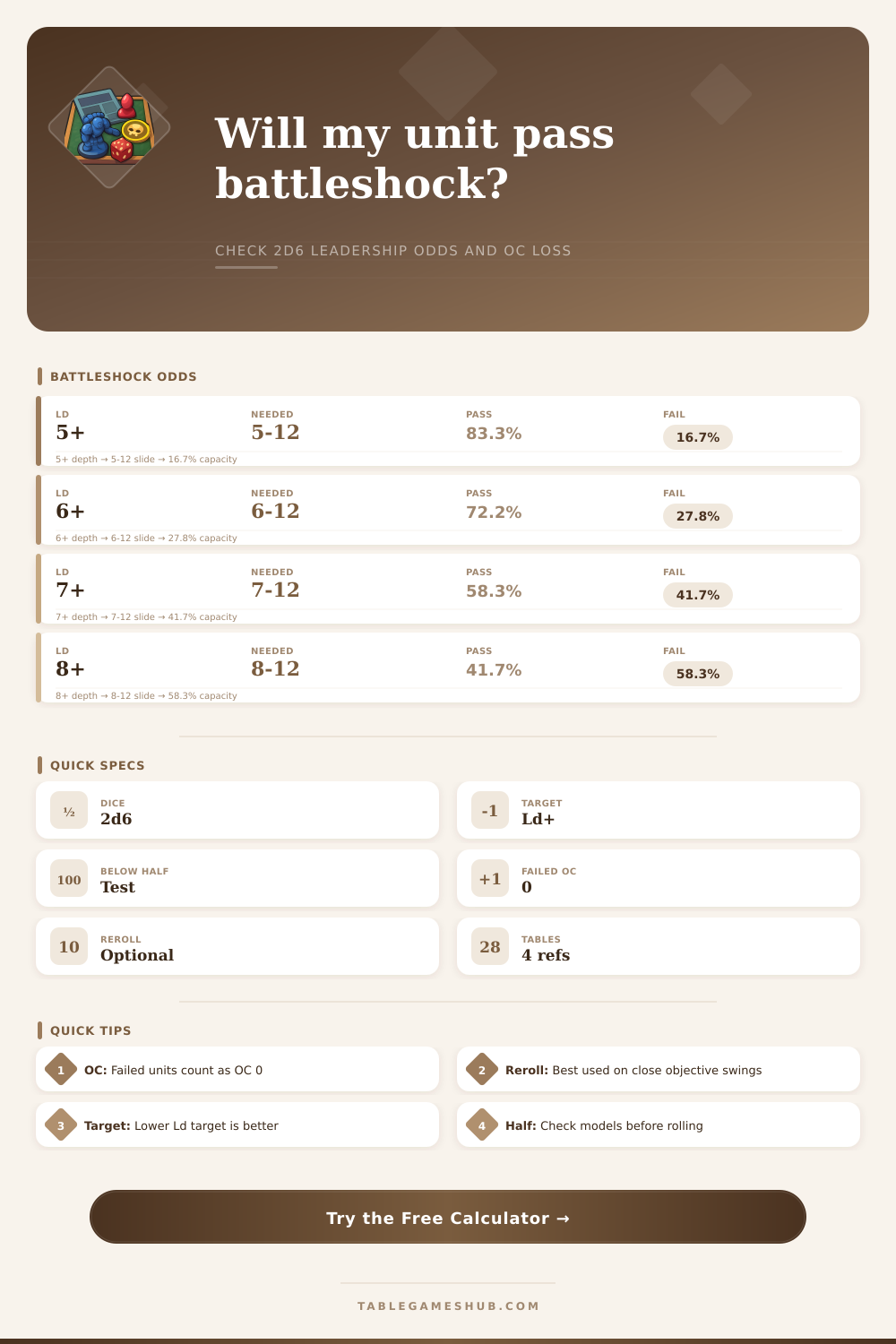
| Leadership target | Needed unmodified totals | No modifier pass chance | No reroll fail chance | With failed-test reroll |
|---|
| Roll modifier | Effective raw roll needed | Pass chance | Fail chance | With reroll pass chance |
|---|
| Outcome | Unit OC | Objective comparison | Control status | Probability |
|---|
| Starting size | Below half at | Example remaining | Trigger note | Common use |
|---|---|---|---|---|
| 1 model | Wound based | Damaged model | Use relevant unit rule check | Vehicle or monster |
| 2 models | 0 models | Destroyed | Two-model units rarely test by model count | Small teams |
| 5 models | 2 or fewer | 2 remaining | Less than half of 5 is 2 | Elite infantry |
| 10 models | 4 or fewer | 4 remaining | Less than half of 10 is 4 | Battleline units |
| 20 models | 9 or fewer | 9 remaining | Large units test after heavy losses | Hordes |
In a game of Warhammer 40,000, a unit may undergoes a leadership test. A leadership test is a game mechanic that determine if a unit becomes battle-shocked. A unit becomes battle-shocked if that unit fails its leadership test.
A battle-shocked unit will experience certain consequence during the game. Therefore, you may have to make a decision as to whether a unit will pass its leadership test or fail its leadership test. A tool that calculate the mathematical odds of a leadership test can help you make such a decision.
How Leadership Tests Work and Why They Matter
You perform a leadership test by rolling two die and adding any applicable modifiers to the result of the two dice. Then you compare the resulting number to the Leadership value of the unit. The leadership test is a complicated process due to various factors, such as the consequences of failing a leadership test.
For example, if a unit loses its Objective Control during a leadership test, the unit may lose control of an objective in the game. Consequently, losing control of an objective may lead to the opponent gain the primary score of the game. Such a calculator will ask for the Leadership target for the unit, any applicable modifiers, whether or not a reroll is available, and the model count for that unit.
The most common situation that triggers a leadership test is if a unit fall below half of its original model count. For instance, if a unit has ten models, the unit will fall to half strength if it is reduced to four models or fewer. However, a five-model unit will fall to half strength if it is reduced to three models or fewer.
Thus, elite units will reach the strength required to trigger a leadership test at a lower model count than horde units. However, horde units will lose more models before they fall to half strength. Furthermore, the presence of certain ability may force a leadership test even if a unit is still at half strength or more.
When an ability forces a unit to undergo a leadership test, the leadership test is no longer conditional on the unit’s strength. Modifiers can add to or subtract from the Leadership value of a unit. A negative modifier will reduce the number of leadership test a unit succeeds on.
A positive modifier will increase the number of leadership tests a unit succeeds on. A reroll for a leadership test provides a second roll in the case that the unit fail its leadership test the first time it is rolled. Rerolls are especially valuable during leadership tests that involve objectives.
If the unit pass its leadership test, it can maintain its Objective Control. If it fails its leadership test, the unit cannot maintain its Objective Control. The calculator will show the value of any modifiers to a leadership test and whether or not using a reroll is worth the cost of using it.
If a unit fails its leadership test, it will have a value of zero for Objective Control. A unit with zero Objective Control is unable to hold an objective in the game. Even if the models of that unit are present on the game board, there Objective Control is 0.
Therefore, if a unit was responsible for providing the Objective Control necessary to maintain an objective, if that unit fails its leadership test, the opponent will gain control of that objective. A leadership test calculator will ask for the Objective Control value of each model in the unit and the total Objective Control of the enemy to calculate whether or not the unit will gain control of an objective after the leadership test. There are many mistake that a player may make when a player decides whether or not a unit will pass its leadership test.
For instance, a player may think that because a unit passed a leadership test during one turn of the game that it will pass another leadership test during a later turn. However, model counts may have changed or other moddern modifiers may be active that can prevent a unit from passing a leadership test. Another common mistake by players is to focus only on the Leadership value of a unit and to not consider the effect of a reroll on the leadership test.
The leadership test calculator will provide information regarding each of these variables, but the player must provide appropriate information about their unit to the calculator to enable it to provide its calculations. The value of the objective that is being contested can help a player to make a decision regarding whether or not to use a reroll for a leadership test. For instance, if failing a leadership test will cause the opponent to gain a primary score in the game, a player will want to use a reroll.
However, if the player has already lost the objective, a reroll may not be necessary. While a leadership test calculator can calculate the probabilities of each outcome of a leadership test, a player must use their own judgment to decide whether or not to use a reroll. If a leadership test fails, it can impact the primary score of the game, which can determine the outcome of the game.
Thus, understanding the probability of a leadership test is a useful skill to have as a player of the game of Warhammer 40,000.