Battle Map Grid Squares Calculator
Plan tabletop battle maps by grid squares, scale, printable sheets, encounter footprint, terrain coverage, and mini base spacing.
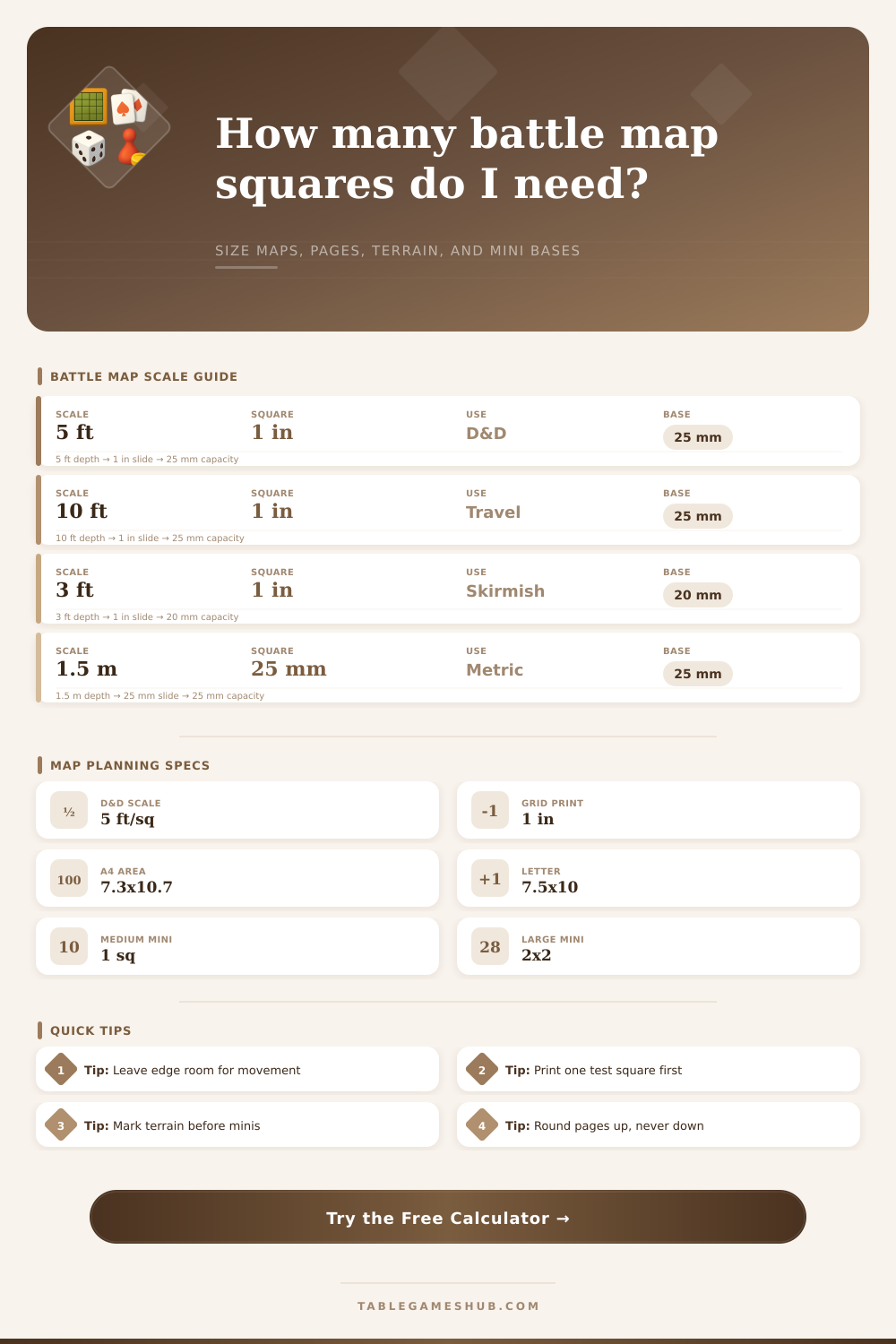
| Grid scale | Physical square | Best for | 30 x 24 map covers |
|---|---|---|---|
| 5 ft per square | 1 in or 25 mm | Standard fantasy combat | 150 x 120 ft |
| 10 ft per square | 1 in or 25 mm | Travel, siege, large rooms | 300 x 240 ft |
| 3 ft per square | 1 in or 25 mm | Tight skirmish movement | 90 x 72 ft |
| 1.5 m per square | 25 mm | Metric tactical maps | 45 x 36 m |
| Paper | Sheet size | With 0.5 in margins | 1 in squares per page |
|---|---|---|---|
| US Letter portrait | 8.5 x 11 in | 7.5 x 10 in | 7 x 10 |
| US Letter landscape | 11 x 8.5 in | 10 x 7.5 in | 10 x 7 |
| A4 portrait | 210 x 297 mm | 7.3 x 10.7 in | 7 x 10 |
| Tabloid | 11 x 17 in | 10 x 16 in | 10 x 16 |
| Coverage | Use case | Effect on minis | Planning note |
|---|---|---|---|
| 10% | Open room or road | High capacity | Mainly scatter pieces |
| 25% | Balanced encounter | Normal movement lanes | Good default |
| 40% | Forest, ruins, cave | Lower base density | More choke points |
| 60% | Dense dungeon clutter | Tight movement | Keep exits readable |
| Creature base | Squares occupied | Typical diameter | Use in capacity math |
|---|---|---|---|
| Small | 1 square or less | 20 mm to 25 mm | 0.75 square footprint |
| Medium | 1 square | 25 mm to 32 mm | 1 square footprint |
| Large | 2 x 2 squares | 50 mm | 4 square footprint |
| Huge | 3 x 3 squares | 75 mm | 9 square footprint |
Print one test square
Before printing a multi-page map, print a single test page and measure the square. A 1 inch grid that prints at 96% will slowly throw off movement and base fit.
Keep lanes open
Terrain coverage is useful, but base capacity drops fast. For busy encounters, reserve roughly 10% to 20% of the grid as open movement lanes around objectives and doors.
Creating a battle map for your game requires you to determine how much physical space you will need for the map. You must determine how much physical space you will need for your game because the amount of physical space that is required for the map can depend on the type of encounter that you are having, the size of the map, and the amount of terrain that you will want to include in your map. If you dont calculate how much physical space you will need for your map, then your game sessions may stall while each of the players must measure the movement of each of the creatures in the encounter or you may find that the creatures are too large for the map itself.
The battle map calculator allow you to calculate the physical space that your map will require. In order to use the calculator, you will need to provide the calculator with the dimensions of your map, the size of each printed square on the map, and the scale of each printed square. The battle map calculator will calculate for you the number of squares that your map will have, the number of feet or meters that each of those squares will cover, and how many printable pages your map will require.
How to Use a Battle Map Calculator
Additionally, the calculator will estimate the number of miniatures of different base sizes that will fit onto the map. The game master can adjust each of these parameters in order to produce a map that is apropiate for the game session that you will be having. Many game groups use a scale of five feet to each square on the map.
This is often the scale that many fantasy game rules use. A five-foot scale is often used for indoor battles between creatures. An alternate scale can also be used, however, if, for instance, the battle take place outdoors, and each square represent ten feet of the environment.
The calculator allows for maps to be printed at different scales without having to redraw the map. Changing the scale for the map will change the amount of physical distance that is represented by the map, but the number of squares for the map will remain the same. Thus, the calculator will allow players to easily compare maps that are printed at different scales.
Another feature for game masters to consider when creating a battle map is the number of printable pages that the map will require. Many game masters may consider that their map will be printed and looked at on the computer screen, but the printed map may sometimes be awkward in how many sheets of paper it prints on. The calculator will allow for game masters to select the size of the print pages, and will print the map and tell the game master the number of sheets of paper that will be required for the map.
Furthermore, the calculator will print the map and indicate if the map could potentially be smaller in size but will print on the same number of pages. The third and final consideration for game masters for battle maps is the amount of terrain that will be included in the map. If the terrain includes twenty-five percent of the map, there will be more open land for the creatures to move on the map.
If, however, forty percent of the map includes terrain, there will be more choke point for the creatures. The calculator will account for the amount of terrain that will be printed in the map, and adjust the number of open squares for miniatures accordingly. Therefore, the terrain percentage can be adjusted prior to drawing the map.
Similar to the percentage of terrain that will be printed on the map is the size of the miniatures for the creatures that will take place within the map. Each medium-sized creature will take up one square on the map, while each large-sized creature will take up four squares on the map. The battle map calculator will account for the size of the miniatures when it calculates the number of miniatures that can fit onto the map.
This calculation will help the game master to determine if each of the creatures will have enough space to move on the map. The reference tables that are printed on the battle map calculator website allow game masters to view the relationship between the scale for the map, the size of the printed squares on the map, and the type of encounter that can occur within the game. These tables allow the game master to make certain that they are using the proper size for the map that they are creating.
For example, a map that is to be used for a skirmish mat will cover less ground than maps that are to be used for travel maps, but the two maps can use the same grid size for the map. However, if each map is of a different scale, the game master should be aware of this differance. Another decision that the game master should make is to print two different versions of the same map.
The game master can create one version of the map as the largest size that the game masters printer can print. The second map can be smaller in size or have less terrain within the map. By printing two different versions of the same map, the game master can compare the two maps and determine which is the best suited to the game that is to be played.
Often, the smaller map will be more playable for the players. The battle map calculator can also be used for adapting adventures that are published but do not include the dimensions of the maps for those adventures. Most published adventures include the dimensions of the rooms in which the players will experience the encounter.
The dimensions are provided in feet. The battles, however, are published without providing the grid maps for those adventures. The battle map calculator can be used to provide the size in squares of the maps of the adventures that are to be published.
Finally, the calculator can be used to print maps that will be used for adventures in which the game master must print the map onto a map mat. Many map mats include dimensions of the map in feet. Therefore, the game master can use the battle map calculator to determine how many squares will be required for the encounter to take place on the map mat.
This will allow the game master to ensure that the encounter cannot take place within a map that is too large to draw on the map mat. It could of been a problem if you didnt use it.