Sheepshead Score Calculator
Settle picker and partner hands, solo calls, leaster rounds, schneider bonuses, no-trick bonuses, doublers, and defender payouts.
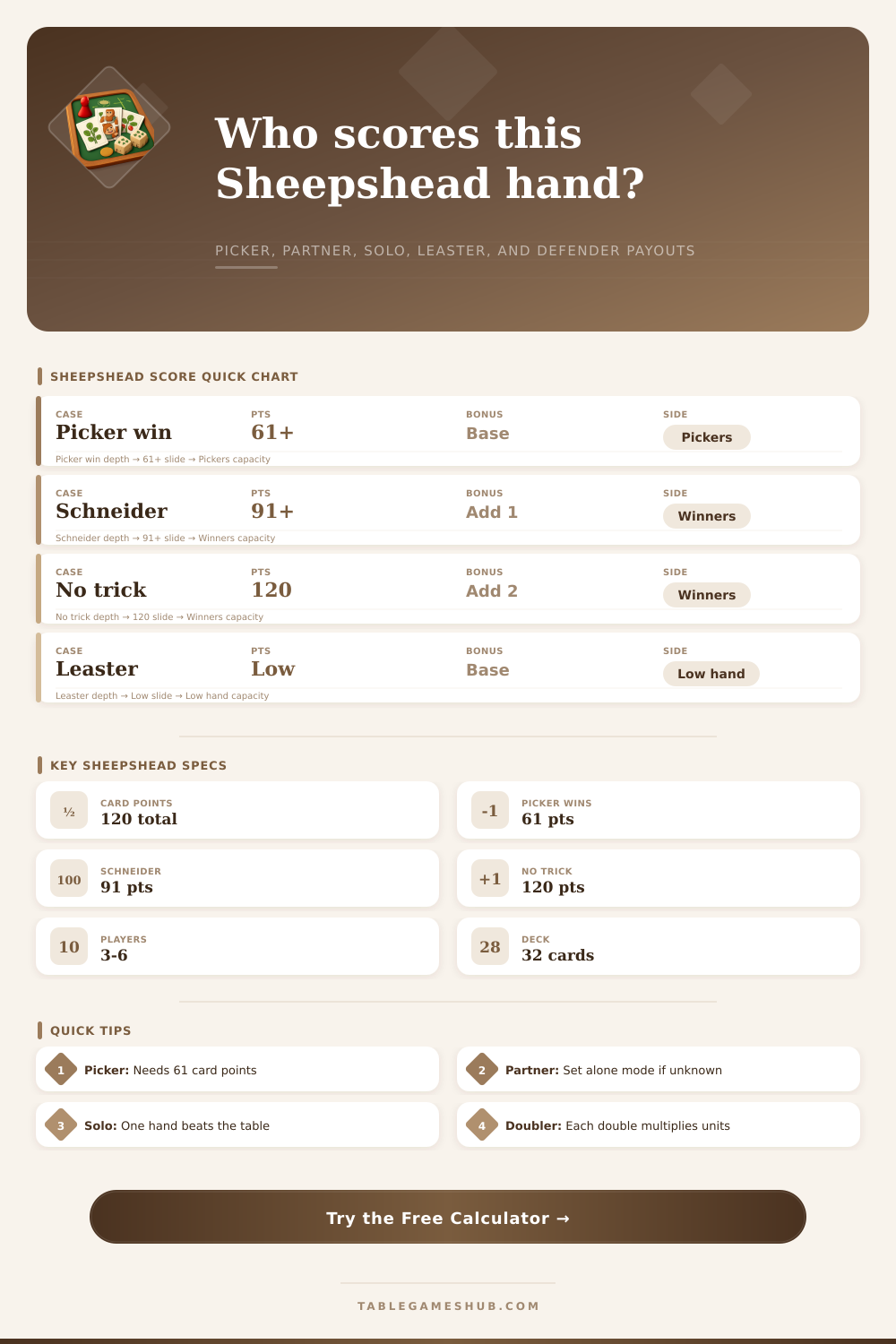
| Hand result | Picker side points | Opposing points | Calculator treatment |
|---|---|---|---|
| Picker or partner win | 61 to 90 | 30 to 59 | Base units go to the picker side. |
| Picker schneider | 91 to 119 | 1 to 29 | Schneider bonus applies if enabled. |
| No trick sweep | 120 | 0 | No-trick bonus applies after schneider handling. |
| Picker set | 0 to 60 | 60 to 120 | Defenders score against the picker side. |
| Players | Partner hand | Solo hand | Each-seat settlement |
|---|---|---|---|
| 3 players | Picker often alone | 1 vs 2 | Winner settles with 2 seats. |
| 4 players | 2 vs 2 if partner is known | 1 vs 3 | Each winner collects from each loser. |
| 5 players | 2 vs 3 standard table | 1 vs 4 | Picker side often settles with 3 defenders. |
| 6 players | 2 vs 4 or house variant | 1 vs 5 | Confirm partner and sit-out customs. |
| Variant | Base units | Schneider | No trick |
|---|---|---|---|
| Simple partner game | 1 | Add 1 | Add 2 |
| Solo premium | 3 or 4 | Add 1 or double | Add 2 or double |
| Leaster | 1 or 2 | Usually off | Usually off |
| Doubled call | Any base | Before multiplier | Before multiplier |
| Preset | Players | Call | Focus |
|---|---|---|---|
| 5-Player Picker Win | 5 | Partner | Basic 61+ picker-side result. |
| Partner Schneider | 5 | Partner | 91+ points with a schneider bonus. |
| No-Trick Sweep | 5 | Partner | 120 to 0 with no-trick scoring. |
| Solo Win Doubled | 5 | Solo | Premium base units with one doubler. |
Sheepshead scoring is an method for calculating the points and the units after a game of sheepshead has been finished. Scoring after games of sheepshead can become difficult for players due to the different ways that players remembers the number of points that each player had during the game. However, accurate scoring of each hand of sheepshead is required for players to settle their debts with one another.
The calculator described in the article use a series of specific inputs to calculate the sheepshead scoring for each game. These specific inputs are the number of players that is participating in the game, the type of sheepshead game that is being played, and the total number of points for each player in the game. The players must fill out each of these fields in order to calculate the sheepshead scoring for that game.
How to Use the Sheepshead Score Calculator
In a game of sheepshead, one player is the picker, and that player is attempting to score at least sixty-one of the one hundred twenty available card points. Each of the remaining players are the defenders of the picker, and they are attempting to keep the total number of card points of the picker to sixty-one or less. If the picker is successful in reaching sixty-one or more card points, the picker is the winner of that game.
However, if the picker does not reach sixty-one or more card points, the defender players are the winners of that game. Additionally, many games of sheepshead include a bonus called the Schneider bonus, which the game awards to either the picker or the defenders when they score at least ninety-one of the available one hundred twenty card points. Additionally, a no-trick bonus is awarded to the players that lose the game if they end the game with zero card points.
Each of these bonuses can be toggled on or off in the calculator, as different groups of players use different rules regarding these bonuses. The mode settings for the calculator change the method of calculating the scoring for games of sheepshead. For instance, if the players select the partner mode for the game, they must select whether they would like to play in the known partner mode or the alone mode.
In the known partner mode, the calculator splits the units between the two offensive player. There are two different models for splitting the units between these offensive players: each-seat and pool. In the each-seat model, each winning player receives units from each losing player.
In the pool model, the defenders is grouped together into a pool, and the calculator divides the total number of units among all of the defenders. The players can select each of these models in the calculator. In addition to calculating the points and units for games of sheepshead, the calculator can also calculate the outcome of leaster games of sheepshead.
In leaster games, the players seek to reach the lowest number of points out of all of the players. In this instance, the calculator compares the card-point total of the players to the total of there rival in the game. As in regular games of sheepshead, Schneider and no-trick bonuses are not awarded in leaster games of sheepshead.
Thus, the calculator calculates leaster games different than the scoring of regular sheepshead games. In this mode, the total of the number of points of each player must be entered into the calculator. The calculator includes fields for the running totals of the games of sheepshead that are played.
These fields allow the players to see if the current picker is beginning to gain an advantage over the defender players, or if the picker is beginning to fall behind from the other players. The calculator automatically updates these running totals after the players hit the calculate button. Thus, players can use these fields to easily monitor their game.
Many of the mistakes that can be made after games of sheepshead occur as a result of the different rules for doublers and bonuses. For instance, some groups of sheepshead players use a rule that rewards the players with a certain number of units with a doubler if they are awarded additional bonuses, while other groups of players award the bonus before applying the number of units that are awarded with the doubler. The bonus toggles and the doubler count field in the calculator can be used to establish the rules for these games.
By setting these rules within the calculator, each player can avoid any debates regarding which rule should of been applied during the game. The number of players in a game of sheepshead can impact the way in which the game is scored. For instance, games that are played with five players will have two players that are the offensive players (the picker and their partner), and the other three players are the defenders.
With four players in a game, however, the number of offensive players and defenders is different. The player count selector allows the players to select the number of players in the game, and the calculator will automatically calculate the number of offensive and defender players. Thus, the players must ensure that they select the correct number of players in the game.
In addition to the calculator that is presented to the players, the article also includes reference tables regarding the sheepshead game. These reference tables include the number of points that are required to trigger Schneider and no-trick bonuses for the players, as well as the number of defenders for the game. Players can use these tables to verify the rules of each player, so that they dont have to memorize the different number of points for these bonuses.
Overall, the calculator will provide the mathematical calculations of sheepshead games for the players. However, it cannot manage the social rules for sheepshead. For example, some groups of players use “mercy” rules to award units to the players that lose a game, while other groups of players do not use these rules for sheepshead games.
Thus, the calculator will calculate the results of the game, but the players must decide with whom they will use these social rules. By keeping a record of the scoring of sheepshead games, the players can observe any patterns in the game. For instance, they can determine whether the player that is the picker in the game is likely to score an advantage or a disadvantage with the opponents.
Additionally, the players can determine if certain partner players are not as profitable as others to include in a team of sheepshead players. Thus, by keeping a running record of the games, the players can gain an understanding of the outcome of the game that is played over a long period of time.