Skittles Pin Spacing Calculator
Scale pin centers, pattern depth, frame footprint, and ball clearance for pub table skittles, hood skittles, alley frames, and garden sets.
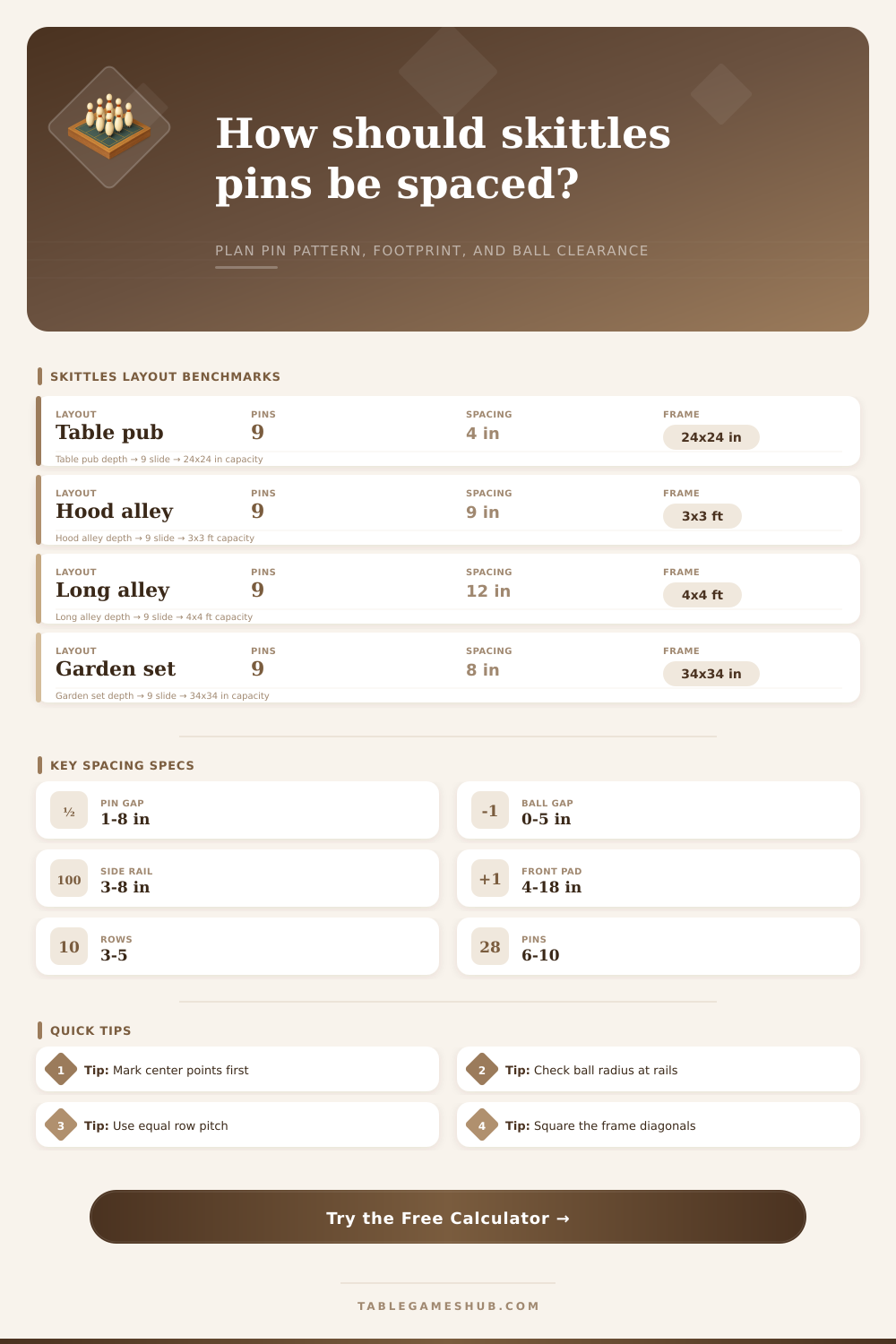
| Preset | Typical use | Pattern | Center spacing | Frame focus |
|---|---|---|---|---|
| Table Pub 9 | Small pub table or home box | 9-pin diamond | 4 in | Tight rail clearance |
| Northants Table | Regional table skittles board | 9-pin diamond | 4.5 in | Square frame balance |
| Hood Alley 9 | Short alley under hood board | 9-pin square | 9 in | Back cushion space |
| Long Alley Rack | Traditional alley pin square | Staggered 9 | 12 in | Large reset area |
| Garden Skittles | Portable lawn or patio set | 9-pin diamond | 8 in | Mat footprint |
| Pattern | Pin count | Rows | Width formula | Depth formula |
|---|---|---|---|---|
| 9-pin diamond | 9 | 1, 2, 3, 2, 1 | 2 x spacing + pin | 4 x row pitch + pin |
| 9-pin square | 9 | 3, 3, 3 | 2 x spacing + pin | 2 x spacing + pin |
| Staggered 9 | 9 | 3 offset rows | 2.5 x spacing + pin | 2 x row pitch + pin |
| 6-pin diamond | 6 | 1, 2, 2, 1 | 1 x spacing + pin | 3 x row pitch + pin |
| 10-pin triangle | 10 | 1, 2, 3, 4 | 3 x spacing + pin | 3 x row pitch + pin |
| Clearance check | Formula | Good target | Watch point |
|---|---|---|---|
| Pin-to-pin open gap | Spacing - pin diameter | Positive and consistent | Too tight causes touching pins |
| Ball through pin gap | Gap - ball diameter | Negative for dense skittles | Positive creates a clean lane |
| Ball to side rail | Side clearance - ball radius | 0.5 in or more | Low value clips rails |
| Rear cushion space | Rear clearance - ball radius | 1 in or more | Low value rebounds sharply |
| Point | X from center | Y from center | Role |
|---|---|---|---|
| Center | 0 in | 0 in | King or middle pin |
| Left row | -4 in | 0 in | Side pin line |
| Right row | 4 in | 0 in | Side pin line |
| Front row | 0 in | -7 in | Approach side |
The correct spacing for a Skittles setup are necesary to determine whether the game will function good or if the game will fail. The pins need to have enough space to stand alone but they should not be so far apart that the ball pass through the pins. If the pins are too close together, then the game is based on luck.
If the pins are too far apart from one another, there will be no character to the game once the ball is thrown. Many people will only discover these issue after they mark the game board with the Skittles pins. Before cutting any wood or placing any tape on the board, you must make calculations regarding the distance between the centers of each pin and the distance between each pin’s base once they is standing.
How to space the pins and ball for Skittles
Additionally, you must calculate the size of the ball that will be used in the game to ensure that it will not clip the pins before it enter the game area. These three measurements is dependent upon each other, as changing the distance between each pin will change the distance between each pin’s base. Additionally, changing the diameter of the ball will change the amount of clearance that is necessary for the ball to remain in contact with a rail.
Many people will begin with choosing the type of Skittles frame that they would like to build. Table skittles boxes are relatively small in size because they are meant to be played on a table that an opponent can reach. Alley frames have deeper space at the back of the frame to allow for the pins to bounce off of the wood.
Garden sets requires extra space to account for the ground not being flat beneath the pins. These three types of frames all influence the amount of clearance that is available for the ball on the sides of the frame. These choices the calculator will make calculations for the player.
The diameter of the pins is an important measurement that many people often overlook. A wider pin will create less clear space between each pin than a pin with a narrower base. The gap between each pin can create the situation where a ball pass through the pins without interacting with any of the pins.
The calculator will use the width of the base of each pin to calculate the measurements for the player. The same is true for the ball, the larger the ball, the more space that is required for that ball to remain in contact with the rail without clipping into the wood of the frame. The angle at which many people will rotate the pattern of pins is another variable that many people will ignore until they have built the frame for the Skittles game.
If the pins are to be laid out in a straight pattern, there will be no rotation of the pins. Should the pins be rotated 45 degrees, it will create a different footprint of the game. While the math for calculating the placement of the pins will be the same, the rotation of the game will change the amount of clearance that is provided to the ball on the sides of the frame.
Many people will make a variety of common mistake when building a Skittle frame. For example, they may treat the pattern of the pins as a fixed object and treat the other measurements as modifiable objects. Each of these three variables is actualy interdependent upon the others.
For example, modifying the distance between the pins will impact the size of the frame. Additionally, modifying the size of the frame will change the amount of clearance that is provided to the ball on the sides of the frame. The calculator can avoid these issues.
Additionally, people often measure from the edge of the pin as opposed to the center of the pin. The tool calculates the distances from the center of the pins because that is how the player will place the pins on the game board. Ball diameter and the size of the frame is also often incorrectly calculated.
The radius of the ball will impact the amount of space between the ball and the rail on the sides of the frame. Additionally, the size of the frame will impact the depth of the pins at the back of the frame to ensure they do not leave the frame when hit by the ball. For example, table skittles boxes can often fail in providing enough margin between the ball and the side of the frame.
The calculator will output a status regarding whether the ball will remain within the frame. For those who use garden sets, the ground is rarely level. To accommodate for this, some people will leave a buffer in the final footprint for the game so that they can adjust the position of the rails based on the results of the initial throws.
The tool will provide for this buffer as a percentage of the inside dimension of the frame. The row pitch will impact the distance between each row of pins. A tight row pitch will allow for fast games between two players but a wide row pitch will allow for the ball to settle into its path of the ball.
The row pitch will also impact the depth of the frame; the deeper the pitch, the more space that is required for the ball’s movement. The depth of the frame impacts the amount of cushion that is required at the back of the pins so that they do not leave the frame. Once the numbers is set, the process of marking the board is relatively easy.
A player should strike a centerline for the pins and mark the first row of pins. After this initial marking, any pins that are created will be marked according to the spacing between each pin. The output of the calculator will reveal the coordinates of each pin to ensure that the game is symmetrical.
A symmetrical game ensures that each pin will be equally placed in relation to the center of the game. An off-center game may create issues for the players when attempting to throw the ball into each pin. The footprint of the game will reveal the size of the frame with the pins and their bases.
A frame that is too large will not fit on any given table. A frame that is too small to allow for the depth of pins that are required will create issues for the players in that frame in creating a satisfying game of Skittles. Each of these dimensions will be visible to the player in the calculations provided by this tool.
The dimensions of the game will help to define the amount of space that each player will need to effectively play Skittles on the prepared board. Additionally, the calculations of the distance between the pins will help to define the character of the game. The spacing between the pins is the most important measurement for the game of Skittles as opposed to the type of wood that is used to create the frame.
A well-proportioned game will reward players with well-thrown balls and will punish those who attempt to throw the ball into the pins with wild throws of the ball. By providing measurements for these various aspect of the game, this tool will ensure that the game plays the way that the players have intended for it to function.