Ring Toss Bottle Spacing Calculator
Plan bottle grids by neck diameter, body width, ring inner diameter, clearance, row offset, tray margin, and layout density.
Use this for the physical bottle layout: how far apart the bottle centers sit, how much room the ring has around each neck, and whether the whole grid fits your board or table area.
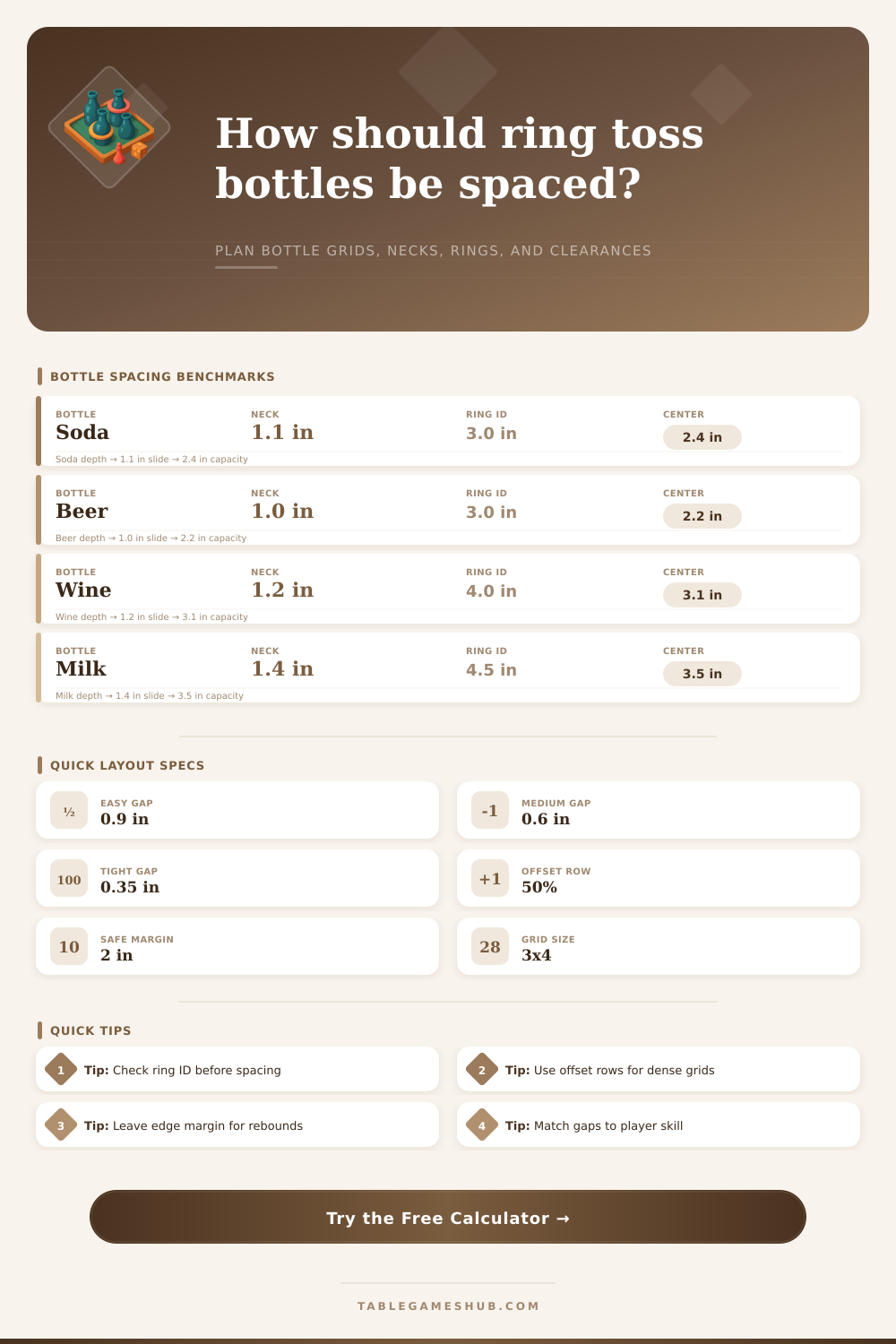
| Bottle type | Neck diameter | Body diameter | Typical ring ID | Starter center spacing |
|---|---|---|---|---|
| 12 oz soda bottle | 1.0-1.1 in | 2.3-2.5 in | 3.0-3.5 in | 2.8-3.2 in |
| Longneck glass bottle | 0.9-1.1 in | 2.3-2.7 in | 3.0-3.5 in | 2.8-3.4 in |
| Milk bottle prop | 1.3-1.5 in | 2.9-3.3 in | 4.0-4.5 in | 3.6-4.2 in |
| Wine bottle | 1.1-1.3 in | 2.9-3.2 in | 4.0-5.0 in | 3.5-4.3 in |
| Mini party bottle | 0.7-0.9 in | 1.5-1.9 in | 2.25-3.0 in | 1.9-2.5 in |
| Grid | Bottles | Best use | Approx board for soda bottles | Layout note |
|---|---|---|---|---|
| 2×4 | 8 | Small tabletop | 14 in x 10 in | Good for short boards and younger players. |
| 3×3 | 9 | Classic square | 13 in x 13 in | Easy to center, balanced from every side. |
| 3×4 | 12 | Carnival lane | 16 in x 13 in | Popular mix of density and visibility. |
| 4×5 | 20 | Large rack | 20 in x 17 in | Works best with staggered offset rows. |
| 5×6 | 30 | Dense arcade | 23 in x 20 in | Use consistent markings to avoid drift. |
| Difficulty | Ring-to-neck clearance | Body gap | Best layout | Player feel |
|---|---|---|---|---|
| Easy | 1.1 in or more | 0.8-1.2 in | Straight grid | More visible open lanes around bottles. |
| Medium | 0.8-1.1 in | 0.5-0.8 in | Square or staggered | Balanced for mixed ages and casual events. |
| Hard | 0.5-0.8 in | 0.25-0.5 in | Staggered | Rings brush neighboring bottles more often. |
| Expert | Under 0.5 in | 0-0.35 in | Dense diamond | Best for controlled rings and fixed racks. |
| Preset | Rows x columns | Bottle style | Ring ID | Primary purpose |
|---|---|---|---|---|
| Carnival 3×4 Soda | 3 x 4 | Plastic soda | 3.0 in | Balanced booth target grid. |
| Beer Bottle 4×5 Rack | 4 x 5 | Longneck glass | 3.0 in | Dense adult party display layout. |
| Kids Milk Bottle 3×3 | 3 x 3 | Wide neck prop | 4.5 in | Large opening practice board. |
| Mini Bottle Party 5×5 | 5 x 5 | Mini bottles | 2.5 in | Compact tabletop target field. |
| Wine Bottle Challenge | 3 x 4 | Wine bottles | 4.25 in | Tall bottle spacing with wider rings. |
Ring toss is a game that require specific setup procedures. The way in which the setup procedure for ring toss are performed will determine the way in which the player will play the game. For instance, the spacing between the bottle must be decided because the spacing between the bottles will change the difficulty of the game.
If there is too much spacing between the bottles, the player’s rings will bounce off an each of the bottles. If the spacing is too small for the rings to land in the bottles, the game may feel empty. The location of each bottle’s center must be decided, as must the amount of room that the ring will need to land within the bottle.
How to Set Up a Ring Toss Game
The diameter of the bottle neck is another important measurement for setting up the ring toss game. The diameter of the neck matter because it is the target of the game. The rings will need to drop over the neck of the bottle, not hit the shoulder of the bottle.
The opening of the ring must be larger than the diameter of the neck of the bottle. This will allow the ring to pass through the neck of the bottle, rather than bouncing off of the bottle. You can use a calculator to determine the relationship between the neck of the bottle and the inner diameter of the ring to make sure that the game will allow the rings to fit each of the bottles.
The diameter of the bottle body will determine the minimum distance that the bottles will be from each other. If the bottles have a large body diameter, their bodies may touch each other if the center of each bottle is placed too close to each other. A gap should be left between each body of the bottle.
A large gap between each bottle body will make the game more easier. A narrow gap between the bodies will create more difficulty for the player. The bottles can be arranged in a variety of different pattern.
Each of these different patterns will change the appearance of the game. For instance, arranging the bottles in straight rows will be easier for the players to mark than staggered rows. However, staggered rows allow for more bottles to fit in a smaller area.
Additionally, diamonds will create visual line in the game but will require more careful measuring of each bottle center. Each pattern will create each bottle in a different density and visibility so that the player of all skill levels can enjoy the game. In creating the game, the margin of the board must be considered.
If the player’s rings miss any of the bottles, the rings may bounce off of the edge of the board. If the bottles are too close to the edge of the board, the rings will leave the board and the game will lose some of its energy. Therefore, a margin must be left around the outer bottles in order to allow for the missed bottles to bounce.
Different type of bottles have different constraints. For instance, soda bottles have narrow neck and bodies. Therefore, beginners is best played by using the game with smaller rings.
Wine bottles are taller and have a wider opening than soda bottles. Additionally, they are heavier and require more skill for tossing. Milk bottle props have the widest neck and therefore have the most impact on the inner diameter of the ring required and the distance between the centers of each bottle.
The inner diameter of the ring should be measured to the neck of the bottle prior to marking any bottles. The difficulty for the game can be adjusted by changing the number of gaps between the bottles. Games that use wide clearances around each neck and a wide gap between each bottle will be easy to play.
Games that use less clearance and gaps will be of medium difficulty. Finally, games that use very little gap between each bottle will be the most difficult but may be secured so that the bottles will not fall over. When creating the game, some people might focus on just one of the measurements.
For instance, a person may create a wide gap between each bottle but not allow the rings to fall into the bottles due to narrow neck. Another person might use a large ring so that it will fall into the bottles, but the neck of the bottle is narrow. Each of these instances show the importance of making sure that the people understands all of the measurements of the game prior to finalizing the positions of each bottle.
Another thing that should of been ensured prior to playing the game is that the bottles are well placed. If the diameter of each bottle is measured, then the bottles are placed, the rows of bottles may drift from there measured positions. A method of verifying the measurements would be placing a ring on the board so that it is flat on two necks of bottles to verify the gap between each bottle.
Ring toss is a game of simple motion. Each bottle will not move once placed. Each ring will follow a set path to its destination.
The only variable for the game will be the distances between the bottles. Therefore, if the distances are set up correctly, the game will have both challenge and fairness in the game. Additionally, the layout of the bottles will have an impact on the quality of the game for the players.