Domino Topple Time Calculator
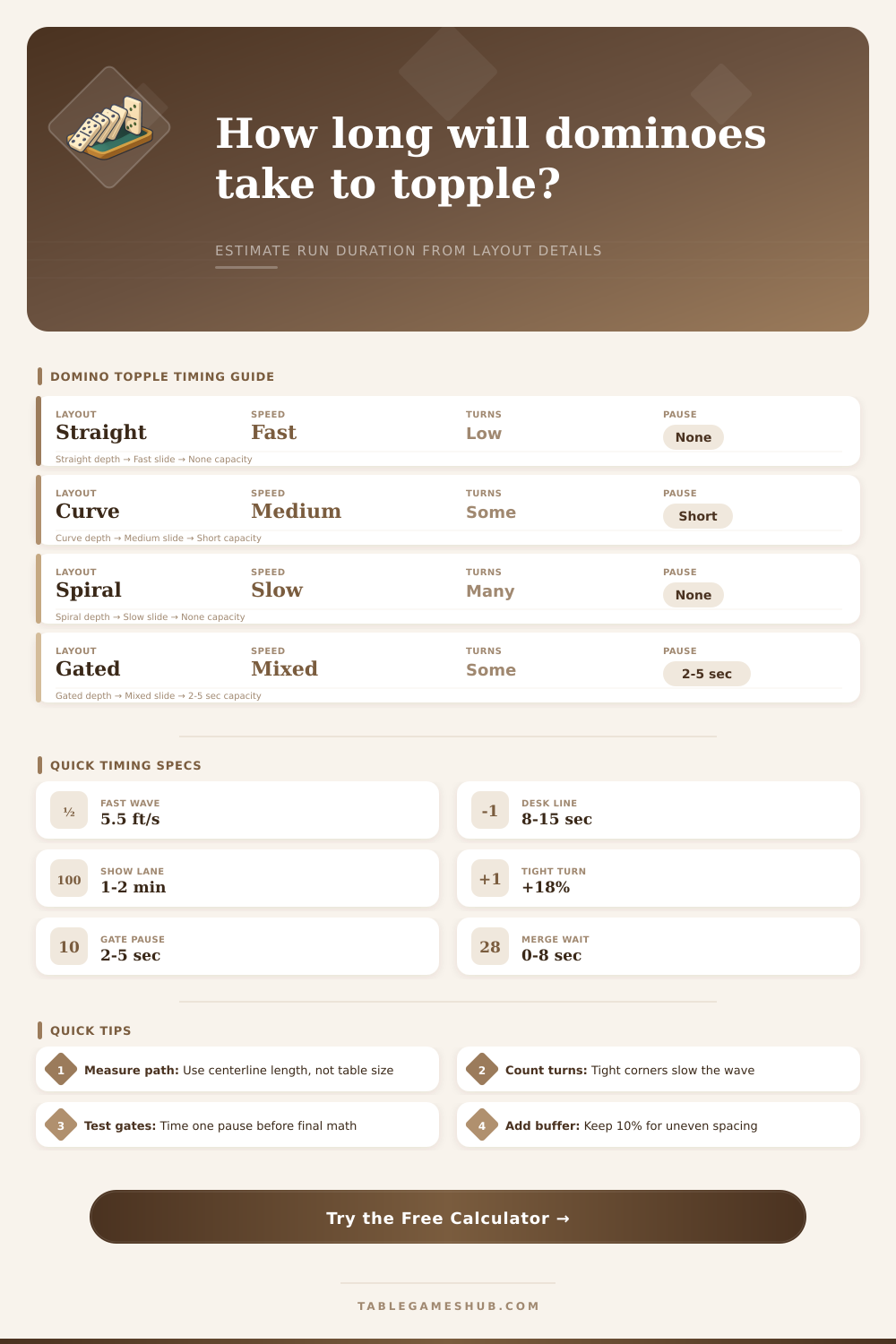
Estimate the visible run duration for a domino layout using wave travel, measured path length, turn slowdowns, gate pauses, and lane merge waits.
| Step | Formula Element | Purpose | Notes |
|---|---|---|---|
| Travel wave | Path length / adjusted speed | Base topple duration | Uses measured centerline, not table footprint |
| Turn penalty | Base time x turn factor | Slows corners and spirals | Applied separately from gate delays |
| Gate pauses | Gate count x pause seconds | Adds timed reveals | Useful for levers, drops, ramps, and beat pauses |
| Lane sync | Extra lanes x merge wait | Accounts for branches | Only added when parallel paths rejoin |
| Final buffer | Subtotal x buffer percent | Allows setup variation | Not a speed estimate; it is duration planning |
| Layout Type | Speed Modifier | Turn Penalty | Best Use |
|---|---|---|---|
| Straight / gentle line | 1.00x | 0.6% per turn | Race timing, classroom demonstrations |
| Curved path | 0.94x | 1.2% per turn | Arcs, initials, small room layouts |
| Tight spiral | 0.82x | 2.0% per turn | Centerpieces and compact displays |
| Gated sequence | 0.92x | 1.0% per turn | Timed reveals with intentional pauses |
| Branch and merge | 0.90x | 1.4% per turn | Parallel lanes, splits, and synchronized finishes |
| Riser cascade | 0.78x | 1.8% per turn | Books, ramps, and stair-style drops |
| Scenario | Path | Dominoes | Timing Notes |
|---|---|---|---|
| Desk Straight Line | 10 ft | 75 | Fast test strip with no gates |
| Classroom Curve Run | 28 ft | 210 | Several gentle bends across tables |
| Tabletop Spiral Centerpiece | 18 ft | 190 | Slower wave due to tight radius |
| Trigger Gate Demonstration | 34 ft | 260 | Two gate pauses dominate the duration |
| Double Lane Merge | 42 ft | 320 | Branch sync wait added at the merge |
| Club Finale Layout | 140 ft | 1250 | Long path with multiple reveals |
| Spacing Style | Typical Gap | Wave Effect | Use When |
|---|---|---|---|
| Close display spacing | 1.0-1.3 in | Usually stable, slightly slower | Small tables and curves |
| Standard plastic dominoes | 1.4-1.8 in | Balanced speed and reliability | Most home and club layouts |
| Wide theatrical spacing | 1.9-2.4 in | Faster until misses appear | Long straight visual runs |
| Oversized blocks | 2.5-4.0 in | Needs measured test speed | Outdoor or stage props |
A domino run is a project in which one person set up a series of dominoes so that when one falls, it trigger the next to fall. Domino runs can travel quick across a room, or they can travel slow due to the layout of the run. Each of these element of a domino run has a relationship with the speed at which the topple wave travels across the domino piece.
The topple wave created by dominoes set up in a straight line will travel at a set rate. Most plastic domino set have a topple wave that travels at a rate of between three and six feet per second. The rate at which the dominoes are spaced from each other, the friction of the surface upon which they are placed, and the weight of each domino create the speed of the topple wave.
How to Measure and Time a Domino Run
To find the exact speed of the topple wave for a given set of dominoes, one can perform a test strip measurement of twenty of the dominoes. The speed of the topple wave will be the rate at which the test strip of twenty dominoes fall on the given surface. With the speed of the topple wave calculated, the individual can calculate the impact of other element on the domino run.
Curves in a domino run can slow the topple wave. Curves in a domino run will create a delay in the topple wave; gentle curves will create a minimal delay, but tight curves will create a longer delay due to the increased number of change in the direction of the falling dominoes. Each of these changes in the falling direction will create a small delay for the domino run.
A calculator allow the individual to account for these delays by entering the length of the path to be traveled, the number of turns along the path, and the sharpness of those turns. The calculator will account for each turn in the path and display the additional time that each turn will take to travel the distance. Gates in a domino run are create as a means of adding a delay to the domino run.
Gates are created as mechanism or ramps that hold the dominoes in place. These gates will create delays in the domino run that are different than the delays created by the curves in the path. The calculator accounts for the pauses created by these gates by allowing the individual to enter the number of gates along the path and the length of each of those pauses.
For instance, a two-second pause created by a gate along a thirty foot domino run will have a different impact on the total time of the run than the same length of pause along a hundred foot run. By entering these variable into the calculator, the individual can determine the impact that each gate will have on the total time of the domino run. Branching path in a domino run can also create delay within that domino run.
Each of the separate path to the same destination will create delays at the point of which each path reaches the same destination; the first group of falling dominoes will have to wait for the other to arrive at the same point in the path. An input within the calculator allow the individual to account for the time it will take for each path to arrive at the same destination. Some domino run builder create their domino runs so that each path arrives at the same time at the merge point in the path.
Others may create each additional path as a way of adding a delay to the run. The calculator help to show the difference in time between each of these design. Another element of a domino run is the spacing of the individual domino piece.
The spacing of the dominoes will impact the rate at which the topple wave move along the path of the dominoes. If the spacing is too tight, the topple wave may move slow along the path. However, tight spacing create more reliability of the topple wave along curves.
Wide spacing of the dominoes will allow for the topple wave to travel faster along the path, but if the spacing is too wide, the topple wave may halt along the path. The spacing of the dominoes can be checked in the calculator by entering the spacing between each domino and the total number of dominoes along the path. Additionally, the spacing between each domino will impact the number of gaps in the path; if the spacing is different along the path, or if the total number of dominoes is incorrect, the domino run may halt somewhere along its path.
A buffer percentage for a domino run allow for the addition of time to the total time for the domino run. This time allow for any small variation in the travel of the topple wave to be accounted for. For instance, if the domino run is on a clean surface, a small buffer for time may be all that is necessary.
However, if the pieces are on a mixed surface that may impact the way in which the dominoes fall, more time may be necessary to account for those impact. Thus, the buffer to the total time account for elements like temperature shift along the path, or any domino that is place incorrectly along the path. Many of the element mentioned can be combined within a domino run to create a complex layout.
For example, one could create a layout that has a straight path of the dominoes, curves around piece of furniture in the room, and a gate at the end of the path. The calculator allow for each of these element to be combined; there is no requirement for the individual to use only element within a single category. The individual can enter the length of the path, the number of turn along the path, any gate along the path, and any merge in the path to view how each of those element will impact the total time for the domino run.
Additionally, the output for the calculation help to the individual to determine in what ways the time for the domino run could be adjusted. Many individual will learn of the timing of their completed domino run by actually constructing the domino run and testing it after it is constructed. However, it is far easier to construct large domino run layout if the individual understands each of the element of the design of a successful domino run.
For instance, if the individual understand the rate at which the topple wave will travel, the individual can determine if a gate along the path is too long, or if it is dramatic enough to have an intended impact upon the spectator of the domino run. Furthermore, if the individual is aware of the time that it will take for the separate branch of the domino run to arrive at the same destination, the individual can be certain that the design of the branches is correct; they can avoid having to calculate the time by which each branch will arrive at the merge point in the path. The single most useful habit for individuals that wish to build a successful domino run is to measure a test strip of twenty dominoes along the surface in which they plan to construct the run.
By measuring the speed of the topple wave created by these twenty dominoes, the individual can use the calculator to determine the total time for the entire domino run. Furthermore, any planning that is done prior to construction of the actual domino run will determine whether the speed created by the dominoes is the speed that the individual intend to create for the spectator of the domino run.