🧩 Domino Number Needed Calculator
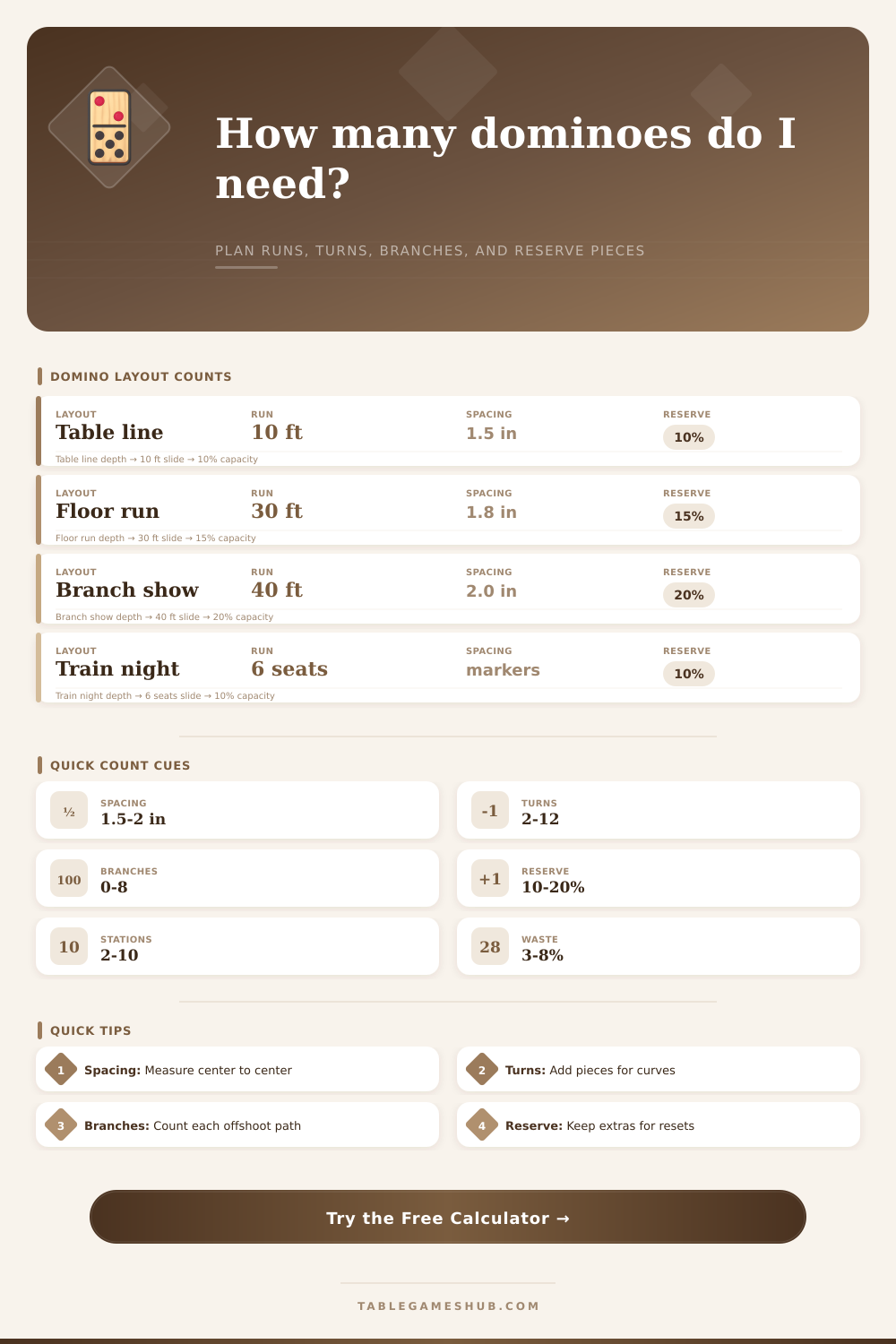
Estimate domino inventory for straight runs, branching layouts, train tables, turns, reset waste, and reserve pieces.
| Layout Type | Typical Spacing | Turn Allowance | Reserve Range |
|---|---|---|---|
| Tabletop line | 1.3 to 1.7 in | 1 per turn | 5% to 10% |
| Floor chain | 1.6 to 2.1 in | 2 per turn | 10% to 15% |
| Branching display | 1.5 to 2.0 in | 3 per turn | 15% to 25% |
| Train table | marker based | hub pieces | 5% to 15% |
| Spacing | Pieces Per Foot | Pieces Per Meter | Use Case |
|---|---|---|---|
| 1.2 in | 10.0 | 32.8 | Tight tabletop |
| 1.5 in | 8.0 | 26.2 | Controlled run |
| 1.8 in | 6.7 | 21.9 | Floor setup |
| 2.2 in | 5.5 | 17.9 | Large display |
| Set Type | Tile Count | Common Players | Planning Note |
|---|---|---|---|
| Double-six | 28 | 2 to 4 | Small games |
| Double-nine | 55 | 2 to 6 | Mid table |
| Double-twelve | 91 | 2 to 8 | Train games |
| Bulk pieces | 100 plus | display | Toppling runs |
| Feature | Count Method | Extra Pieces | Why It Matters |
|---|---|---|---|
| Main run | length / spacing | rounded up | Base inventory |
| Branches | branch paths | 2 per hub | Offshoot starts |
| Turns | turn count | 1 to 4 each | Curve control |
| Stations | markers | chosen amount | Starts or gates |
Tip 1: Measure the centerline
For curved layouts, measure the path the domino centers will follow, then add turn pieces for curve control.
Tip 2: Separate waste from reserve
Waste covers setup losses, while reserve is the untouched extra stack you keep for repairs and extensions.
When planning a domino layout, a person must consider the total number of dominoes that is required to complete that layout. Although a person might have an idea of the length of the layout, a person must also account for any turns, branch, or junctions that are to be included in the layout. If these elements are not accounted for in the planning stage, it is likely that a person will run out of dominoes before the layout are complete.
The spacing between the dominoes in a layout is another primary element that determine the total number of dominoes that will be used in the layout. If the spacing between dominoes is relatively tight, then more dominoes can be placed within a specific distance. Thus, using tight spacing will increase the total number of dominoes that is used in completing the layout.
How Many Dominoes Do You Need for a Layout
Using wide spacing will require fewer dominoes to complete the same distance, but may reduce the stability of the dominoes. A person must choose a type of spacing for the domino layout based off the type of surface on which the person will establish the layout. Curves or turns in a domino layout require more dominoes than straight lines.
In order to curve or turn, a series of dominoes are required to form that turn or curve. More tightly spiraled curves require more dominoes than wide curves. Additionally, each turn will require additional dominoes to form those turns in the layout.
Branches will also require additional dominoes to create the junctions for the branches to emerge from the main layout of dominoes. Although the stations and markers are not part of the main layout of dominoes, they still use the same inventory of dominoes as the main layout. Thus, if a person plans for stations or markers, those dominoes need to be accounted for in the initial count of the total number of dominoes that will be used.
If a person does not account for these in the initial count, they may find that they have used all of their dominoes for the stations and markers prior to beginning the main layout. Another factor to consider when calculating the total number of dominoes to purchase is the need for waste and reserve. Waste is used for knocked over dominoes or for rejecting some of the dominoes that are used in the initial building of the layout.
Reserve is used for additional dominoes that may be needed for any repairs to the layout or for extending the length of the layout. These are different variables because waste is used during the building of the layout, but the reserve is for after the building of the layout is complete. Both of these elements should be included in the initial calculation to ensure that there are enough dominoes to complete the layout and any repairs.
Another factor that can impact the number of extra dominoes that are needed is the type of surface that is to be used for the layout. If the person is to establish the layout on a tabletop, then fewer reserve dominoes are needed. However, if the person is to establish the layout on the floor, more reserve dominoes are needed due to the fact that the floor may be uneven.
Additionally, if the layout is to be created on the floor and to travel around furniture pieces, even more reserve and waste dominoes is needed. In planning a domino layout, it is essential for a person to understand how each of the variables impact the total number of dominoes that are needed for the layout. For instance, if the spacing between the dominoes is increased, the total number of dominoes needed will decrease.
Additionally, if there are more branches to the layout, the number of dominoes needed will increase due to the number of junctions needed for those branches. If the person is to shorten the length of the main layout of dominoes, the number of stations and the turns that will be used will take up a larger portion of the total inventory of dominoes. A common mistake when planning a domino layout is to calculate the length of the straight line that is to be created and to add a percentage to that length to account for the remaining components of the layout.
However, the turns, branches and stations will require more dominoes than this calculation indicates. This percentage-based calculation does not account for the number of turns in the layout. Each turn will require additional dominoes to form the turn.
Another decision that a person must make after determining the total number of dominoes that are needed for the layout is the purchase of those dominoes. Standard sets of dominoes are often purchased for those who wish to create smaller layouts of dominoes. However, bulk packs of dominoes are often purchased for those who plan to create long layouts of dominoes.
Based on the total number of dominoes that is calculated, it may also be necesary to purchase an additional pack of dominoes. Finally, in planning for a domino layout, the goal should not be to ensure that there are zero dominoes left over at the end of the layout. Domino layouts are physical systems, and all physical systems are subject to shifts.
Therefore, it is best to always establish a reserve of dominoes that can be used to even the most challenging shifts within the layout. Youll find that even with a moddern plan, a person should of accounted for teh extra pieces. A person cant be sure without extra.
If the layouts size is too big, you might not recieve enough. It is alot of work to make sure your planning is correct. It is important to check the layoutts stability too.
If the floor isnt flat, the layout will fail. It makes sense more then anything else.