Egg Drop Terminal Velocity Calculator
Estimate terminal velocity, finite-height impact speed, stopping load, and safety margin for egg drop parachutes, capsules, cones, and bare-egg tests.
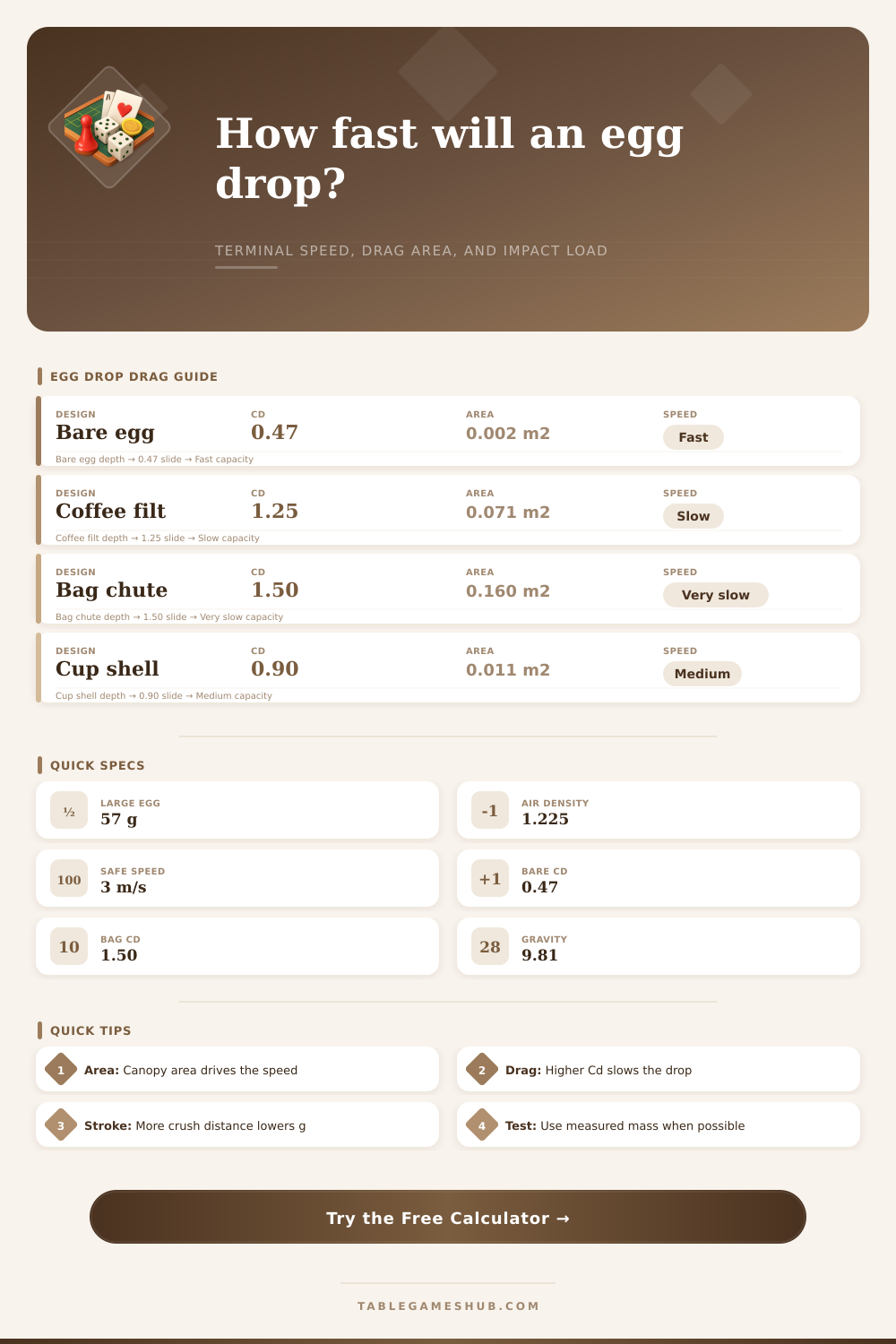
The calculator uses quadratic drag: terminal velocity equals the square root of 2mg divided by air density, drag coefficient, and projected area. For a real drop height, it also computes the lower impact speed reached before terminal velocity.
| Egg reference | Mass used | Typical diameter | Calculator use |
|---|---|---|---|
| Quail egg small test | 9 g | 2.5 cm | Low-mass mini drop and quick canopy tests |
| Medium chicken egg | 50 g | 4.2 cm | Smaller classroom egg baseline |
| Large chicken egg | 57 g | 4.4 cm | Default egg drop challenge reference |
| Extra large chicken egg | 64 g | 4.6 cm | Heavier load with similar projected area |
| Jumbo chicken egg | 71 g | 4.8 cm | Stress test for weak cushioning |
| Duck egg classroom proxy | 80 g | 5.2 cm | Large-mass design comparison |
| Design shape | Cd range | Area behavior | Best use in calculator |
|---|---|---|---|
| Bare egg or smooth capsule | 0.45 to 0.60 | Small oval frontal area | Fast baseline impact estimate |
| Egg carton pocket | 0.70 to 0.95 | Blunt, irregular face | Modest drag with short stopping stroke |
| Foam cup shell | 0.80 to 1.05 | Broad cup rim if stable | Capsule with crush distance |
| Coffee filter canopy | 1.10 to 1.35 | Round concave canopy | Low mass, moderate parachute area |
| Tissue parachute | 1.20 to 1.55 | Wrinkled canopy, variable spill | Soft, slower descent estimate |
| Plastic bag parachute | 1.35 to 1.75 | Large spread canopy | Slowest common classroom design |
| Drop height | No-drag speed | Good parachute speed | Design note |
|---|---|---|---|
| 1 m table test | 4.4 m/s | Often not terminal | Short tests mostly check cushioning |
| 3 m balcony test | 7.7 m/s | Partial drag effect | Canopies start to separate designs |
| 6 m stairwell test | 10.8 m/s | Near canopy speed | Drag area becomes more important |
| 10 m classroom roof | 14.0 m/s | Often near terminal | Use finite-height impact speed |
| 15 m high drop | 17.2 m/s | Terminal likely | Safety factor matters more |
No-drag speed is square root of 2gh, included only as a comparison against the quadratic-drag model used by the calculator.
| Component setup | Typical span | Stopping stroke | Physics effect |
|---|---|---|---|
| Bare egg only | 4 to 5 cm | 0.2 to 0.5 cm | High speed and very high g load |
| Bubble wrap capsule | 8 to 12 cm | 2 to 5 cm | More stopping distance than drag |
| Straw tetrahedron | 12 to 18 cm | 3 to 8 cm | Frame crush can reduce peak load |
| Coffee filter canopy | 18 to 25 cm | 2 to 4 cm | Large drag area with low added mass |
| Plastic bag parachute | 35 to 55 cm | 2 to 6 cm | Very low terminal speed if stable |
The egg drop challenge involve the concept of air resistance. When an egg is dropped, the egg accelerate towards the ground, and then it hits the floor with a force. The force of that impact can be too much for the eggshell to take, and hence, the egg will crack.
In order to avoid this from occurring to the egg, it is necessary to both reduce the speed at which the egg falls, as well as to increase the distance that it travels while it comes to a halt upon reaching the floor. Air resistance is a force that works against falling objects. The smoother the egg, the less area that the air can push against the falling egg.
How to Protect an Egg in the Egg Drop Challenge
Conversely, if a canopy of some sort is added to the package that contain the egg, then the surface area against which the air can act upon the falling object will increase. The speed at which an object falls is referred to as its terminal velocity. However, the terminal velocity of an object is not a constant value; instead, it can change based off the mass of the falling object, the shape of the falling object, and the amount of air resistance that the object experience.
Thus, altering any of these variables will alter the terminal velocity of the falling object. One of the best methods of increasing the air resistance that an object experiences as it falls is to increase the size of the canopy that is used to contain the egg. Using items like plastic bags or coffee filters as the canopy will enable the object to distribute itself in a way that increases the air resistance that it encounter.
Additionally, shapes like straw tetrahedron or paper cones will also create air resistance without adding additional mass to the falling object. A calculator can help to determine the final falling speed of the package by entering the mass of the falling object, the span of the canopy, and the drag coefficient of the object. Beyond the speed at which the falling object reaches the floor, another important consideration is the stopping distance of the falling object.
For instance, if the falling object lands directly on the floor, then the stopping distance is short. A short stopping distance result in a high force that the egg experiences. Therefore, using items like bubble wrap, foam cups, or straw frames will increase the stopping distance of the falling object.
These items will allow for a “crush zone” for the falling object. The force will be distributed over a period of a few extra centimeter, which will reduce the force that is experienced by the egg. Thus, a parachute that is slightly faster in its falling speed but incorporates good cushioning may be the best design compared to a slow falling parachute that lands directly on a hard platform.
In the real world, the conditions will often not be the same as in the perfectly-controlled test conditions. For instance, wind may act upon the falling object, the ground may not be even, and the object may contain flaws in its construction. Because of the potential of these variables, people often introduce a safety margin into their calculations.
A safety margin accounts for differences between the calm test and the messy competition, as well as for accounting for any small error that may occur when measuring the size of the canopy or the weight of the falling object. Mass is one factor that impacts the speed at which a falling object will travel. The egg is the starting mass of the falling object.
However, if protective systems are added to the egg, then the mass of the falling object will increase. An increase in the mass of the falling object will increase its terminal velocity (unless the area that is exposed to the air is also increased). Thus, designs that are the lightest in weight will often be the most successful at protecting the egg.
The shape of the falling object also have an impact upon the drag coefficient of that object. One advantage of utilizing a round canopy is that the round shape will allow for even distribution of the forces that are created during the fall of the package. Shapes that are not round may cause the air to “rock” or spill off of one side of the falling object.
The area factor input allow for adjustment of this factor in the calculator. The height from which the falling object is dropped will also have an impact upon the force of air resistance. For instance, if the object is dropped from a low height, the object may not reach its terminal velocity prior to hitting the floor.
However, if the object is dropped from a height of a high roof, the falling object will reach its terminal velocity. Thus, the height of the drop will impact the speed at which the falling object reaches the floor; the higher the drop, the closer the speed will be to its terminal velocity. Many people will make mistake when completing this challenge.
For instance, many people will incorrectly measure the dimensions of the package. Some will use the diameter of the egg instead of the canopy. Others will use the drag coefficient for a sphere rather than the drag coefficient of a concave surface.
Additionally, some may not account for the stopping distance of a hard floor as compared to a soft surface like grass or carpet. In order to avoid these mistakes, you can use the reference tables to ensure the accuracy of the inputs into the calculator. The most reliable way to succeed in the egg drop challenge is to use the calculator to measure the variables of the falling object, and then to make adjustments to each variable until the falling object successfully reaches a distance and force that the egg can safely endure.
Thus, the calculator can be used both to determine current variables of the falling object, as well as to provide feedback regarding whether adjustments to those variables will result in the successful protection of the egg. Therefore, through iterative adjustments, the falling object will eventually reach a falling speed and load upon the egg that the egg can survive. Overall, the egg drop challenge involve the study of the relationship between speed, surface area, and stopping distance.
The calculator allow individuals to study each of these variables in relation to each other.