Warhammer Statistics Calculator
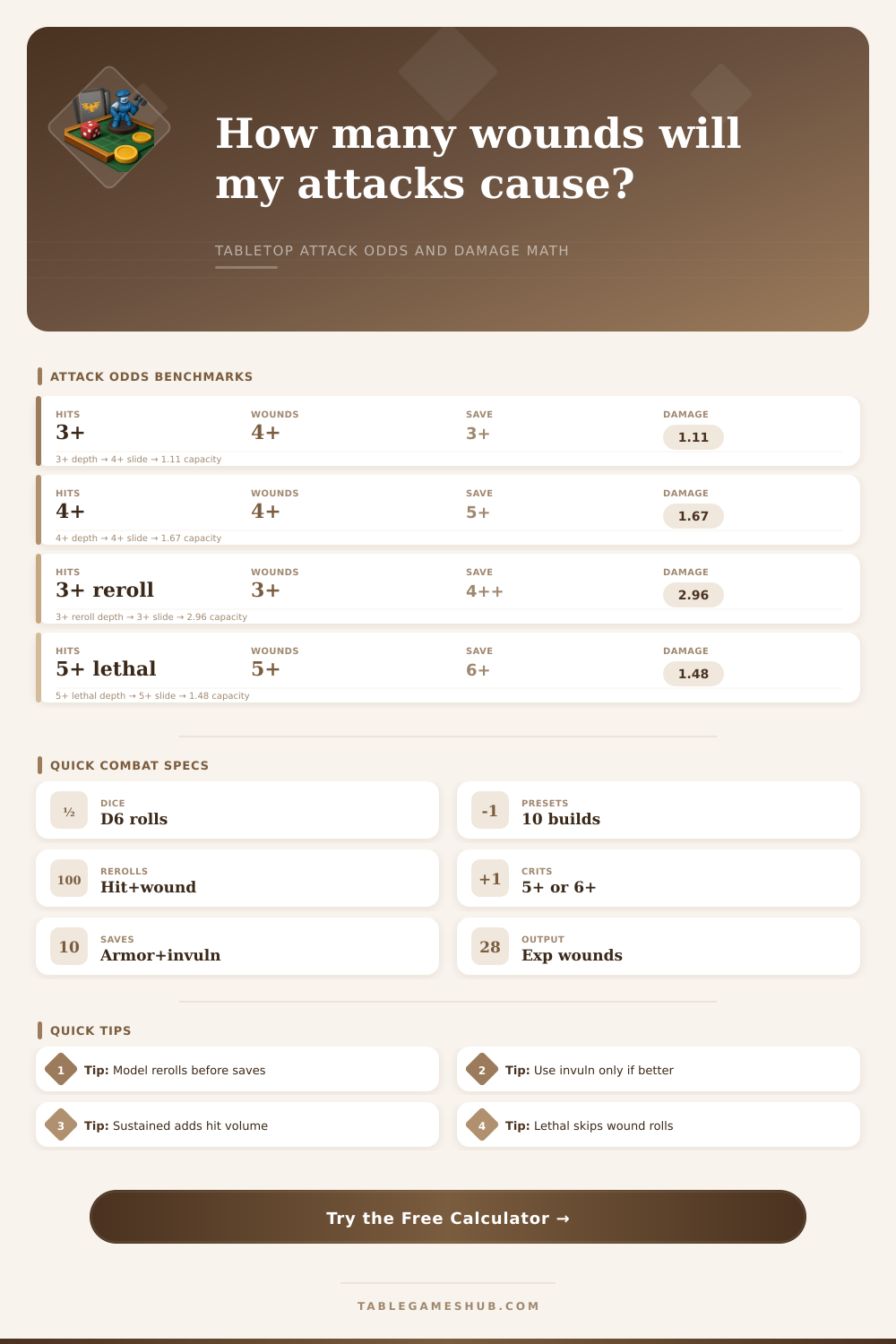
Estimate attack sequence odds for tabletop miniatures: attacks, hit rolls, wound rolls, armor saves, invulnerable saves, rerolls, sustained-style hits, lethal-style hits, and expected unsaved wounds.
| D6 Roll Needed | Base Success Chance | With Reroll 1s | With Failed Reroll | Common Use |
|---|---|---|---|---|
| 2+ | 83.3% | 97.2% | 97.2% | Elite hit or wound roll |
| 3+ | 66.7% | 77.8% | 88.9% | Reliable profile baseline |
| 4+ | 50.0% | 58.3% | 75.0% | Average attack sequence |
| 5+ | 33.3% | 38.9% | 55.6% | Hard wound or poor hit roll |
| 6+ | 16.7% | 19.4% | 30.6% | Desperate or extreme roll |
| Modifier Type | Where It Applies | Calculator Input | Expected Value Effect | Sequence Note |
|---|---|---|---|---|
| Hit reroll | Before wound rolls | Hit reroll rule | Increases final hits and crits | Critical fishing can lower normal hit stability |
| Wound reroll | After hit pool is known | Wound reroll rule | Increases wound conversion | Lethal-style auto-wounds skip this roll |
| Sustained-style hits | On critical hits | Extra hits per crit | Adds more wound rolls | Extra hits are treated as normal hits |
| Lethal-style hits | On critical hits | Auto-wound option | Bypasses wound roll | Defender still rolls saves as normal |
| Save Situation | Armor Save | AP Modifier | Invulnerable Save | Effective Save Used |
|---|---|---|---|---|
| Light AP into armor | 3+ | 1 worse | None | 4+ armor save |
| High AP into shielded target | 3+ | 3 worse | 4++ | 4++ invulnerable save |
| Cover offsets AP | 4+ | 1 worse | None | 4+ with cover improvement |
| No save remains | 6+ | 2 worse | None | No successful save |
| Damage Profile | Average Damage | Best For | Reduction Interaction | Calculator Handling |
|---|---|---|---|---|
| Fixed 1 | 1.0 | Volume fire | Can be heavily reduced | Uses the fixed input value |
| D3 | 2.0 | Medium damage weapons | Subtracts after average | Uses average D3 result |
| D6 | 3.5 | Swingy heavy damage | Reduction lowers mean output | Uses average D6 result |
| D3 + 3 | 5.0 | Reliable heavy damage | Retains stronger floor | Adds flat bonus to die average |
When you play a tabletop game that involve the use of dice, you must make decision about how to attack the enemy units. You can use a variety of strategy, such as using many low-quality attack, or using fewer high-quality attacks. Because the outcomes of the dice rolls are inherentally unpredictable, you must focus on the expected value of the attacks that you make.
By calculating the expected value of your attack, you can determine whether a given strategy for attacking the enemy is sound or likely to fail. When combat begin between two armies, there are a variety of steps that are perform during the combat round. The rules for the game can modify each of these step.
Plan Dice Attacks with Averages
For instance, the first step is an hit roll, during which each attacker rolls a die to determine if their attack hit their target enemy unit. Following the hit roll is the wound roll, during which the attacking player roll again to determine if their attack does the required amount of damage to the enemy unit. Some rules allows for the attacker to reroll a failed roll, which increase the consistency of their attacks.
Additionally, some unit have special ability, such as the ability to deal sustained hit or lethal hit. Sustained hit increase the number of dice that must be rolled to attack the enemy unit. Lethal hit allow the attacker to skip the wound roll stage of attack.
Lethal hit are especially useful against enemy units with high toughness value, since they allow the attacker to avoid the wound roll stage that might be difficult to beat. The defending player can also use a variety of method to prevent damage from being applied to their units. The most common method is the use of armor save to avoid taking damage from attacks.
Armor penetration make it more difficult for the armor saves to succeed. Armor penetration is useful in creating anti-tank unit, since armor penetration will reduce the effectiveness of the armor saves of enemy units with armor. An invulnerable save is different than an armor save in that it does not take into account armor penetration.
An invulnerable save is a limit to the amount of damage that can be taken by an enemy unit. This save is effective regardless of the armor penetration of the weapon that is being use against the enemy unit. In calculating the effective save that the enemy unit will use, one must calculate the best possible save that is provide to that enemy unit.
One aspect of the game are damage profiles. Damage profile affect how much damage is taken by each unit. Fixed damage result in the same amount of damage each time.
Therefore, it is reliable in removing model that have a low number of wounds. Variable damage, such as rolling a six-sided die, is not predictable. Instead of rolling the die, a damage calculator can calculate the average result of the variable damage that is deal by each attack.
If the expected damage is less than the number of wounds of an enemy model, then more unit must commit to the battle to ensure that the model is removed from the battlefield. Rerolls are one of the factor in determining the reliability of the army that is fighting. For instance, the ability to reroll a wound roll will increase the reliability of the army.
Being able to perform both hit and wound roll rerolls will provide consistency in the attacks of that army. Consistency in attacks allow for the army to take risks in battle. Thus, the goal of the players is to find the most efficient means of removing enemy model from the battlefield.
There are a variety of strategy to achieving this goal, whether by using a high volume of attacks to remove enemy unit, or using fewer attacks with high damage values. Regardless of the strategy that the player chooses, the mathematical principle are the same. Thus, if players understand the expected output of their strategy, they can move away from guess work to determine the outcomes of their attacks and begin to play the odds.