Kite Size Calculator
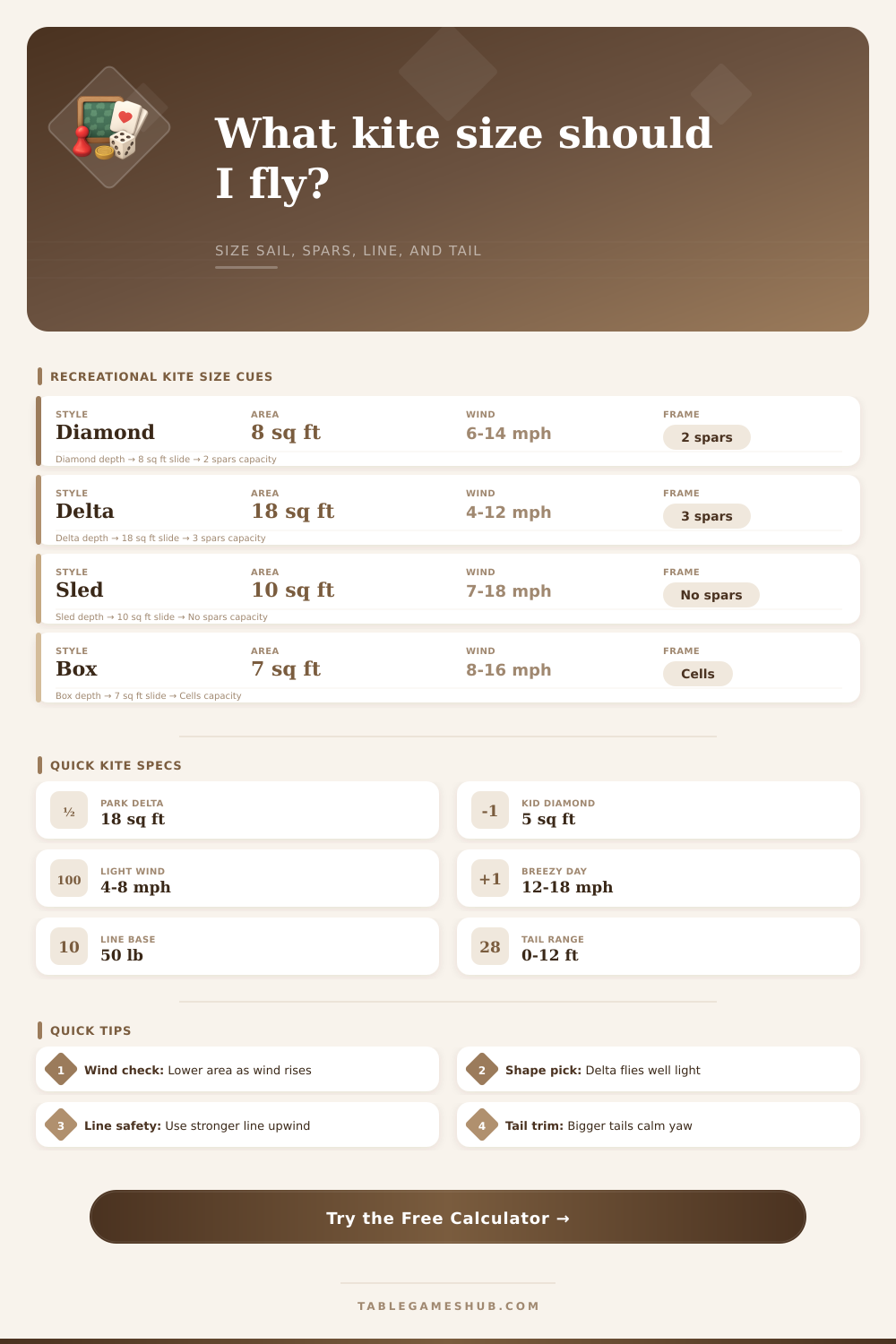
Estimate recreational kite sail area, span, spine length, spar size, flying line, and tail trim from wind, kite style, and flyer comfort.
| Wind band | Speed range | Best recreational kites | Sizing note |
|---|---|---|---|
| Very light air | 3-5 mph / 5-8 km/h | Large delta, light parafoil | Use wide span and light spars |
| Light breeze | 6-9 mph / 10-14 km/h | Delta, diamond, rokkaku | Comfortable beginner range |
| Moderate breeze | 10-14 mph / 16-23 km/h | Diamond, sled, box, stunt | Reduce area for children |
| Fresh breeze | 15-20 mph / 24-32 km/h | Pocket sled, small parafoil | Use small sail and stronger line |
| Strong recreation limit | 21-25 mph / 34-40 km/h | Small vented or rugged kites | Skip large framed kites |
| Kite style | Typical area | Span to height cue | Frame cue |
|---|---|---|---|
| Diamond | 4-12 sq ft | Span about 80% of height | Spine plus cross spar |
| Delta | 10-28 sq ft | Span wider than height | Spine plus two leading edges |
| Sled | 4-18 sq ft | Balanced rectangle-like sail | Usually no rigid frame |
| Rokkaku | 8-30 sq ft | Tall hexagon | Spine and two bowed spars |
| Box / cellular | 5-16 sq ft projected | Depth adds stability | Longerons and spreaders |
| Two-line stunt | 6-16 sq ft | Wide triangular planform | Stiffer leading edges |
| Frame material | Useful diameter range | Strength behavior | Best use |
|---|---|---|---|
| Bamboo / wood dowel | 3/16-3/8 in / 5-10 mm | Flexible, heavier, easy to repair | Diamond and simple rokkaku kites |
| Fiberglass rod | 4-8 mm | Durable bend before break | Beginner deltas and park kites |
| Carbon tube | 4-10 mm | Stiff and light, less forgiving | Large light-wind kites and stunt frames |
| Soft foil / sled | No spar | Load carried by seams and bridle | Travel kites and stronger winds |
| Estimated pull | Suggested line rating | Flyer feel | Practical note |
|---|---|---|---|
| 1-3 lb / 0.5-1.4 kg | 20-30 lb line | Child-friendly | Small diamond or pocket kite |
| 4-8 lb / 1.8-3.6 kg | 50 lb line | Easy adult park flying | Common family delta range |
| 9-15 lb / 4.1-6.8 kg | 80-100 lb line | Firm pull | Use gloves and open space |
| 16-25 lb / 7.3-11.3 kg | 150 lb line | Strong recreational pull | Best with an experienced adult |
| 26+ lb / 11.8+ kg | 200 lb+ line | Display-level handling | Downsize for normal recreation |
Flying a kite require a balance between the energy of the wind and the physical control of the kite owner. The balance between wind energy and physical control is what allow the kite to remain stable in the air. If the size of the kite is too large for the strength of the breeze, the kite will flutter and dive.
If the size of the kite is too large for the strength of the wind, the pull of the kite will become an safety hazard for the kite owner due to the strong pull of the kite. Using a calculator will allow the kite owner to determine the size of the sail that will best suit the prevailing wind speed so that the owner can control the kite. The wind is often not consistenly so that the wind does not always maintain the same speed.
How to Keep a Kite Stable
Even the strongest winds has an average speed. However, kites react to the peak speeds of the wind. As such, the kite owner must account the wind speed to a stability margin.
A stability margin is used as an additional safety measure in case of sudden gust of wind. If a child is using a kite, more allowance should of been made in the stability margin so that the child does not feel the effect of sudden gusts. An adult may be able to handle a smaller stability margin.
The shape of the kite will determine the way in which the kite interact with the air. For instance, a delta kite has wide wings such that it can efficient utilize the air to remain in the air. Such a delta kite can remain in the air even when the wind increase to the point where a box kite would fall to the ground.
A box kite is stable in strong winds due to its structure. However, if a box kite is too large or too strong, it can create stability in the wind yet the kite will be to heavy to remain in the air. The shape of the kite can be used to determine the coefficient of lift of the kite.
The coefficient of lift is the measure of the grip that the kite have for the air. The frame of the kite consist of the spars and the spine of the kite. Each of these component can be made out of different materials and each of these materials will impact the performance of the kite.
For instance, the materials can be made out of bamboo, fiberglass or carbon fiber. Carbon fiber is a very light material yet it is also a very stiff material. Carbon fiber is a good choice for kites that has to remain light yet strong yet it can be brittle.
Fiberglass is a middle ground material for both strength and flexibility because fiberglass include a bend that will prevent the kite from snapping due to too much pressure. However, if the span of the kite is too wide relative to the strength of the material for which the kite is made, the frame will fold. The kite line is the component of the kite that link the kite to the owner.
The line should be made of a material that has a higher breaking point than the pull of the kite. If the pull of the kite is more than the rating of the line, the line will break. The breakage of the line will result in the loss of control of the kite.
Therefore, the line should be rated to be significantly higher then the pull of the kite due to the possibility of strong gust of wind. A kite tail is not just an optional decoration for kites yet it is a functional component for the kite. The tail can add drag to the bottom of the kite which force the nose of the kite to remain pointed upwards.
Should the kite begin to spin or dive, you can add a longer kite tail to the kite to resolve that problem. A longer kite tail will damp the oscillations of the kite so that the kite can move in a more stably manner. However, if the tail is too large, it may add too much weight to the kite which will prevent the kite from being able rise in light breeze.