Archery Draw Length Calculator
Blend body geometry, anchor feel, and bow style to land on a draw length band that feels calm at full draw and stays repeatable.
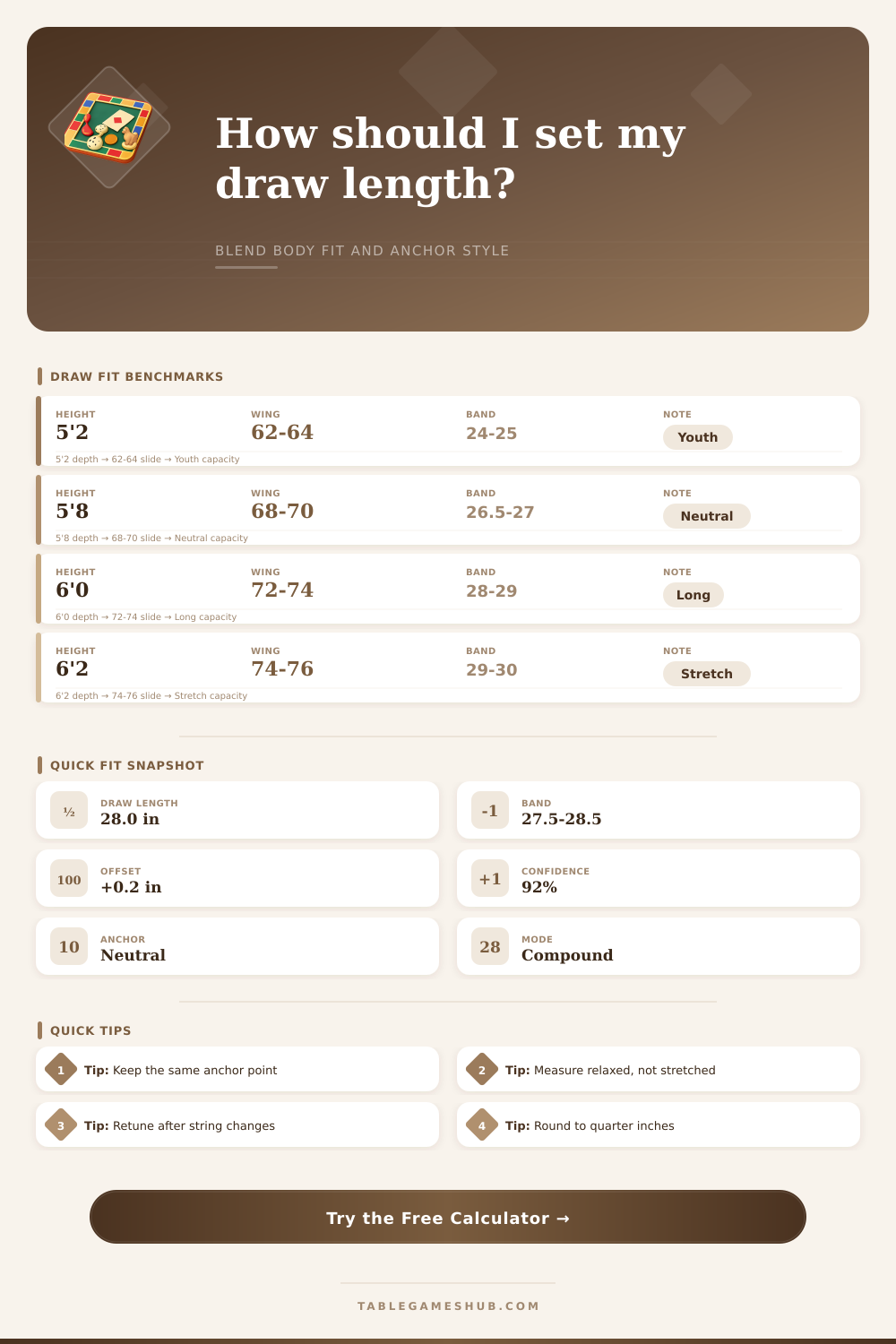
| Height Range | Wing Span | Typical Draw | Notes |
|---|---|---|---|
| 5 ft 0 to 5 ft 4 | 61 to 65 in | 24.0 to 25.5 | Youth fit |
| 5 ft 5 to 5 ft 8 | 66 to 69 in | 26.0 to 27.0 | Compact fit |
| 5 ft 9 to 6 ft 0 | 70 to 72 in | 27.5 to 28.5 | Neutral fit |
| 6 ft 1 and up | 73 in plus | 29.0 to 30.5 | Long reach |
| Bow Style | Baseline Bias | Anchor Cue | Use |
|---|---|---|---|
| Compound | +0.15 in | Stable wall | Peep driven |
| Recurve | -0.10 in | Clean blur | Finger anchor |
| Barebow | -0.05 in | Quiet face | Gap control |
| Longbow | -0.20 in | Natural stack | String picture |
| Release Style | Shift | Feel | Check |
|---|---|---|---|
| Fingers | +0.10 in | Open | Consistent wrap |
| Thumb | +0.05 in | Compact | Jaw touch |
| Mechanical | -0.08 in | Locked | Wrist line |
| Glove | 0.00 in | Natural | Finger roll |
| Anchor Preference | Shift | Length Band | Best For |
|---|---|---|---|
| Close | -0.10 in | Shorter | Compact face |
| Neutral | 0.00 in | Center band | Balanced fit |
| Extended | +0.12 in | Longer | Long anchor |
| Floating | +0.08 in | Soft band | Field tuning |
Draw length are the distance from the nock groove of the arrow to the pivot point of the persons grip. Draw length is important in that draw length impact how the body should align with a bow. If the draw length is too short for the individual, they will feel cramped with tension developing in there shoulders.
Using a draw length that is too long will create difficulties for the bow shooter to be overextended with maintaining proper shooting stability. Thus, it is necesary for the bow shooter to find the correct draw length for their body in order to consistently shoot arrows with the same motion. The best way to calculate the baseline draw length for an individual is to use their wingspan divide by 2.5.
How to find your draw length
An individuals wingspan is the distance from one fingertip to the opposite fingertip when holding their arms out to each side. For example, if an individual have a 70 inch wingspan, their baseline draw length would be 28 inches. This baseline draw length is based off only one physical measurement of the body of an individual.
Other measurements that provide additional detail about the individual include height and wrist to floor distance. Height is one of the most basic measurement of the body frame of an individual. With height measurements, an individual can determine if their frame is more small or larger relative to others.
Wrist to floor distance is another physical measurement that provide detail for calculating draw length. With this measurement, an individual can understand where their hands drop in relation to their stance. This measurement should be taken with the palms flat to the individuals sides with their arms loosely.
These two measurements is important in that they provide detail about the individuals body frame that can be used along with other measurements to determine draw length accurate. The draw length that an individual will use also impacts the type of bow that the individual will use. For compound bows, an individual may have a longer draw length because compound bows has cams that provide an even wall for the individual to pull the bowstring against.
For recurve bows, an individual will have a more precise draw length because the bows require the bowstring to be close to the bow shooters face. Thus, the type of bow that an individual will use will impact the draw length they use. An individuals anchor point and release method can also impact the draw length that they use for their bows.
For individuals using a finger release for their bows, their draw length may have to be longer to allow for even tensioning of the bowstring with their fingers. For individuals using a mechanical thumb release, their draw length can be shorter. An individuals anchor point is where their bowstring will touch on their face.
Depending on where an individuals anchor point is relative to their face, the individual should adjust their draw length to accommodate for this. There are some mistake that some individuals make when trying to determine their draw length. One of the most common mistakes is when an individual extends their wingspan by flattening their arms out to each side with their fingers pointing straight out from their body.
An individual cant use their wingspan as a baseline draw length because of this mistake. Another mistake is to attempt to use the same draw length as there friend. Every individual has a unique wrist drop and physical posture.
An individual can also make a mistake in thinking that changing the string that is used on their bow dont impact their draw length. An individual can test their draw length by using the range. By filming themselves from the side while shooting arrows, an individual can determine if their draw length cause their shoulders to hike or their elbows to flare out at their side.
An individuals draw length may not feel correct while shooting arrows; in this case, the individual should of run the measurement again while in the same stance and with the same physical posture. When standing and shooting arrows, an individual should aim for their anchor point to remain in the same place with every shot. Depending on where the anchor point moves or floats relative to their intended position, the individual can adjust the draw length by a small amount, such as a quarter inch.
This adjustment can then be tested at the range when the individual video themselves to determine if the draw length needs to be adjusted again.