Archery Pin Gap Calculator
Map sight spacing by distance, speed, and anchor so your pin ladder stays clean.
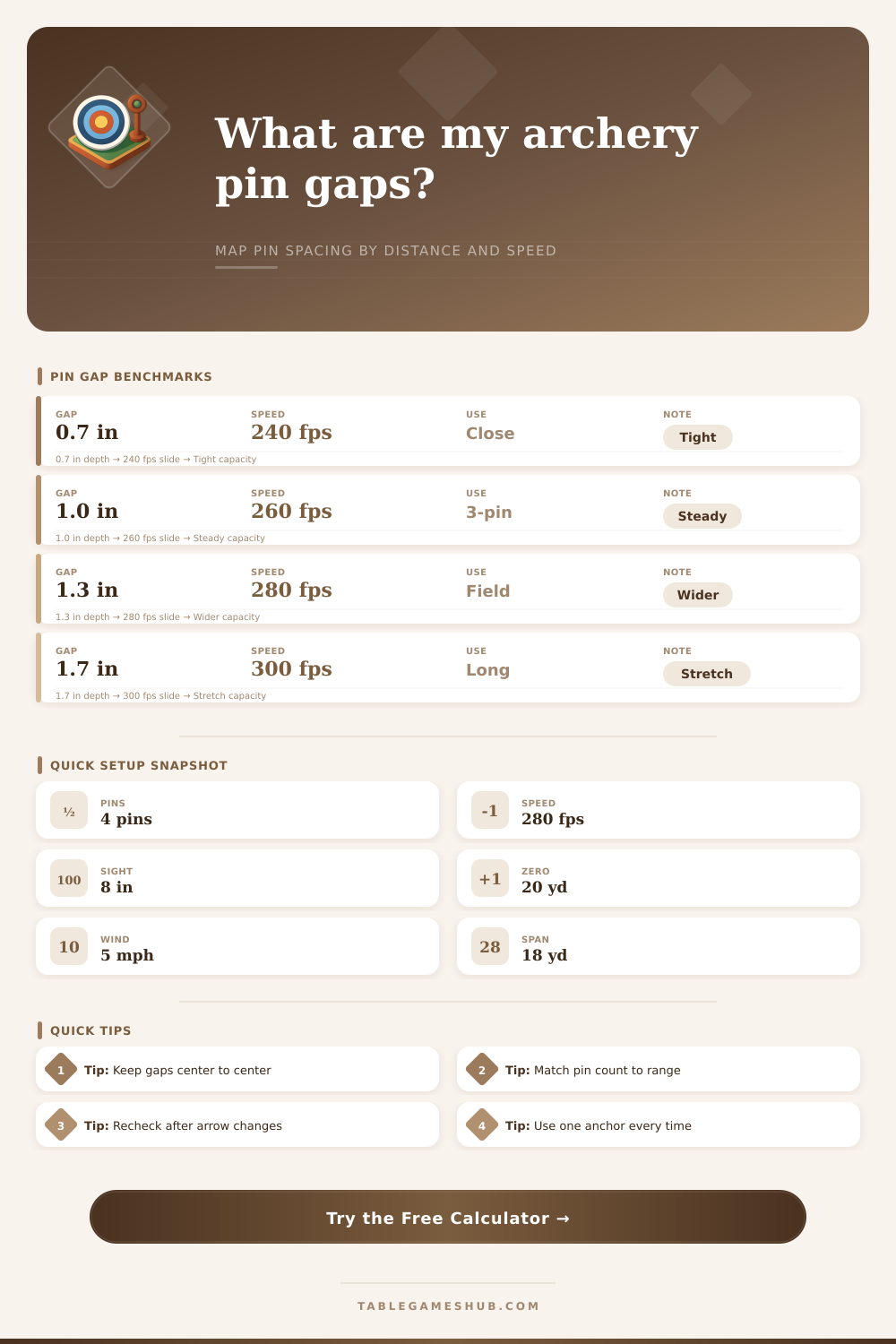
| Gap | Speed | Use | Note |
|---|---|---|---|
| 0.7 in | 240 fps | Close | Tight |
| 1.0 in | 260 fps | 3-pin | Steady |
| 1.3 in | 280 fps | Field | Wider |
| 1.7 in | 300 fps | Long | Stretch |
| Range | Mark | Style | Fit |
|---|---|---|---|
| 20-30 yd | 0.9 in | 3-pin | Short |
| 30-40 yd | 1.1 in | 3-pin | Mid |
| 40-50 yd | 1.3 in | 4-pin | Field |
| 50-60 yd | 1.6 in | 4-pin | Long |
| Bow | Speed | Gap | Feel |
|---|---|---|---|
| Compound | Fast | Tighter | Sharp |
| Recurve | Mid | Medium | Clean |
| Longbow | Slow | Wider | Smooth |
| Crossbow | Very fast | Compact | Flat |
| Arrow | Move | Gap | Use |
|---|---|---|---|
| Heavy shaft | Slower | Smaller | Stable |
| Light shaft | Faster | Wider | Flat |
| Stiff spine | Clean | Normal | Tuned |
| Soft spine | Drift | Looser | Loose |
Measure center-to-center spacing before you finalize a sight tape.
Changing anchor point shifts your sight marks faster than speed changes.
Pin spacing are the distance between the individual marks on an archery sight. Pin spacing is a critical factor to consider when purchasing an archery sight, as the distance between the pins has to match the arrow trajectory. Arrows travel in an arc due to gravity.
As such, the distance between the pins cannot be equal. Arrows that travel at a faster rate will have a flatter arc then arrows that travel at a slower rate. As such, faster arrows will require pins that is closer together, especially at longer distances.
How to Measure and Set Pin Spacing
Slower arrows will require pins that is more further apart. Many people will try to guess at the proper pin spacing for there arrows. However, guessing at the correct pin spacing will result in inaccurate distance between the pins.
Pin spacing for arrows isnt linear. The drop in the arrows is much more greater at longer distances. For instance, the distance between pins at 20 yards may be small, but the distance between pins at 40 yards will be much larger.
Additionally, the sight radius will also impact the pin spacing. A longer sight radius will result in pins that are closer together. The different type of bows will require different pin spacings.
For instance, compound bow will travel at a faster rate than other bows. As such, compound bows will require pins that are closer together. Recurve bows and long bows will travel at a slower rate.
As such, they will require wider pin spacings. Crossbows will travel at a very fast rate, so they will also require pins that is very close together. Additionally, the arrow mass will also impact pin spacing.
Heavy arrows will travel at a slower rate than light arrows. Therefore, heavy arrows will require pins that are further apart. Light arrows will require pins that are closer together.
Finally, wind can also impact how pins should be space. The arrow may drift with the wind, which will change the way distance between pins appear to the archer. To determine if the pin spacing between pins on an archery sight is correct, you can measure the gaps between the pins.
If the gaps between pins are too small, there may be difficulty in being able to clearly see the pins. If the gaps between pins are too large, the archer may find it difficult to aim at maximum yardage. For archery target sights, pins should be spaced so that the average gap between pins is less than 0.8 inch.
For hunting situations, pins may be spaced so that the average gap between pins is more than 1.3 inches. The taper of the pins should also be checked. The tapering of pins refers to the width of the pins’ gaps increasing with distance between the pins.
Another factor to consider with pin spacing is the anchor point of the archers arrow. The anchor point should remain the same for all distances. If the archer change there anchor point, it will change the angle of the bow.
This will result in the archer seeing the wrong pin spacing. Therefore, the archer must maintain a consistent hand placement to maintain the accuracy of the calculation used to create proper pin spacing. Finally, you can perform field test to determine the proper pin spacing.
By tuning the bow to the zero distance of the arrow, the archer can test the bow at the maximum yardage that the archer will shoot at. During this process, the archer should adjust each pin one at a time. The distance from the center of one pin to the center of the next pin should be measured.
These measurements can be written down to create a sight tape. The sight tape will help to show the archer which pins to use at what distances. Additionally, the sight tape will be most accurate and effective if the distances on the sight tape match the actual distance between the pins on the archery sight.