Mini Golf Score Calculator for Course Nights
Track adjusted score, par gap, one-putt control, and round pace for family loops, glow nights, and adventure layouts.
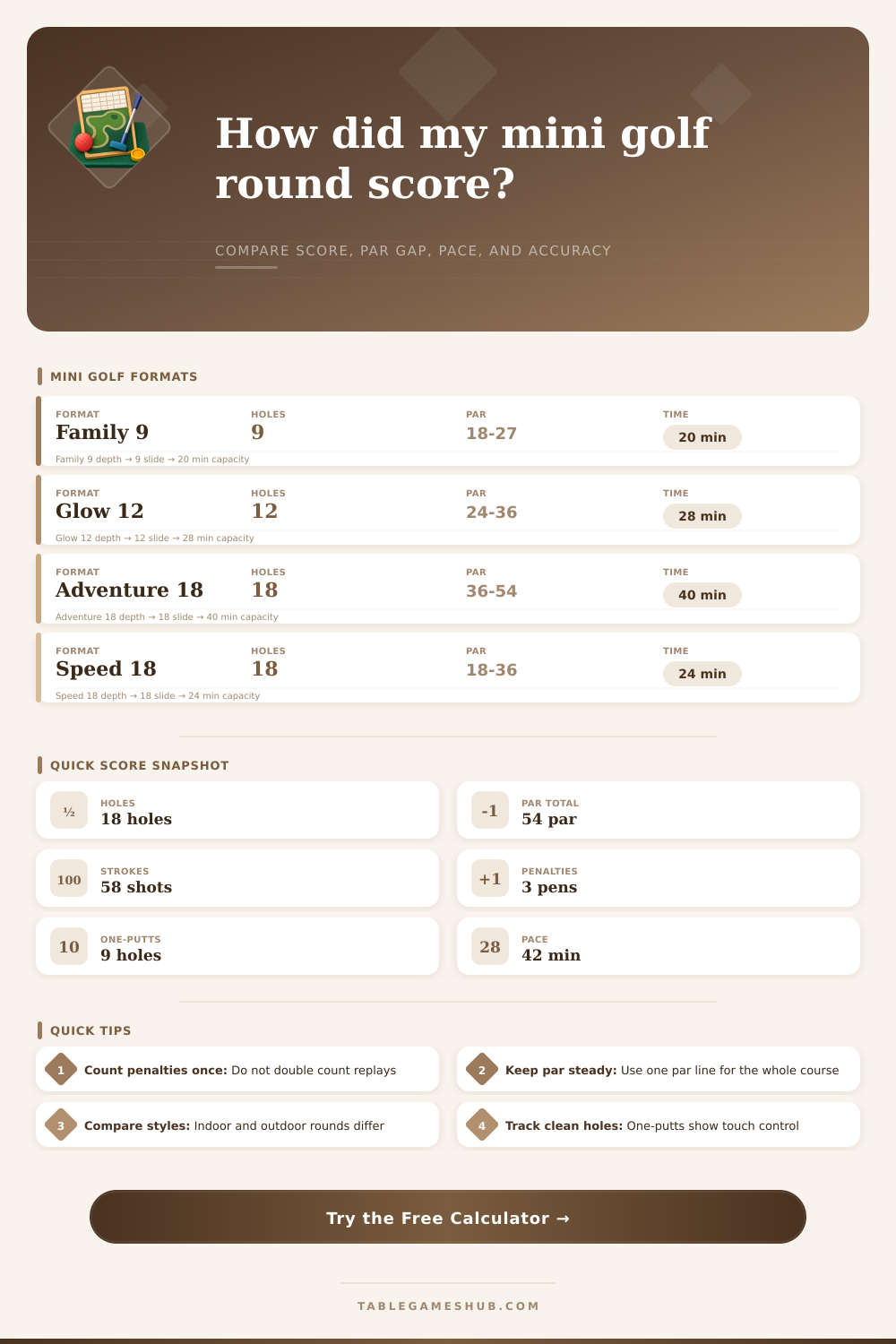
| Format | Holes | Typical Par | Pace |
|---|---|---|---|
| Family 9 | 9 | 18-27 | 20 min |
| Glow 12 | 12 | 24-36 | 28 min |
| Adventure 18 | 18 | 36-54 | 40 min |
| Speed 18 | 18 | 18-36 | 24 min |
| Obstacle | Added Load | Pace Hit | Note |
|---|---|---|---|
| Windmill | +0.4 | Low | Timing lane |
| Tunnel | +0.7 | Med | Line first |
| Ramp | +0.6 | Med | Roll control |
| Water | +0.5 | High | Margin needed |
| Gap | Label | Per Hole | Read |
|---|---|---|---|
| Under par | Sharp round | Under 3.0 | Fast hands |
| Even | Steady round | 3.0 exactly | Clean tempo |
| +1 to +6 | Working round | 3.1-3.3 | Good pace |
| +7+ | Heavy round | 3.4+ | Too many extras |
| Setup | Holes | Par Line | Best For |
|---|---|---|---|
| Backyard | 9 | 18-24 | Casual play |
| Glow Loop | 12 | 24-30 | Night games |
| Adventure Park | 18 | 36-45 | Feature-heavy layouts |
| Speed Course | 18 | 18-27 | Fast scoring rounds |
Mini golf scoring are a method that is used to measure the performance of a person playing mini golf. In order to understand how scoring in mini golf work, it is first important to gain an understanding of the two component that make up a person’s score for a round of mini golf: the total number of strokes that the player used to complete each hole, and the total number of penalty that the player incurred for errors on the course. Should a player make an error that sends the ball into a water hazard, for instance, the player will earn a penalty stroke that must be added to their total stroke to determine their score for that round of mini golf.
A person should track several different variable in order to accurately determine there score for mini golf. Some of the variables that should be tracked include the total number of strokes that the player used for each hole, the total number of penalties for each hole, and the total number of one putts that the player achieved during there round. A one-putt occurs when a player takes only one stroke to putt the ball into the hole after their initial shots on each hole.
How to Score in Mini Golf
Tracking the number of one-putts that a player scores can indicate the precision that the player has in relation to their mini golf game. The level of difficulty of the mini golf course is one additional variable in calculating the player’s score. However, the player cannot control the level of difficulty.
Each mini golf course have a degree of difficulty that is based off the length of each of the course holes, the width of the greens (playing areas for the golfers), and the number of obstacles that must be overcome during each round. Each of these factor will impact the player score and difficulty in mini golf. For these reasons, a player must take into consideration the difficulty of the course when comparing their score to other scores recorded for the same round of mini golf.
One additional variable of importance within mini golf is the concept of “par”. Par is the number of strokes that the player is expected to use to complete each hole in mini golf. If a player completes each hole in a number of strokes that is less than the par score for that hole, the player has beat the par for that hole.
However, if a player takes more strokes to complete a hole than the par number for that hole, the player has failed to beat the par on that hole. By comparing a players score to the par for each hole, it is possible to determine whether their score on the course was good or poorly. In addition to the variables described above, there are a few environmental factor that may impact a player’s score on a mini golf course.
For instance, outdoor mini golf courses often have wind that can impact the golf balls. Indoor mini golf courses, however, do not have wind that impact the balls on the course. For these reasons, players on outdoor mini golf courses may need to account for the impact of the wind on their score.
In addition to the variables mentioned above, there is another metric for scoring in mini golf: the pace of play. The pace of play for a round of mini golf is the amount of time that a player takes to complete the course. Players who take less time to complete each round have a faster pace of play for the course.
Players who require more time for each round will have a slower pace of play. By tracking the amount of time that a player takes to complete each hole on a mini golf course, it is possible to determine the pace of play for that specific course. In order to improve their score on mini golf, players should focus upon reducing the number of penalties that they incur on the course.
By reducing penalties, the total number of strokes that the player will use for the round will decrease. Players can also improve their scores by increasing the number of one-putts that they score. Scoring one-putts indicates that the player has better control over their balls.
Additionally, players can study the course to determine the number of obstacles for each hole. By learning where the obstacles are on the course, players can avoid penalties and more better achieve a lower score for each round. Finally, to track their improvements (or lack of improvements) in their scoring for mini golf, players should of record their scores.