✌ Rock Paper Scissors Probability Calculator
Compare win rates, tie rates, and counter moves for any player mix or match length.
| Measure | Player | Opponent | Notes |
|---|
| Your move | Best against | Ties with | Bad into |
|---|---|---|---|
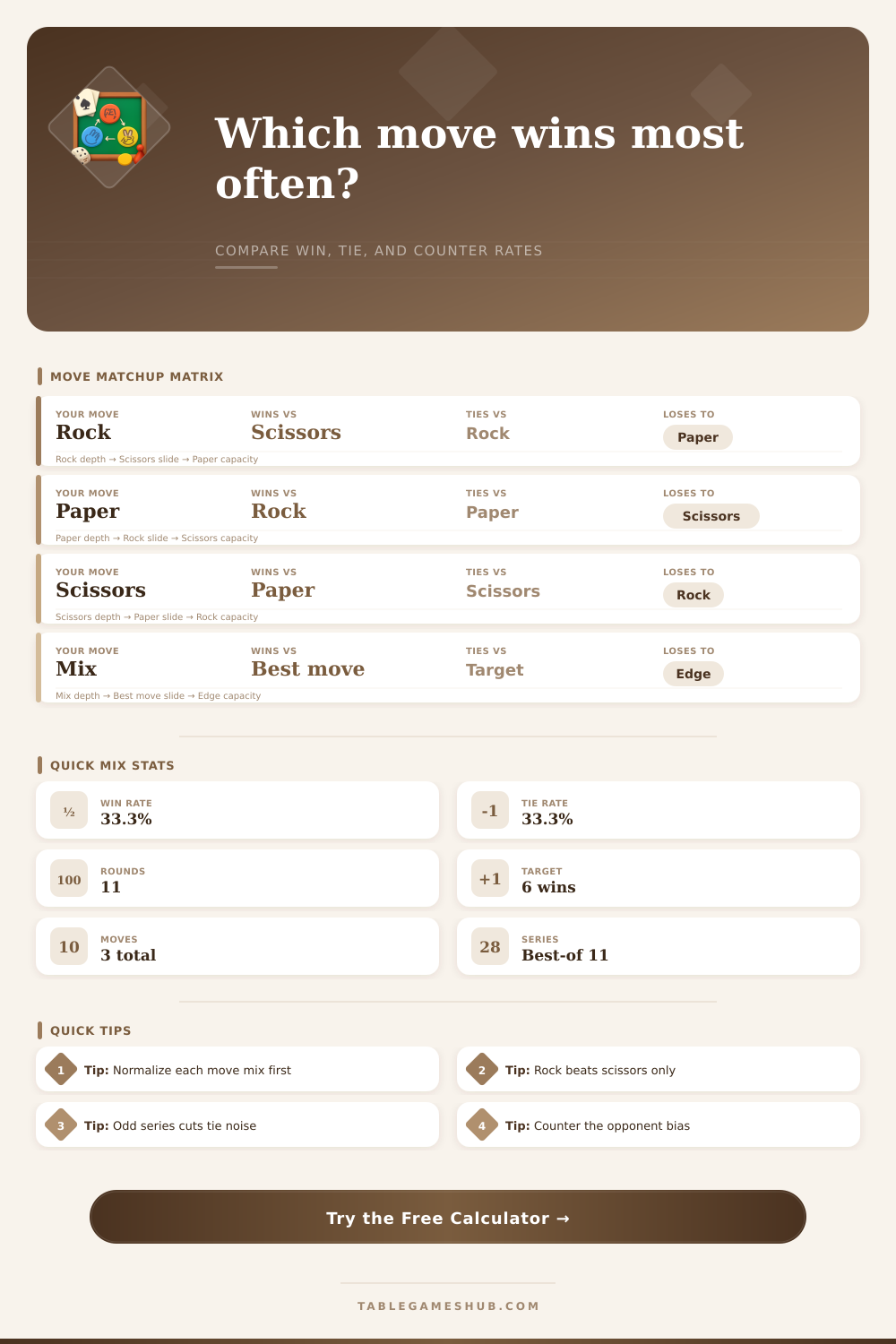
| Rock | Scissors | Rock | Paper |
| Paper | Rock | Paper | Scissors |
| Scissors | Paper | Scissors | Rock |
| Mix | Best counter | Target line | Edge spread |
| Format | Rounds | Target wins | Notes |
|---|---|---|---|
| Single round | 1 | 1 | Pure coin flip feel |
| Best-of-3 | 3 | 2 | Fastest series |
| Best-of-5 | 5 | 3 | Common short set |
| Best-of-7 | 7 | 4 | Good balance |
| Best-of-11 | 11 | 6 | Longer read on bias |
| Opponent bias | Best counter | Win share | Plan |
|---|---|---|---|
| Rock-heavy | Paper | High | Lean paper |
| Paper-heavy | Scissors | High | Lean scissors |
| Scissors-heavy | Rock | High | Lean rock |
| Balanced | Any mix | Flat | Split evenly |
Normalize first
Uneven inputs are fine because the calculator rescales each side to 100%.
Use the best-of line
Longer series make the target win chance more sensitive to small edges.
Rock paper scissors is a game that many peoples believe is entirely based on luck. However, the concept of probability and the observation of patterns in which the opponent throw their moves can influence rock paper scissors. Rock paper scissors has a specific relationship between each of the three move.
Rock will beat scissors, scissors will beat paper, and paper will beat rock. If each player choose their moves at random, then each player will have a one-third chance of winning the game, a one-third chance of losing, and a one-third chance of tying. However, most players does not choose at random.
How to Win More at Rock Paper Scissors
Most players has a bias towards one move over the others. When people has a bias, they will choose one move more than the other two. If you notice your opponent choosing one move more than the others, you can use this information to improve your chance of winning.
If your opponent choose rock moves more than the other two moves, then you should choose paper moves more than the other two because paper will beat rock. By choosing moves according to the opponent’s most frequent throws, you can increase your win rates. The probability of winning can be calculated by determining the specific matchups between your move and your opponent’s moves.
For example, if your opponent chooses rock moves fifty percent of the time, your paper moves will win fifty percent of the time. The other two matchups can be considered as well, but your main goal should be to countering the throws that your opponent chooses the most. By using this method, even small increase to your win rate per round will eventually increase the total number of win that you have during a long series of games.
Thus, you can use this strategy to increase the number of wins that you have against your opponent. Rock paper scissors games can result in ties. A tie will occur if both the opponent and you throws the same move.
Should both players have a bias towards the same move, the number of ties between you and your opponent will increase. Additionally, the number of rounds that a game last will increase. In a best-of-eleven series, the length of the games is more likely to continue into a higher number of rounds.
A best-of-three series is more likely to end with an unpredictably winner. The longer a series of games continues, the more likely it is that the player with a mathematical edge to the game will win that series of games. Short series of games will likely result in the winner of that series of games being the product of luck.
People can make a few mistake when playing rock paper scissors against an opponent. One of the most common mistake is overthinking throws that do not have a pattern or basis. For example, some players may think that a player who recently used rock is on a streak and will choose scissors, even though it is unlikely that the player will choose that move.
The other most common mistake is throwing the same counter to the opponent’s most frequent throw. For example, if your opponent chooses rock moves fifty percent of the time, you might think of only throwing paper moves fifty percent of the time. If you do, you opponent may notice your throws and begin choosing scissors to beat your paper moves.
To avoid making this mistake, mix in some of your own throws that are not the move that counts against your opponent’s most frequent throw. If you only use your optimal counter to your opponent’s most frequent throw, your opponent may begin to predict your throws. To effectively play rock paper scissors against an opponent, you must observe your opponent’s moves.
You should try to do this without showing your opponent that you are watch and counting their moves. If you notice your opponent has thrown rock twice and paper once, your strategy may have to change. The goal of this strategy is to achieve a positive value for each game of rock paper scissors that you play.
If you can select your moves in such a way that the probability of winning is greater than the probability of losing, you will win more games over time. Thus, rock paper scissors is not a game of luck but of probability and management of the variable in each game.