🃏 Reversi Best Move Calculator
Compare flips, corners, mobility, stability, and parity to find the strongest move.
| Measure | Input | Derived | Note |
|---|
| Scenario | Best moves | Ideal depth | Tactical note |
|---|---|---|---|
| Opening Probe | Anthems | 3.4 | Open with mobility |
| Corner Chase | Payoffs | 3.1 | Corners punish loose replies |
| Safe Edge | Rocks | 2.8 | Edges need clean follow-up |
| Fork Pressure | Fillers | 3.3 | Forks and parity matter more |
| Move balance | Risk | Move feel | Fix if low |
|---|---|---|---|
| Opening | Safe | Board pieces are sparse | Add more copies |
| Midgame | Balanced | Playable but swingy | Add support |
| Late | Sharp | Strong game plan | Watch curve |
| Endgame | Forced | Very reliable engine | Trim dead cards |
| Score band | Label | Assembly | Tuning note |
|---|---|---|---|
| 0-39 | Loose | Low | Engine is scattered |
| 40-59 | Balanced | Mid | Needs more glue |
| 60-79 | Sharp | Good | Plan shows up often |
| 80-100 | Sharp | High | Very clean shell |
| Deck size | Bias | Move note | Quick read |
|---|---|---|---|
| Opening | Lower | Fewer blanks | Sharper lists |
| Midgame | Medium | Middle ground | Corner lock |
| Late | Higher | Singleton style | Long game |
| Endgame | Very high | Big spread | Cleanup |
Corner first
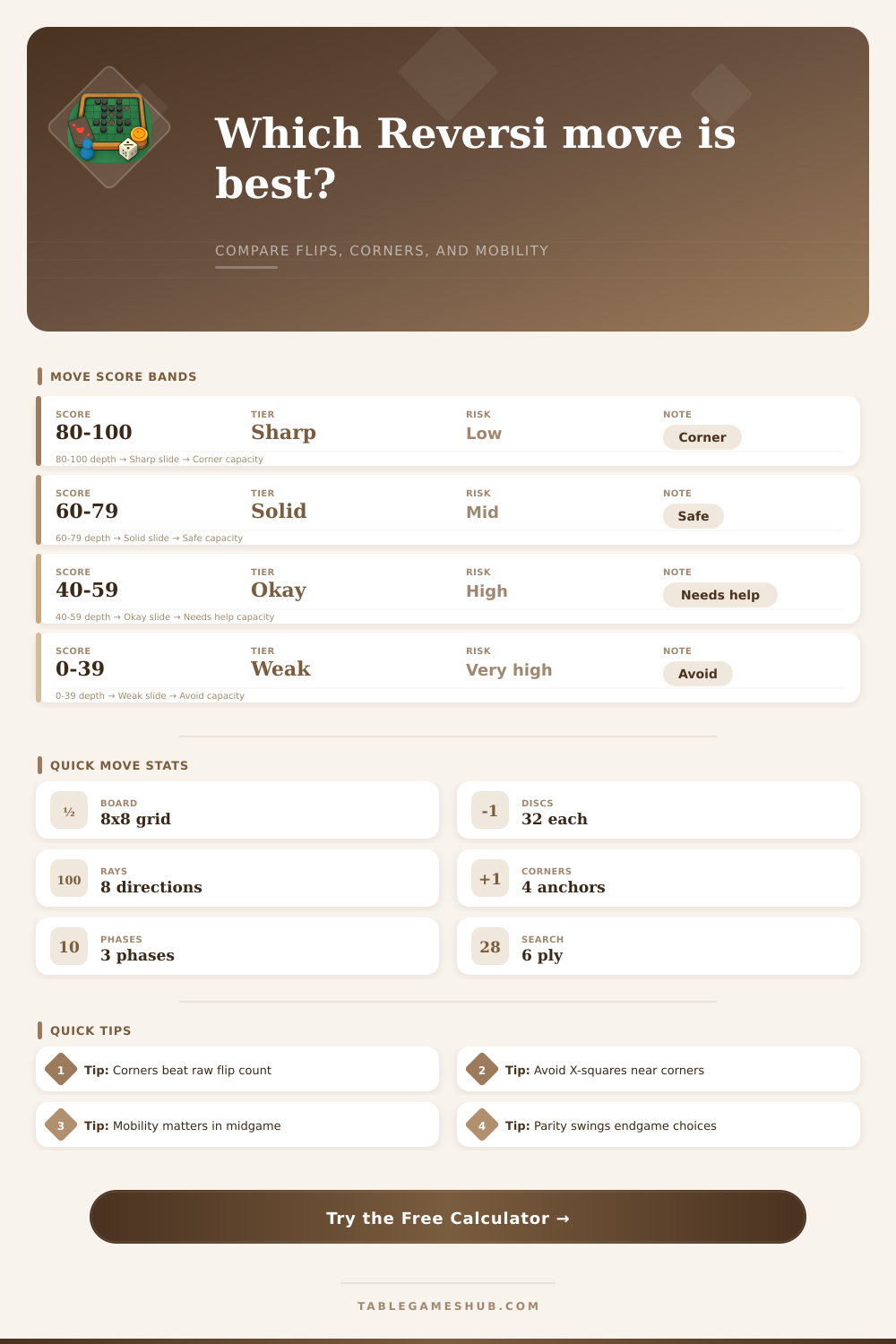
If a corner is available, its long-term value usually outranks a bigger flip count.
Parity last
When empties shrink, a move that keeps the parity line intact can outrank a flashy swing.
Use this Reversi best move calculator to compare flips, corners, mobility, stability, frontier pressure, and parity, then decide which move class should come next.
Reversi is a game that requires strategic planning from the players. This is because the goal of the game of Reversi are not to flip as many discs as possible. Although many people believes that flipping as many discs as possible of the opponent is the goal of the game, flipping discs can often lead to a disadvantage.
Instead, each player should focus upon ensuring control of the game board, as this is more important than the number of disc that are flipped during a given turn. One of the most important aspect of the game is the corners of the game board. The opponent cant flip the discs that is located within the corners of the board.
How to Win at Reversi: Use Corners, Keep Moves, and Plan the Last Move
Thus, if a player gains control of one of the corner of the game board, the player will keep the disc located within that corner for the remainder of the game. The discs located within the corners are important for providing each player with control of the adjacent edges of the game board. Control of the edges of the game board allow a player to turn the opponent’s discs into the player’s discs.
However, a player must take care not to occupy the X squares of the game board. The X squares are the four game board squares that are adjacent to each corner of the game board. If a player occupies any of the X squares, the opponent may be able to utilize that X square to turn the player’s discs into the opponent’s.
Mobility is another important game concept in the game of Reversi. Specifically, mobility is the number of legal moves that any given player can make during the game. Each player desire to have a high mobility for themselves, and to minimize the mobility of the opponent.
High mobility for the player allows for better control of the game and the opponent’s moves, while low mobility for the opponent can lead to mistakes in their moves. Finally, the game changes in relation to the number of disc that are still occupied by empty squares on the game board. In the early stage of the game, a person should focus on their mobility and presence on the board.
In the midgame stages of the game, a player should focus on edge pressure and stability. In the endgame stages of the game, a player should focus on parity. Parity refers to the player that makes the final move on the game of Reversi.
The player that makes the last move gets a significant number of discs on the game board. Therefore, a player must pay attention to the number of empty square on the game board to ensure that they have the advantage in the game of parity. Stability is a player having many discs that are difficult for the opponent to flip.
A player can achieve this by placing their discs near the corners and the edges of the game board. A player who has many stable disc will win the game. Players must find a balance between creating many discs that can be flipped and maintaining the stability of their discs.
If a player creates many discs that can be flipped without ensuring the stability of their discs, then they will likely lose the game to their opponent. A player can use many different strategy to improve their play of the game of Reversi. For example, one strategy is known as the corner-clamp strategy.
Another is the mobility trap strategy. If a player manages their mobility and stability correctly, they will create situations for their opponent to have fewer options in the game. The fewer options their opponent has will force them to make an error in their play of the game.
Overall, the game of Reversi is a game of long term strategy. A player must value the corners of the game board more than having a significant number of discs that can be flipped. A player must value the stability of their discs more than the number of discs they can flip.
Additionally, a player must value their mobility over the number of disc they can have in a single turn. By focusing on the corners, mobility, and the concept of parity, a person can increase there chance of winning the game of Reversi.