⚔ Scythe Score Calculator
Total stars, territory, resources, and endgame bonuses in one clean score sheet.
| Measure | Formula | Input | Score |
|---|
| Popularity | Territory | Resources | Tier note |
|---|---|---|---|
| 0-6 | 2 each | 1 per 2 | Low tier |
| 7-12 | 3 each | 2 per 2 | Mid tier |
| 13-18 | 4 each | 3 per 2 | High tier |
| Factory | +3 | 0 | Counts as 3 |
| Score source | Formula | Counts in calc | Notes |
|---|---|---|---|
| Stars | 3 x stars | Yes | Flat value |
| Territories | Count x tier | Yes | Factory joins here |
| Resources | Pairs x tier | Yes | Odd tokens drop |
| Coins | 1 x coin | Yes | Hand total stays live |
| Control rule | Counts as | Scoring use | Quick note |
|---|---|---|---|
| Worker / mech / hero | Control | Territory score | Direct presence |
| Structure only | Control | Territory score | No enemy units |
| Factory | 3 hexes | Territory score | Special case |
| Resources | Pairs | Resource score | Floor division |
| Final score | Typical mix | What it means | Focus |
|---|---|---|---|
| Under 45 | Small engine | Early finish | More stars |
| 45-69 | Balanced | Steady table | Spread control |
| 70-89 | Strong | High finish | Raise popularity |
| 90+ | Heavy engine | Elite result | Stack all sources |
Floor the resources
Scythe scores resources in pairs, so odd tokens sit outside the final total.
Count the Factory once
If you own it, add 3 territories before the popularity tier is applied.
Scythe is a board game in which the players earns victory points that determine the game’s winner. The game ends when either a player places there sixth star in the game board, or when a player completes a specific action on the top row of their player mat. There is several different ways for players to earn victory points in Scythe, and many of those methods require some form of mathematical calculation in order to determine the number of victory points that a player will earn during the game.
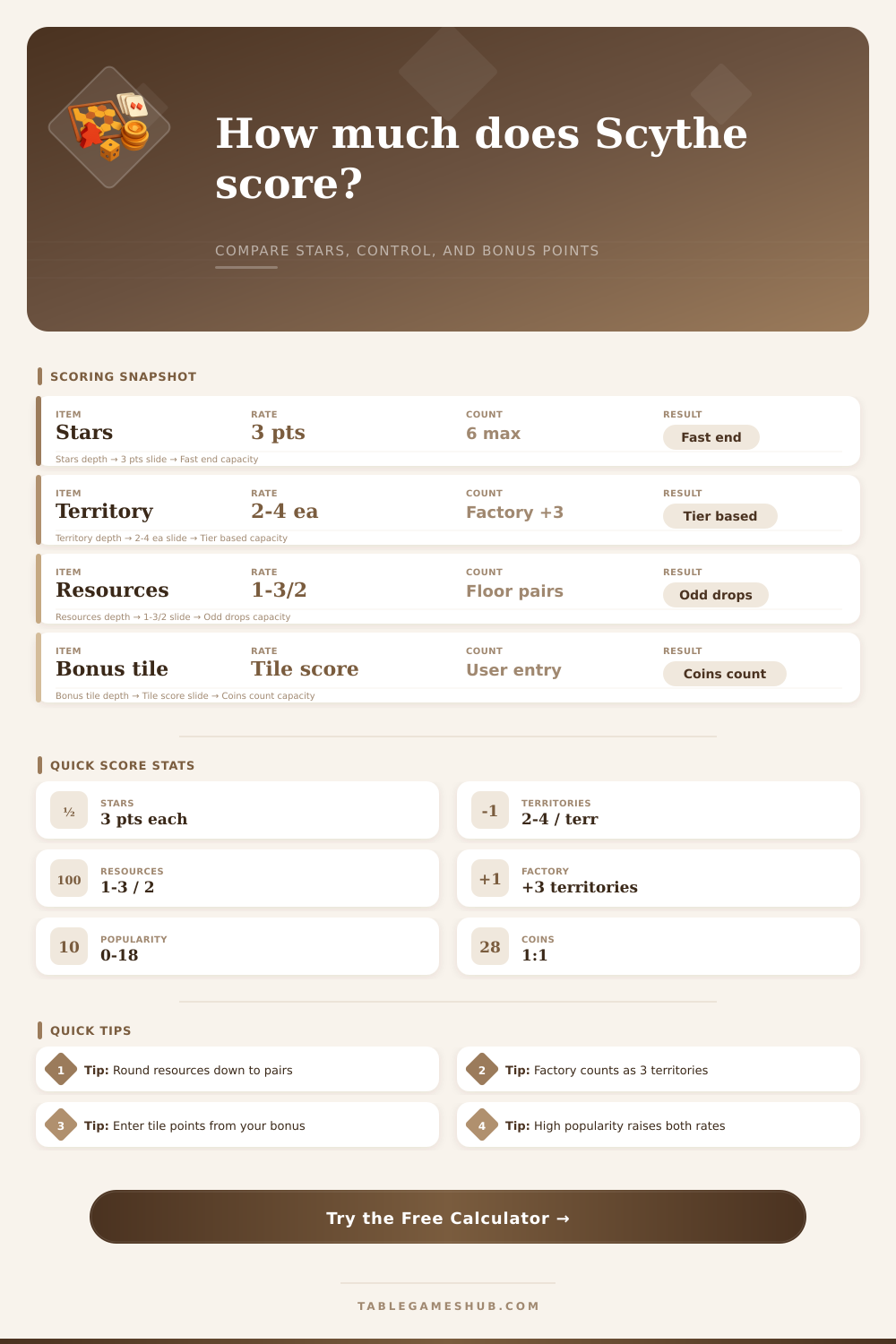
Such calculations may involve determining the number of victory points earned from stars, territories, resources, popularity, coins, and structure tile. Stars are one of the main source of victory points for players in Scythe. Each star that a player places on the game board is associated with three victory points.
How to Score Points in Scythe
Thus, if a player is able to place six stars onto the game board, that player will earn eighteen victory points (6 stars times 3 victory points) with those stars alone. However, a game may end before any player reaches six stars if one of the other players perform an action that can end the game. Territory points are another means of earning victory points in Scythe.
A player earns victory points for each territory that the player controls. A player controls a territory if the player has a structure or a unit in that territory, but if the enemy player does not have a unit within that same territory. For instance, each player may have mechs or workers that occupies a territory.
Additionally, there is a territory in the center of the game board: the Factory. The Factory counts as three different territories for the player that control it. A player earns more victory points from each of the territories that they control if they have a high level of popularity.
Resources can also be used to earning victory points for players. However, the number of resources that a player controls must be divided into pairs. A player does not earn victory points for each of their individual resource.
For instance, a player with five resource tokens will earn victory points for only two pair of their five resources. Each pair of resource tokens earns a player victory points based off the players level of popularity; low popularity earns one victory point for each pair of resources, medium popularity earns two victory points for each pair of resources, and high popularity earns three victory points for each pair of resources. Popularity is a metric for players that determines the number of victory points that a player earns for their controlled territories and resources.
Popularity ranges in value from zero to eighteen. Popularity levels between zero and six indicate that a player has low popularity. Popularity between seven and twelve indicate that a player has medium popularity.
Popularity between thirteen and eighteen indicates that a player has high popularity. High popularity, like high levels of territory and resource control, is beneficial for a player because high popularity levels increases the victory points earned from both controlled territories and resources. However, popularity levels increase at the cost of action, so a player cannot increase their popularity without sacrificing some of their other actions.
Coins are another way for a player to earn victory points. Each coin that a player controls with their coins pile is worth one victory point. Thus, the more coins that a player controls, the more victory points they will earn.
Additionally, because coins are only worth one point each, each coin a player earned is one that the player did not spent during the game. However, coins are worth less victory points per unit than the victory points earned from high popularity levels. Structure tiles are one final means of earning victory points.
Each player starts the game by choosing a structure tile. Each structure tile provides a player with different types of bonuses for each of the types of buildings that they have; for instance, they may earn bonus victory points for each mill that they control. Thus, each player should of choose a structure tile that correlates with the type of strategy that they plan to use during the game.
Outside of winning the game, there are some mistake that players should avoid during the scoring phase of the game. For instance, a player should not miscount the number of territories that they control; they only earn victory points from territories where they have a structure or unit, but the enemy player does not have a unit. A player should also not forget to floor the number of resource tokens that the player controls into pairs; they earn victory points only for pairs of resources, not individual tokens.
Finally, a player should also not forget the victory points from their structure tile; they may earn victory points from it. By understanding these different methods of winning the game, a player can better manage their game components to win as many victory points as possible.