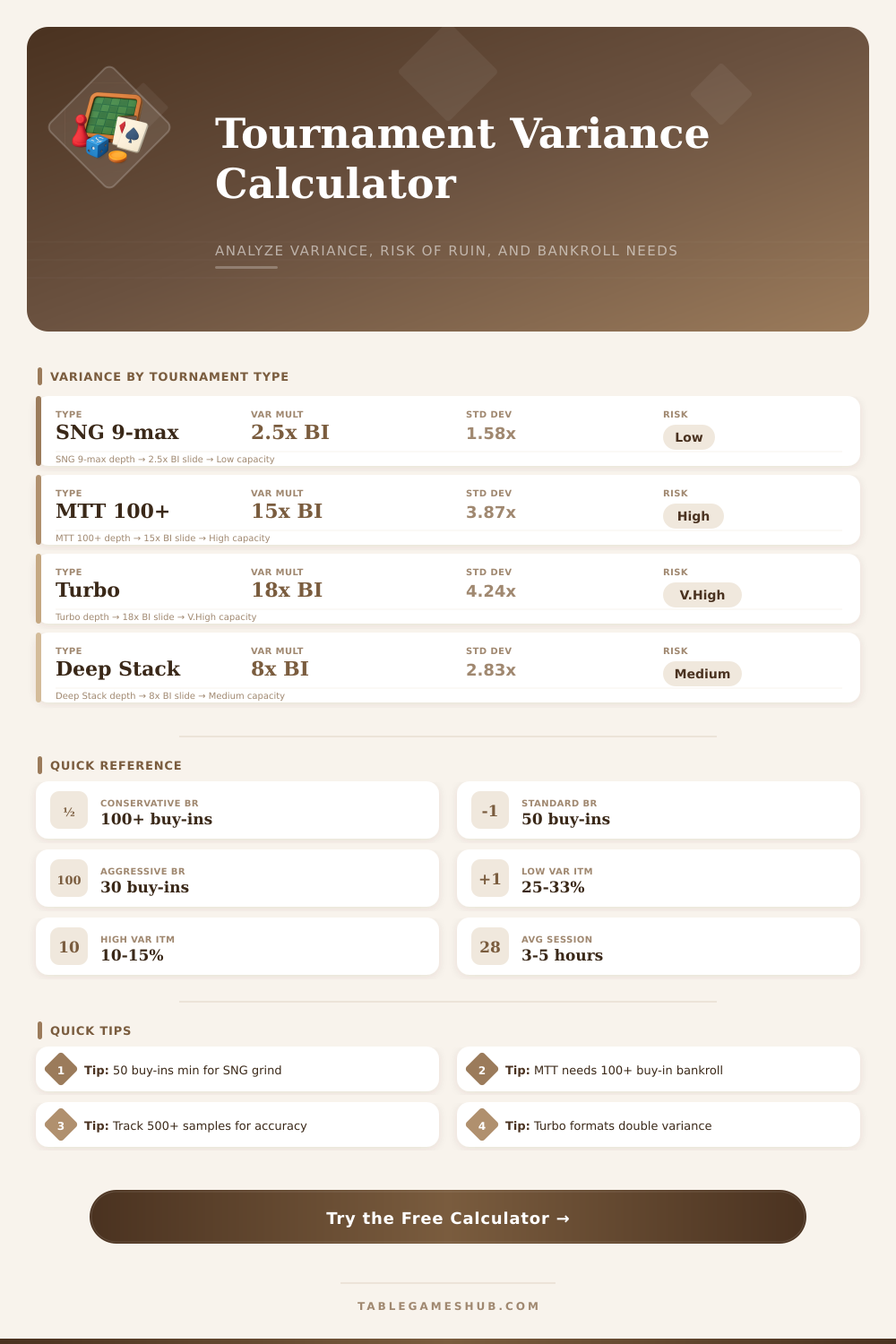
Tournament Variance Calculator
| Tournament Type | Recommended Size | Surface Area | Player Capacity |
|---|---|---|---|
| Standard MTT | 84 x 42 in | 3,528 sq in | 9 - 10 |
| Sit & Go | 48 x 48 in | 2,304 sq in | 9 |
| Turbo MTT | 84 x 42 in | 3,528 sq in | 9 - 10 |
| Deep Stack | 96 x 48 in | 4,608 sq in | 9 |
| Tournament | Chip Sets | Card Decks | Accessories |
|---|---|---|---|
| Standard MTT | 2 sets (500ct) | 2 decks | Timer, dealer button |
| Sit & Go | 1 set (300ct) | 1 deck | Timer, dealer button |
| Turbo MTT | 2 sets (500ct) | 2 decks | Timer, dealer button |
| Deep Stack | 2 sets (500ct) | 2 decks | Timer, dealer button |
| Risk Level | Buy-ins Needed | Variance Tolerance | Session Length |
|---|---|---|---|
| Conservative | 100+ | Very Low | 4 - 6 hrs |
| Standard | 50 | Low | 3 - 5 hrs |
| Aggressive | 30 | Medium | 2 - 4 hrs |
| High Risk | 15 | High | 1 - 3 hrs |
In the world of poker, variety leads to the natural chances in results of players. It likes to pitching a coin hundred times. Although you expect to get 50 heads and 50 tails, you might get 55 heads and 45 tails.
That shows positive or negative variety, and same logic counts for poker. Variety forms the core of the game, that it is possible not to ignore. Professional players do not win every tournament.
What is poker variance?
For instance after 50 tournaments they do not reach the top 20.
Tournaments bear more variety than cash games with money. In those games a player stays at least 100 bb deep. Big multi-table tournaments add high variety because of the crowd that must defeat for prize money.
Play heads-up brings only big variety, because it involves many hands and the winner-take-all of the prize. An aggressive poker style opens you to more variety. Risk big chips commonly means big stack, but also bust.
On the contrary, a tight style with flat-calls and small pots improve chances in a tournament by means of a decrease of risk lose everything in one hand.
Estimate variety is much more tricky cause for tournament players. It is possible not simply count won chips, because its value adjusts through the tournament. Blinds and antes push upward, but chips do not have fixed worth until departure of players.
Variety in big MTTs can even extend to whole life of people. A loss of five precious flips in a row sends the chart down for 5,000 games. Here what variety looks, when payments weigh peak and moments that most matter bear most a lot of uncertainty.
That does not show a rigged system.
A tournament variance calculator helps to understand expected swings and superbly manage bankroll. Enter your win rate and hand numbers, to see the variety impact. Size of faked events matter.
Bigger numbers give precise results, but requires more time. For instance a big simulation show 40% risk lose after 1,000 tournaments, requiring 23,069 dollars of bankroll. Little simulation point only 18% loss risk with 8,742 dollars.
Easy calculations for best and worst ROI gives notion about worst scripts for a particular game.