🧩 Sudoku Difficulty Calculator
Score clue density, candidate pressure, and solving depth to estimate how hard a puzzle will feel for a human solver.
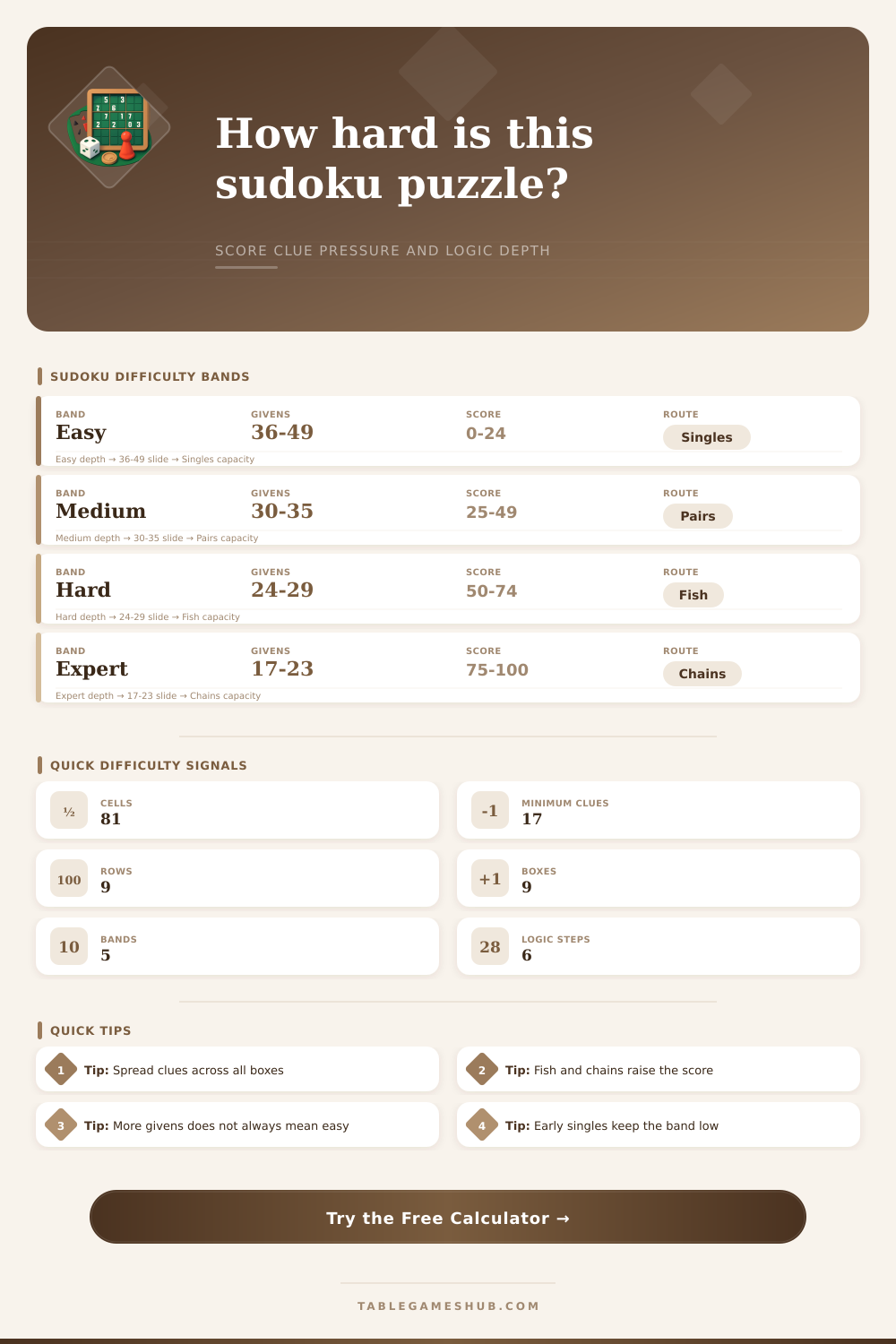
| Band | Score | Typical clues | Solver route | Feel |
|---|---|---|---|---|
| Easy | 0-24 | 36-49 | Singles | Quick scan |
| Moderate | 25-39 | 30-35 | Pairs | Steady logic |
| Hard | 40-59 | 24-29 | Triples | Needs focus |
| Very hard | 60-79 | 20-23 | Fish | Longer search |
| Expert | 80-100 | 17-19 | Chains | Deep logic |
| Brutal | 90+ | 17-18 | Guessing | Late-stage trap |
| Technique | Common clue | Difficulty effect | Weight | Notes |
|---|---|---|---|---|
| Naked singles | One candidate left | Lowers score | -1.4 | Always helps |
| Hidden singles | Only spot in a house | Lowers score | -1.1 | Core human scan |
| Locked candidates | Pointing or claiming | Lowers score | -0.8 | Cleaner grid flow |
| Pairs / triples | Subset or elimination | Slightly lowers | -0.4 | Useful mid-tier logic |
| X-Wing | Fish pattern | Raises score | +1.8 | Needs pattern spotting |
| Chains | Forcing sequence | Raises score | +2.5 | Advanced human solving |
| Backtracking | Try and test | Raises score | +3.4 | Logic is no longer enough |
| Clustered layout | Clues packed together | Raises score | +0 to +12 | Distribution matters |
| Given range | Open cells | Common style | Expected label | Typical time |
|---|---|---|---|---|
| 40+ | 41 or less | Scans first | Easy | 5-15 min |
| 34-39 | 42-47 | Singles + pairs | Moderate | 15-30 min |
| 28-33 | 48-53 | Pairs + triples | Hard | 30-60 min |
| 24-27 | 54-57 | Fish begins | Very hard | 1-2 hr |
| 20-23 | 58-61 | Chains likely | Expert | 2+ hr |
| 17-19 | 62-64 | Deep search | Brutal | Multi-step |
Sudoku seems simple at first but when you pass the basics and sink, it soon becomes a real challenge. Puzzles can be easy or extremely hard, or in between, everything depends on the techniques used.
Hard Sudoku are marked by few numbers in the cells compared to simple or medium ones. The amount of given numbers directly show the level of trouble. Less numbers, more hard the solution.
How Sudoku Difficulty Works
For instance, a puzzle with only 17 numbers you consider much more hard than that with 25. Puzzles with less than 18 numbers commonly are called evil sudoku.
To solve extremely hard sudoku you require more than only the basic rules. It requires strong knowledge about strategies like X-Wing and Swordfish, because initially almost no numbers on the board. Simple and medium puzzles you can solve by consecutive logical steps.
Mediums usally include more cases, that require mixing info.
The grade most depends on the most hard technique to solve. When you rate a puzzle, most important are the methods you use. Use a score for naked single and hidden single for every technique, and add them up.
In the Sudoku community the SE rating is most famous; it rates according to the most difficult used technique. Swordfish have SE 4.0, and the maximum reaches 13.6. Whether Swordfish or Y-Wing are easier, stays open.
Every website uses its own scale. Sudoku Exchange and Sudoku Coach rate according to the most hard involved technique, regardless of the steps. HoDoKu counts a weighted sum of particular moves that the solver uses.
The rating seems subjective and depends on the website. Some mark them as High School, College and Graduate. There is no official accepted system that all follow.
The usual way to make a puzzle of a set grade is to create it, rate it later and repeat until you get a good value. No one will want to play if the trouble is random. Many apps have hints, that use human strategies to find the simplest next move from the present board.
Some ranges on purpose overlap, so the most hard medium puzzles are like the easiest tricky ones. There are board game versions, where a referee sets up the board using puzzles split into Easy, Medium and Hard groups for two to four players.