🗡️ Gloomhaven Turn Calculator
Plan initiative order, rest cycles, card longevity & action efficiency for every scenario
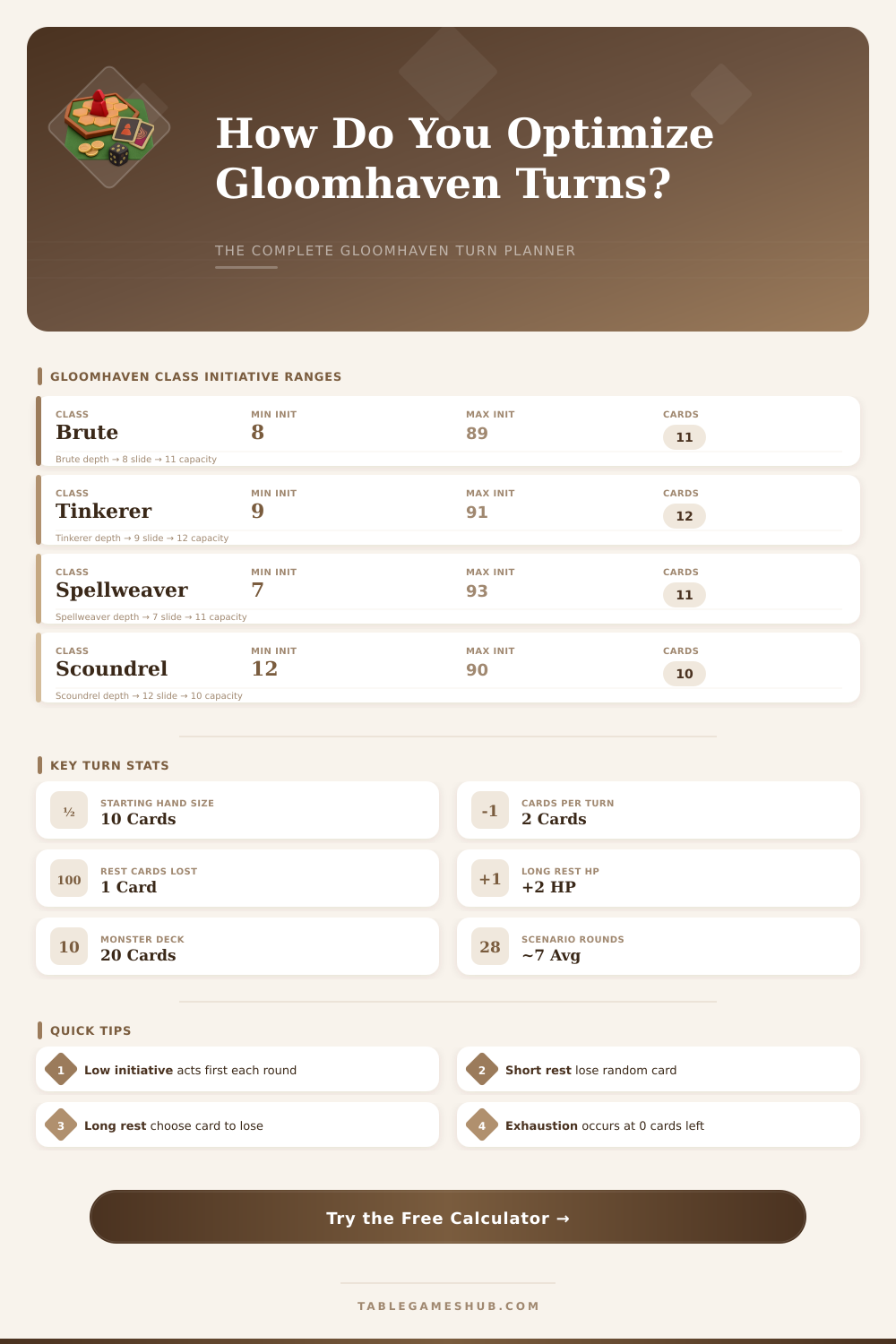
| Class | Hand Size | HP (Lvl 1) | HP (Lvl 9) | Init Range | Role |
|---|---|---|---|---|---|
| Brute | 10 | 10 | 26 | 8–89 | Tank/Melee |
| Tinkerer | 12 | 10 | 22 | 9–91 | Support |
| Spellweaver | 8 | 6 | 18 | 7–93 | Ranged/Magic |
| Scoundrel | 9 | 8 | 20 | 12–90 | Melee DPS |
| Cragheart | 11 | 10 | 24 | 10–88 | Versatile |
| Mindthief | 9 | 6 | 18 | 6–95 | Control |
| Sunkeeper | 10 | 8 | 22 | 5–78 | Healer/Tank |
| Quartermaster | 11 | 10 | 24 | 14–85 | Equipment |
| Nightshroud | 9 | 8 | 20 | 11–96 | Stealth |
| Diviner | 9 | 6 | 18 | 8–89 | Curse/Hex |
| Scenario Level | Monster HP Mult | Monster Attack | Monster Move | Gold Mult | Bonus XP |
|---|---|---|---|---|---|
| 0 | x0.75 | -1 | Standard | x1.0 | +0 |
| 1 | x1.0 | Standard | Standard | x1.0 | +0 |
| 2 | x1.25 | +1 | Standard | x1.25 | +1 |
| 3 | x1.5 | +2 | +1 | x1.5 | +2 |
| 4 | x1.75 | +3 | +1 | x1.75 | +3 |
| 5 | x2.0 | +4 | +2 | x2.0 | +4 |
| 6 | x2.5 | +5 | +2 | x2.5 | +5 |
| 7 | x3.0 | +6 | +3 | x3.0 | +6 |
| Component | Quantity | Notes | Storage Size |
|---|---|---|---|
| Scenario Books | 95 scenarios | + side scenarios | Standard box |
| Monster Standees | 1,718 total | 17 monster types x avg ~6 | 6 plastic trays |
| Ability Cards (hero) | 504 cards | 6 starters + unlockable | Card sleeves needed |
| Attack Modifier Deck | 20 cards each | Per player + monster | Card box |
| Damage Tokens | 270 tokens | Various denominations | Token tray |
| Map Tiles | 17 sets | Double-sided hexagonal | Flat storage |
| Condition Tokens | 150+ | Poison, Wound, Stun, etc. | Ziplock bags |
| Gold Tokens | 220 tokens | 1 and 2 denomination | Token tray |
| Action | Cards Used | HP Recovered | Items Refreshed | Timing |
|---|---|---|---|---|
| Short Rest | Lose 1 random from discard | None | None | End of round |
| Long Rest | Lose 1 chosen from discard | +2 HP | All spent items | Instead of turn |
| Loot Action | None lost | None | None | During turn |
| Recovery via card | Return from lost pile | Varies | Varies | During turn |
| Exhaustion | 0 cards + no move | None | N/A | Immediate |
Gloomhaven is a team game about tactical combat, in which the players struggle against monsters and accomplish their own targets in an ongoing, evolving world that spreads through several sessions. It works as a script-based dungeon crawl for one to four players. Although it brings thoughts of role-playing games like Dungeons & Dragons or other tabletop dungeon crawlers it now uses mechanics more like modern Euro games.
Some call it a Turn-based tactical game dressed in dungeon crawl format with elements of deck building.
How to Play Gloomhaven
The characters and monsters move on hex floors, that describe caves and tunnels. The base of the game rests in smart use of cards. At every Turn, the players at the same time choose two cards to play.
Every card splits into upper and bottom part. The players combine the upper of one card with the bottom of the second. Such actions allow characters to do things like move, heal or attack monsters.
When all chose their cards, the order of Turns is set according to initiative. Starting from the lowest intiative number, players and monsters do their actions one by one. The upper parts of cards no longer matter after the initiative is set.
In their Turn, a player does one upper action from one played card and one bottom from the other.
Monsters do not have a separate player. Their choices come from a system of action cards, that automatically say what they do in their Turn according to the initiative order. All monsters do the actions listed on their card for the round, following the order pointed on it.
Effects that one receives during a Turn last until the end of the Turn of that same player in the next round. For instance, making a character invisible by means of a first action will make it stay invisible for the remaining actions of that round and for both actions in the next Turn. Similarly work conditions like blind.
If a Turn starts with a still active condition, it gets removed at the end of that Turn.
One key rule points out that elements cannot be used in the same Turn in which they are created by the same character. Even so, elements from monsters or partners can be used in that same Turn. Communication plays a big role.
Players do not share exact skills during picking of cards, but talking about strategy during the rest of the round helps to avoid mistakes. Knowing when to use lost cards is key. Burning too many cards too soon causes you to quickly end the Turns.
Classes with nine or ten cards, that need long rest around five times, usually run out after nineteen to twenty-one Turns. A helper app can cut downtime for setup and simplifyturns, tracking actions and conditions.