🟦 Azul Score Calculator
Track points for all players — Classic Azul, Summer Pavilion & Stained Glass variants
| Adjacent Tiles | Points Scored | Example Scenario | Cumulative Max |
|---|---|---|---|
| 0 (isolated) | 1 | First tile on wall | 1 |
| 1 adjacent | 2 | Edge of existing row | 3 |
| 2 adjacent | 3 | Gap fill (same row) | 6 |
| 3 adjacent | 4 | Corner of 2 lines | 10 |
| 4 adjacent | 5 | Center of cross | 15 |
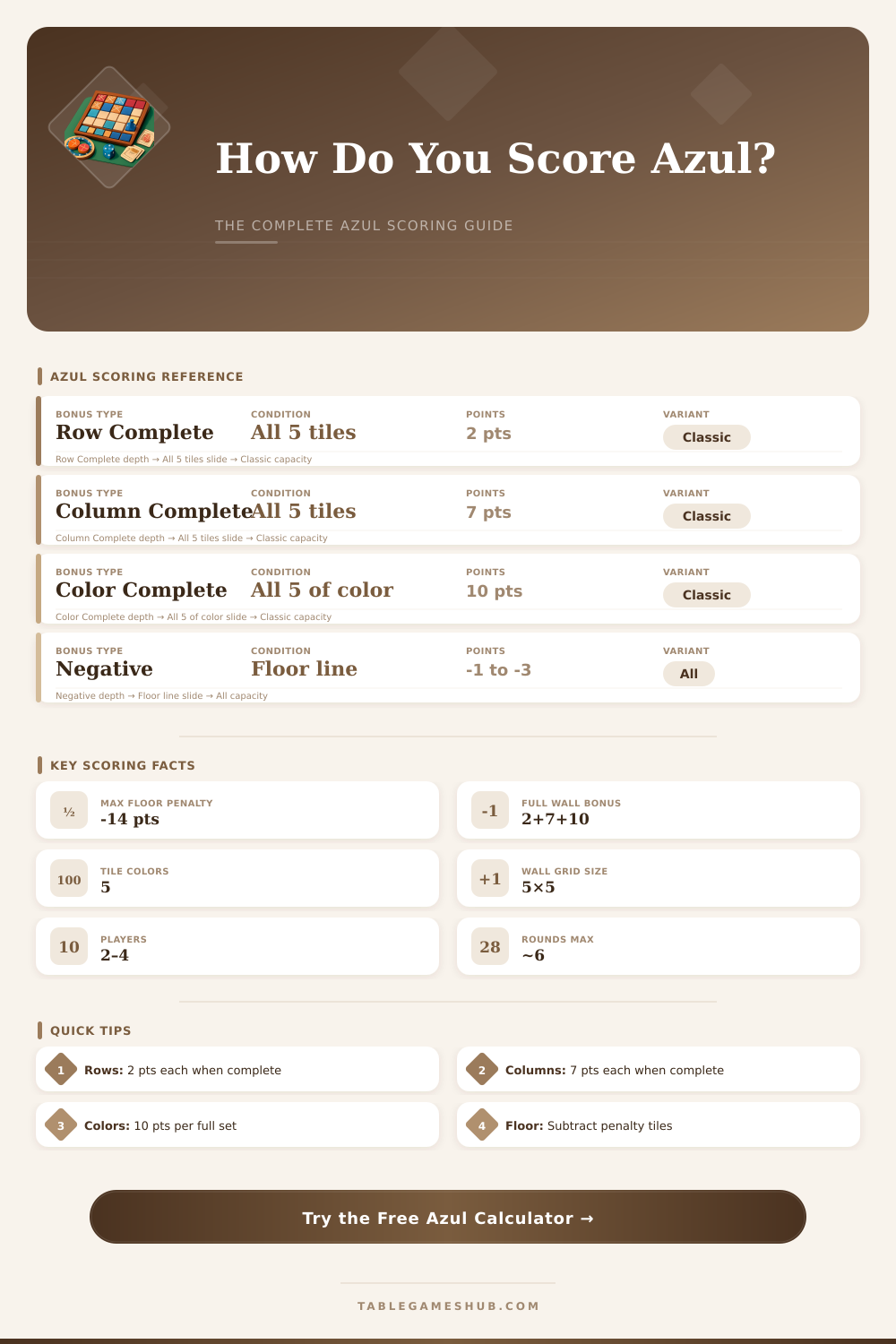
| Row of 5 complete | +2 bonus | Horizontal full row | — |
| Column of 5 complete | +7 bonus | Vertical full column | — |
| Color set complete | +10 bonus | All 5 of one color | — |
| Floor Space | Penalty (Classic) | Cumulative Total | Summer Pavilion |
|---|---|---|---|
| Space 1 | -1 | -1 | -1 |
| Space 2 | -1 | -2 | -1 |
| Space 3 | -2 | -4 | -1 |
| Space 4 | -2 | -6 | -1 |
| Space 5 | -2 | -8 | -1 |
| Space 6 | -3 | -11 | -1 |
| Space 7 | -3 | -14 | -1 |
| Variant | Wall Type | Max Bonus Points | Players |
|---|---|---|---|
| Classic Azul | Fixed color grid | 19 per row/col/color | 2–4 |
| Summer Pavilion | Star-shaped spaces | Varies by star size | 2–4 |
| Stained Glass of Sintra | Sliding windows | Window bonuses | 2–4 |
| Players | Low Score | Average Score | High Score |
|---|---|---|---|
| 2 Players | 40–60 | 65–85 | 90–120 |
| 3 Players | 35–55 | 60–80 | 85–110 |
| 4 Players | 30–50 | 55–75 | 80–105 |
Azul is about setting floors, in that the players struggle to reach the biggest number of points by means of collecting and placing those bits on their own board. Michael Kiesling created it and it appeared at the publishers Next Move Games and HABA in 2017. The main idea is made up of choosing colorful floors from the central pockets and laying them on the wall to win points.
The theme deals about nicely decorating the walls of a palace by means of tiled floors.
How to Count Points in Azul
The spots for scoring in Azul really are the most hardly explained part. There is always doubt, do the folks do it right. When one lays a floor on the wall, it gives only one point, if it does not touch any other floor.
Even so, when it is beside others, the result becomes much more fun. For the line, that it belongs to, one gets one point for every floor in that line, if the line has more than one bit. Similarly, for the column it forms, it counts one point for each, if the column passes one floor.
The points are counted right away when the floor lays on the wall.
Players often ask about the columns. For instance, if a floor ends a column with three bits, the points will be one for the line plus three for the column, what does entirely four. That commonly surprises the players.
At the end of the game, the bonuses decide the winner. Each finished horizontal line on the board gives two points. Full vertical columns are worth seven points.
And for every colour, if all five floors lay on the wall, that adds ten more points. The game ends after some player completes one hole horizontal line during the phase of placing on the wall. The folk with the most points wins.
The dumped floors really lower the score, so carelessness costs a lot.
The points can change a lot. Some players hardly pass 55 points in their first games, while others reach even 259, because of waiting on the final setup and almost full setup of the wall. A score of 78 commonly is enough to beat most games.
In a double game, the best average for a player is around eight points from columns, what shows, that one usually ends only one column for a whole game.
There are apps and online tools, that help to learn and count points, what is handy, because manual counting commonly confuses the folks. The physical score board with cubes also can create troubles, because the cubes are lightweight and easily roll. Also the game boards and the score board are sometimes calledtoo fragile.
After the base of the original game, the follow-ups like Stained Glass of Sintra and Summer Pavilion easily stick. Summer Pavilion adds more modes for scoring and is a bit more extra version. Another game by Kiesling, that deserves a try, is Riverboat.