Five Tribes Meeple Calculator
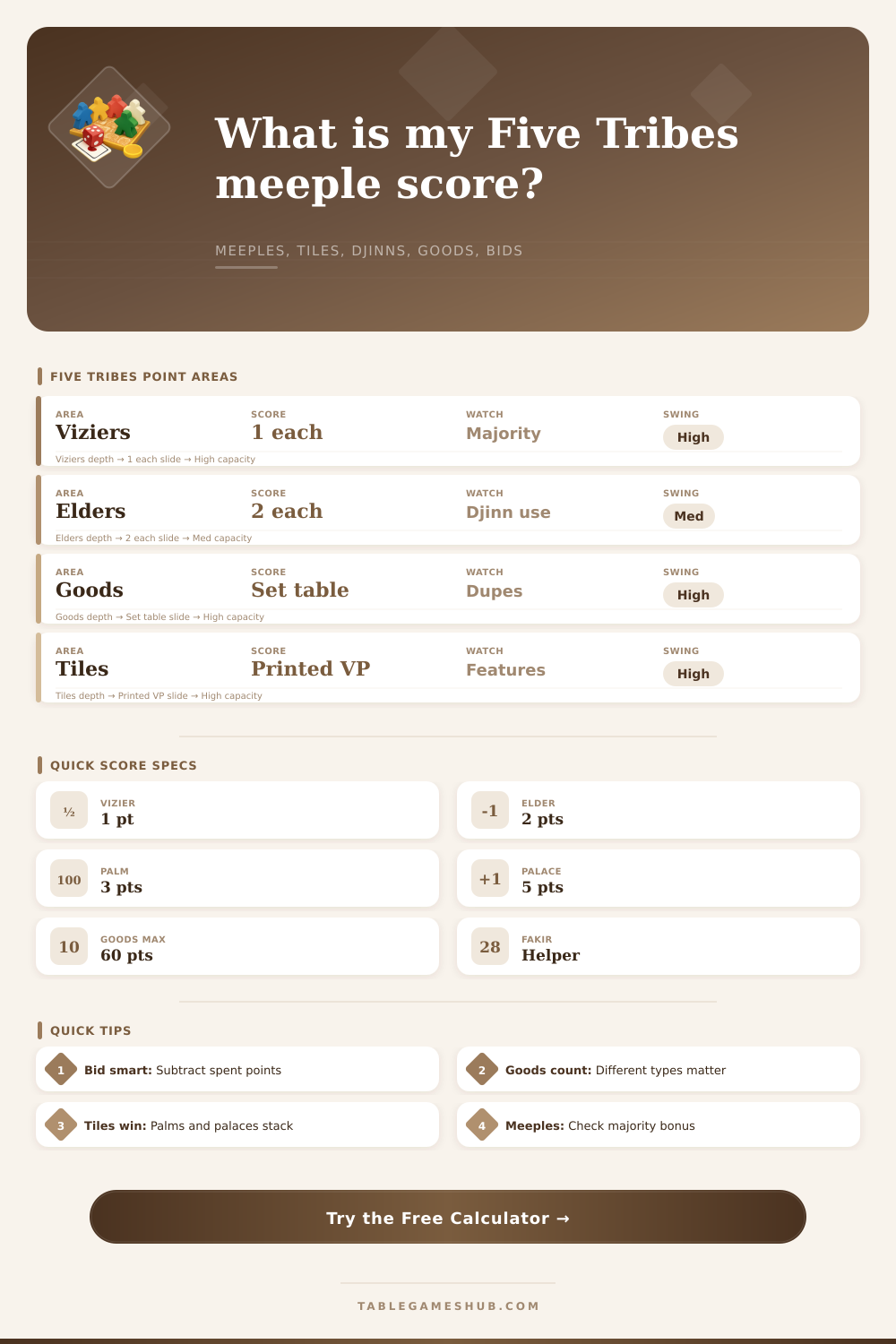
Total your Five Tribes position from meeple colors, assassins, builders, merchants, viziers, elders, controlled tiles, Djinns, goods, palms, palaces, and bid order points.
Use the worksheet near final scoring or after a key turn to see whether the tribe engine, market haul, tile network, or bid track is carrying the position.
| Different Goods | Set Points | Marginal Gain | Calculator Use |
|---|---|---|---|
| 1 unique good | 1 point | Base card | Small leftover set |
| 2 unique goods | 3 points | +2 points | Early market pickup |
| 3 unique goods | 7 points | +4 points | Useful small set |
| 4 unique goods | 13 points | +6 points | Solid table share |
| 5 unique goods | 21 points | +8 points | Strong merchant turn |
| 6 unique goods | 30 points | +9 points | Major end score |
| 7 unique goods | 40 points | +10 points | Winning pressure |
| 8 unique goods | 50 points | +10 points | Elite market set |
| 9 unique goods | 60 points | +10 points | Complete collection |
| Tribe Color | Main Score Input | Formula Used Here | Position Signal |
|---|---|---|---|
| Yellow Viziers | Collected yellow meeples | Viziers + majority bonus | Endgame points and tie pressure |
| White Elders | Unspent elders | Elders x 2 | Djinn fuel or saved points |
| Blue Builders | Builder meeples and blue tiles | Builders x blue tiles + fakirs | Single-turn scoring burst |
| Green Merchants | Goods types and duplicates | Set table + support value | Market and caravan strength |
| Red Assassins | Assassins used and targets | Targets x 2 + assassin reach | Board denial and capture swing |
| Controlled Feature | Point Rule | Typical Range | Calculator Field |
|---|---|---|---|
| Printed tile value | Score printed points | 4 to 15 each | Printed Points on Controlled Tiles |
| Palm tree | 3 points each | 0 to 6 common | Palm Trees on Controlled Tiles |
| Palace | 5 points each | 0 to 5 common | Palaces on Controlled Tiles |
| Djinn card | Printed points plus ability | 4 to 10 printed | Djinn fields |
| Bid track | Subtract spent points | 0 to 30 common | Bid Order Points Spent |
| Component | Count or Range | Scoring Role | Planning Note |
|---|---|---|---|
| Player camels | 8 or 11 each | Mark tile control | Limited supply can end game |
| Turn markers | 2 or 3 each | Bid order selection | Bid points reduce final total |
| Resource cards | Goods and fakirs | Set table scoring | Different goods beat duplicates |
| Djinn cards | Drawn market row | Printed and conditional VP | Elders and fakirs unlock many powers |
| Palm and palace pieces | Placed on tiles | Feature point stack | Only matters if you control tile |
The Five Tribes calculator are a tool that will help you calculate your score in the game Five Tribes. The game Five Tribes has a complex scoring system that combine several different scoring elements into a single number. The game makes it so that players cant observe the individual scoring elements of there position; rather, players are required to remember the rules of the game.
Furthermore, the complex nature of the meeple tribes can make it difficult for players to remember the way that each tribe contribute to the game. The Five Tribes calculator allows players to enter the current state of the game for an estimation of their score. The calculator can separate the meeple score from the market score and the tile score.
How to Use the Five Tribes Score Calculator
Each of the five meeple tribes provide points in slightly different ways. For instance, Yellow viziers earn points and may provide a majority bonus to the player with the most vizier. White elders either earn points for the player or provide fuel to Djinn cards to activate their power.
Blue builders earn points for each adjacent tile of land that the player control. Green merchants earn points for each good of a type that the player controls instead of volume of good. Red assassins earn points when the player remove another players piece from the game.
If the game treated these five tribes as the same, a player would not be able to appreciate the way in which the meeple tribes may impact the game. The Five Tribes calculator also allows players to view the value of the tiles that they control. Each of the tiles has a printed value with each territory.
In addition to the printed values, however, there are also palms and palaces on each of the tiles that provide additional points to the player who control that territory. The value of a tile that includes a high printed value and two palms is not the sum of those two scores due to the effect that the feature have on the player who controls the land. The calculator can calculate the value of the separate features to provide a player with an estimation of the efficiency of their camel placement.
The goods sets contribute to the score in a way that utilize a scoring curve. The game provides more points for each type of good that a player controls rather than the number of goods of any type that the player controls. The initial types of goods provide less points than later types of goods.
Thus, a player who has obtained one of each good may have a higher score than a player who has collected many of one good type. The Five Tribes calculator use a set table for this scoring rather than using a flat scoring multiplier for each good. Thus, the calculator avoids overvaluing the quantity of goods that a player controls compared to the variety of goods that the player have collected.
The calculator handles the Djinn cards separately. Djinn cards has printed values that contribute to a players score. In addition to those printed values, however, each Djinn may contribute additional points to the game depending upon its abilities.
For instance, a Djinn may provide more points if a player has specific other piece on the game board. Another example is that a Djinn may allow a player to move one of their pieces to another part of the game board, but only if that player controls specific tile. Players may not desire a Djinn with a low printed value but high conditional abilities, however.
Djinn with seemingly flashy abilities may be useless if the player does not have the elders or fakirs that is required to use those Djinn cards. Thus, the calculator allows a player to view the value of each Djinn card apart from the bonus that it may contribute to the game for each different scenario. The last score that can be entered into the Five Tribes calculator is the bid points.
The player subtracts any points that are spent to secure a better turn order for the player from their score. The calculator can both calculate the subtraction of those points from the total score for the player, as well as flag which level of subtraction is occurring (light, moderate, or heavy). Thus, the player can review the benefits of the turn order against the subtraction of bid points to determine whether the additional actions is worth the bid points.
The main benefit of the use of the Five Tribes calculator during the game is that it can reveal which portion of the players position is the weakest. For instance, if the score reveals that the meeple score is low, the player can determine the need to seek out elders and builders. Alternatively, if the market score is low, the player can recognize the need to diversify their good.
If the player controls most of the scoring tiles, though, they may want to focus upon protecting the players scored tiles rather than seeking to collect new tile. Thus, the calculator does not eliminate the players need to make decisions, but it does eliminate the guesswork as to which portions of there position contribute to the score. In incorporating such a tool into the game, a player can have more clarity as to there position within the game.
This clarity allows a player to steer there game based off the calculation of the tool.