🐉 Challenge Rating Calculator
Balance D&D 5e encounters by party size, level, and monster CR — with XP thresholds and difficulty ratings
| Level | Easy XP | Medium XP | Hard XP | Deadly XP | Prof Bonus | Daily Budget |
|---|---|---|---|---|---|---|
| 1 | 25 | 50 | 75 | 100 | +2 | 300 XP |
| 2 | 50 | 100 | 150 | 200 | +2 | 600 XP |
| 3 | 75 | 150 | 225 | 400 | +2 | 1,200 XP |
| 4 | 125 | 250 | 375 | 500 | +2 | 1,700 XP |
| 5 | 250 | 500 | 750 | 1,100 | +3 | 3,500 XP |
| 6 | 300 | 600 | 900 | 1,400 | +3 | 4,000 XP |
| 7 | 350 | 750 | 1,100 | 1,700 | +3 | 5,000 XP |
| 8 | 450 | 900 | 1,400 | 2,100 | +3 | 6,000 XP |
| 9 | 550 | 1,100 | 1,600 | 2,400 | +4 | 7,500 XP |
| 10 | 600 | 1,200 | 1,900 | 2,800 | +4 | 9,000 XP |
| 11 | 800 | 1,600 | 2,400 | 3,600 | +4 | 10,500 XP |
| 12 | 1,000 | 2,000 | 3,000 | 4,500 | +4 | 11,500 XP |
| 13 | 1,100 | 2,200 | 3,400 | 5,100 | +5 | 13,500 XP |
| 14 | 1,250 | 2,500 | 3,800 | 5,700 | +5 | 15,000 XP |
| 15 | 1,400 | 2,800 | 4,300 | 6,400 | +5 | 18,000 XP |
| 16 | 1,600 | 3,200 | 4,800 | 7,200 | +5 | 20,000 XP |
| 17 | 2,000 | 3,900 | 5,900 | 8,800 | +6 | 25,000 XP |
| 18 | 2,100 | 4,200 | 6,300 | 9,500 | +6 | 27,000 XP |
| 19 | 2,400 | 4,900 | 7,300 | 10,900 | +6 | 30,000 XP |
| 20 | 2,800 | 5,700 | 8,500 | 12,700 | +6 | 40,000 XP |
| Monster Count | Multiplier (3-5 players) | Multiplier (6+ players) | Notes |
|---|---|---|---|
| 1 | ×1.0 | ×0.5 | Single target encounter |
| 2 | ×1.5 | ×1.0 | Paired threat |
| 3–6 | ×2.0 | ×1.5 | Small group encounter |
| 7–10 | ×2.5 | ×2.0 | Medium group encounter |
| 11–14 | ×3.0 | ×2.5 | Large group encounter |
| 15+ | ×4.0 | ×3.0 | Horde encounter |
| CR | XP Value | Prof Bonus | Typical Monster Example | AC Range | HP Range |
|---|---|---|---|---|---|
| 0 | 10 XP | +2 | Commoner, Rat | 8–10 | 1–6 |
| 1/8 | 25 XP | +2 | Bandit, Kobold | 12–13 | 7–35 |
| 1/4 | 50 XP | +2 | Goblin, Skeleton, Wolf | 13 | 36–49 |
| 1/2 | 100 XP | +2 | Orc, Gnoll, Scout | 13 | 50–70 |
| 1 | 200 XP | +2 | Bugbear, Ghoul, Dryad | 13 | 71–85 |
| 2 | 450 XP | +2 | Gargoyle, Ghast, Ogre | 13 | 86–100 |
| 3 | 700 XP | +2 | Manticore, Minotaur | 13 | 101–115 |
| 4 | 1,100 XP | +2 | Banshee, Werewolf | 14 | 116–130 |
| 5 | 1,800 XP | +3 | Troll, Vampire Spawn, Beholder Zombie | 15 | 131–145 |
| 6 | 2,300 XP | +3 | Cyclops, Mummy Lord | 15 | 146–160 |
| 7 | 2,900 XP | +3 | Stone Giant, Shield Guardian | 15 | 161–175 |
| 8 | 3,900 XP | +3 | Frost Giant, Fomorian | 16 | 176–190 |
| 9 | 5,000 XP | +4 | Cloud Giant, Fire Giant | 16 | 191–205 |
| 10 | 5,900 XP | +4 | Young Red Dragon, Stone Golem | 17 | 206–220 |
| 11 | 7,200 XP | +4 | Djinni, Efreeti, Roc | 17 | 221–235 |
| 12 | 8,400 XP | +4 | Archmage, Erinyes | 17 | 236–250 |
| 13 | 10,000 XP | +5 | Adult White Dragon, Nalfeshnee | 18 | 251–265 |
| 15 | 13,000 XP | +5 | Adult Green Dragon, Mummy Lord | 18 | 281–295 |
| 17 | 18,000 XP | +6 | Adult Red Dragon, Death Knight | 19 | 311–325 |
| 20 | 25,000 XP | +6 | Adult Gold Dragon, Pit Fiend | 19 | 356–400 |
| 30 | 155,000 XP | +9 | Tiamat, Tarrasque | 25 | 676–850 |
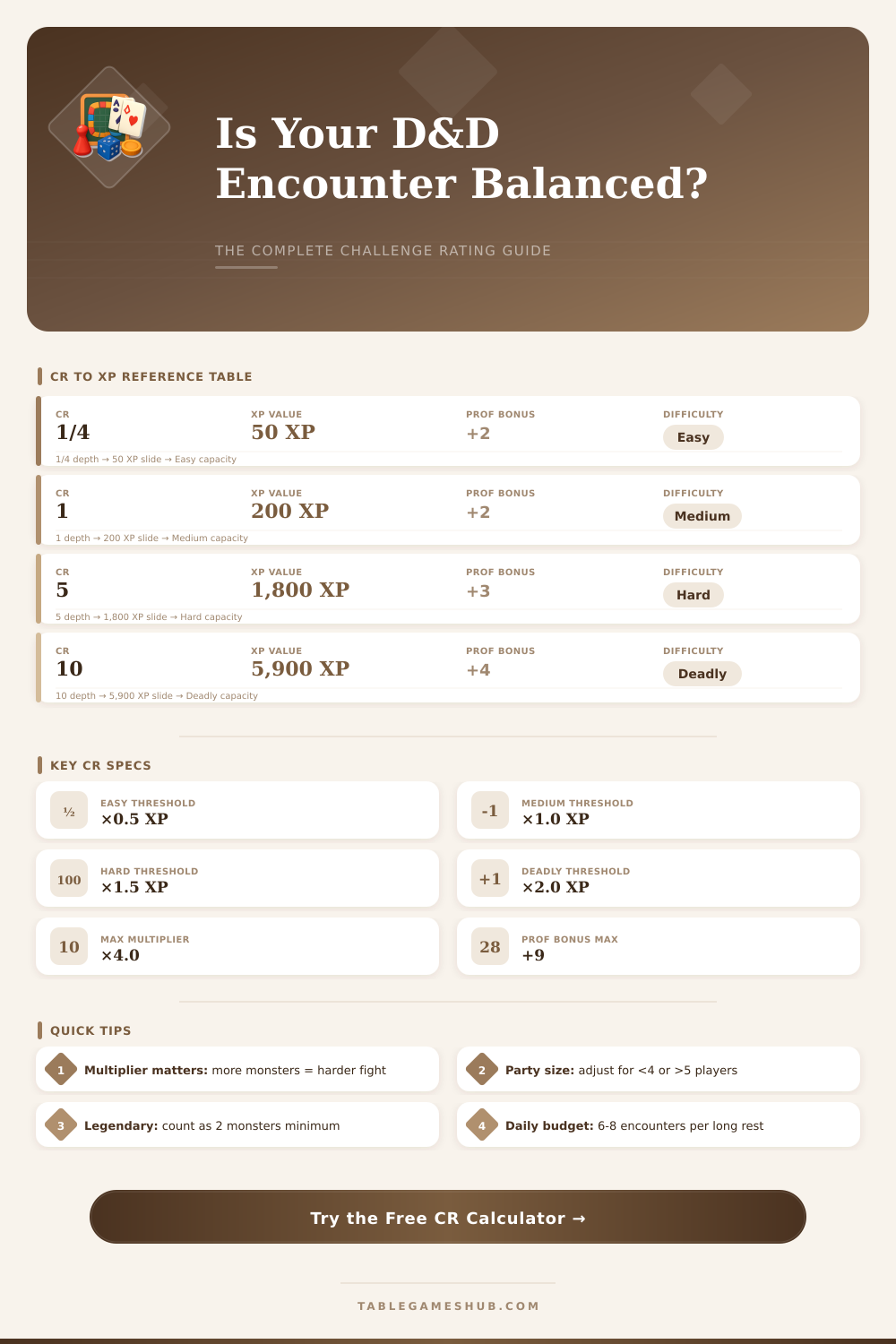
Challenge Rating, usually abbreviated as CR, is a tool for Dungeons & Dragons that helps the Dungeon Master plan encounters and risks fit for the players. It shows how serious a threat a monster forms. The main idea is that a creature of a particular CR presents a medium challenge to four characters at the same level.
Like this, a monster with CR 5 should provide a good fight for four players of the fifth level.
What Challenge Rating Means
The system is based on a group of four members, that is quite well prepared, but not extremely mighty. After rest and with fit gear, such a group should beat a monster whose CR matches their level, without big troubles. When CR passes the party level, the monster becomes probably deadly.
Rather, if it is lower, the creature likely does not pose real danger.
Monsters have CR between 0 and 30. A creature of CR 0 cannot be considered a real challenge. CR 1/4 shows that it counts as a challenge for one lone character.
While CR 1/8 means that two such creatures can face one character. Roughly said, CR 10 should give standard combat trouble to four characters at teh tenth level.
Even so CR stays only a rough guess. Every Challenge Rating is only close. Different parties handle things differently.
For instance, a group with many divine players struggles more effectively against undead. Also the amount of enemies plays a big role. The economy of actions matters a lot, a party receives one turn each member, commonly with several attacks, like this one monster can quickly find itself beaten.
Because of that, many encounters require extra creatures or more tough versions too stay interesting.
Changing the monster count or party size also affects the trouble. Six characters at the third level could face one monster of CR 7 for the same challenge, while three players of the same level find it at a CR 3 creature. The attack force of a monster does not decide everything.
One creature maybe strikes hard, but with only 4 hit points in total, its CR sinks, because the defense is bad.
Some think the CR system entirely unreliable. Four characters at the fifth level sometimes can easily beat a monster of CR 9 or even 10, yet die because of several creatures of CR 1. The skill of the DM running the encounter is likewise important as the numbers.
There even exists an improved method for building better encounters, called Challenge Rating 2.0, that was born after studies showed important flaws in the original version. Combining XP budgets with CR, instead of depending only on CR, helpsfor creating fair fights.