📋 Contract Bridge Score Sheet Calculator
Score contracts, overtricks, slams, and penalties with a clean bridge ledger.
| Measure | Formula | Value | Score sheet note |
|---|
| Level | Minor suit | Major suit | No trump |
|---|---|---|---|
| 1 | 20 | 30 | 40 |
| 2 | 40 | 60 | 70 |
| 3 | 60 | 90 | 100 |
| 4 | 80 | 120 | 130 |
| 5 | 100 | 150 | 160 |
| 6 | 120 | 180 | 190 |
| 7 | 140 | 210 | 220 |
| Bonus | Not vul | Vulnerable | Notes |
|---|---|---|---|
| Partscore | 50 | 50 | Below 100 |
| Game | 300 | 500 | 100+ pts |
| Small slam | 500 | 750 | Level 6 |
| Grand slam | 1000 | 1500 | Level 7 |
| Insult | 50 | 100 | Doubled make |
| State | Not vul | Vulnerable | Notes |
|---|---|---|---|
| Undoubled | 20 / 30 | 20 / 30 | Same strain |
| Doubled | 100 / 200 | 200 / 400 | Per overtrick |
| Redoubled | 200 / 400 | 400 / 800 | Double doubled |
| Down | Undoubled | Doubled | Redoubled |
|---|---|---|---|
| 1 | 50 / 100 | 100 / 200 | 200 / 400 |
| 2 | 100 / 200 | 300 / 500 | 600 / 1000 |
| 3 | 150 / 300 | 500 / 800 | 1000 / 1600 |
| 4 | 200 / 400 | 800 / 1100 | 1600 / 2200 |
Use this contract bridge score sheet calculator to total tricks, bonuses, and penalties in one place, making every board easier to verify before the result goes on the record.
In order to score bridge with duplicate bridge, an understanding of several different component is necessary. Components such as trick value, bonuses, penalties, vulnerability, and multiple scoring section must be understood to calculate the score for each player correctly. Should the tricks or any of the other component be calculated incorrectly, the total score for the game can become inaccurate.
Bridge score are divided into two sections: the points scored below the line and the points scored above the line. The points scored below the line are the total value of the tricks that were made according to the contract. The points scored above the line are any bonus or penalties.
How to Score in Duplicate Bridge
For instance, if the tricks scored by the contracts reach a certain amount, the maker of the contract will score a bonus for making a game contract. If the tricks made by the players did not reach the necessary tricks to earn the game bonus, they will score a partscore instead of a game score. The value of the tricks scored by the players are based off the suit of the tricks made.
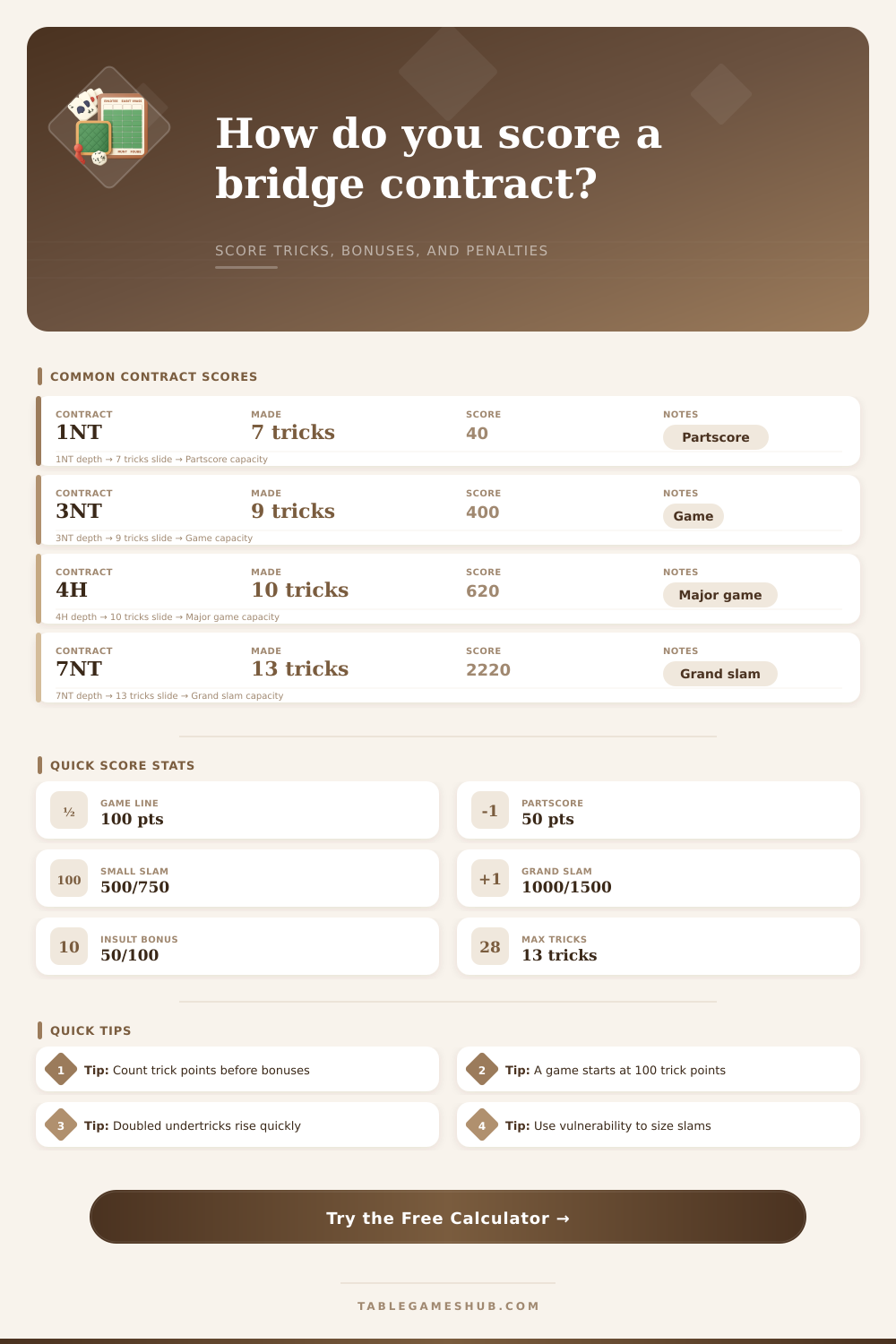
If the tricks made are of the minor suits (clubs or diamonds), the tricks will score 20 point each. If the tricks made are of the major suits (hearts or spades), the tricks will score 30 points each. If the contract made by the players is a no-trump contract, the first trick will score 40 points, but each trick after the first will score 30 points.
If the contract is doubled, the players will score each trick as if it was multiplied by two. If the contract is redoubled, each trick will score as if multiplied by four. Vulnerability for bridge involve the number of points that are awarded or lost by the players for making or failing to make the tricks of the contract.
If a player is non-vulnerable, they will score fewer points for losing tricks than if the player is vulnerable. For instance, if a player loses one trick to the opponents in a doubled contract, the vulnerable player will score a loss of 200 points, but the non-vulnerable player will score a loss of only 100 points. Because losing tricks results in a vulnerability for the losing player, the opponents of the vulnerable player will seek to force them into a vulnerable position.
In addition to vulnerability, players can score a variety of bonus for fulfilling the conditions of their contracts. If a contract scores enough tricks to fulfill the requirements for the game contract, the player will score a bonus for making a game contract. Additionally, if the player doubles the contract and fulfills it, the player may score an insult bonus for the tricks they made.
Finally, if a player scores enough tricks to fulfill a slam contract (small slam or grand slam), they will score a bonus for making a slam contract. The most common mistake made in bridge scoring are usually the result of forgetting to account for vulnerability or doubling the contract of the player. To calculate the tricks made by a player, you should of first calculated the number of tricks the player needed to make their contract.
After determining the total tricks required for the contract, that number can be compared with the number of tricks that the player actualy made. If the player made more tricks than required of the contract, they have overtricks. If the player made fewer tricks than required to fulfill the contract, they scored undertricks.
Presets can be used to calculate bridge scores quick. A preset will ask for the contract that the players made, the number of times that the contract was doubled, and the vulnerability of the player. The vulnerability and the other information will determine the score that the preset calculates.
The output of the preset will indicate the net score for the declarer side, the contract points scored below the line, and the bonuses (or penalties) scored by the player above the line. Additionally, another error that can be made is forgetting that overtrick points change with doubled contracts. For example, each trick made beyond those required to fulfill the contract will score 100 points if the contract was doubled, but will score 200 points if the contract was redoubled.
Finally, another error that can be made is forgetting which side of the bridge is the declarer side (east-west or north-south). The declarer side is the side that scores points for fulfilling the contract. By remembering each of these components of duplicate bridge scoring, a player can accurately calculate the score of each player.