🎳 Bowling Handicap Calculator
Calculate your exact bowling handicap for any league format. Enter your average and league settings below.
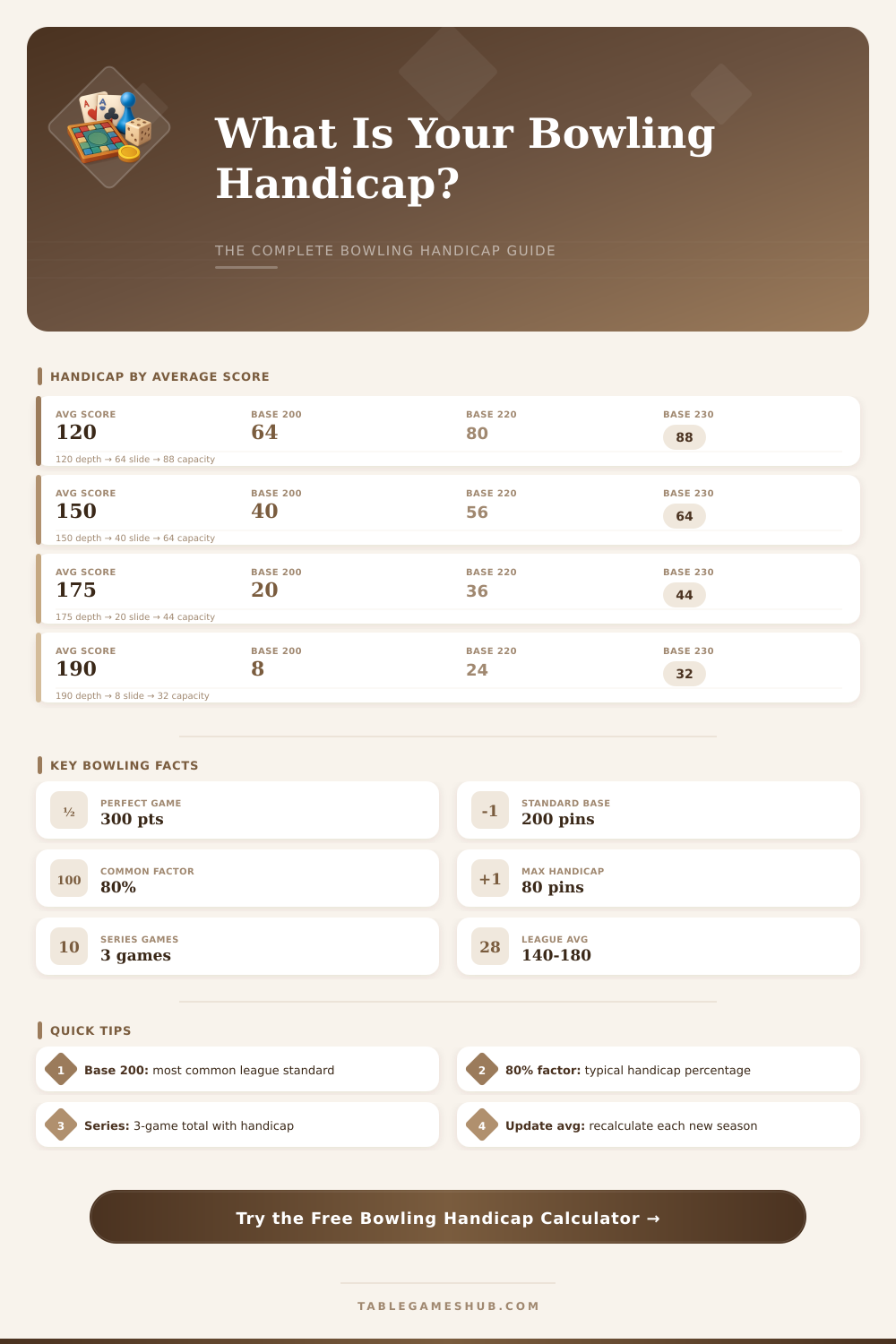
| Bowler Average | Handicap (Base 200) | Handicap (Base 210) | Handicap (Base 220) | Handicap (Base 230) | Skill Level |
|---|---|---|---|---|---|
| 100 pins | 80 | 88 | 96 | 104 | Novice |
| 110 pins | 72 | 80 | 88 | 96 | Novice |
| 120 pins | 64 | 72 | 80 | 88 | Beginner |
| 130 pins | 56 | 64 | 72 | 80 | Beginner |
| 140 pins | 48 | 56 | 64 | 72 | Developing |
| 150 pins | 40 | 48 | 56 | 64 | Developing |
| 160 pins | 32 | 40 | 48 | 56 | Intermediate |
| 170 pins | 24 | 32 | 40 | 48 | Intermediate |
| 175 pins | 20 | 28 | 36 | 44 | Above Average |
| 180 pins | 16 | 24 | 32 | 40 | Above Average |
| 190 pins | 8 | 16 | 24 | 32 | Advanced |
| 200 pins | 0 | 8 | 16 | 24 | Advanced |
| 210 pins | 0 | 0 | 8 | 16 | Expert |
| 220 pins | 0 | 0 | 0 | 8 | Expert |
| 230+ pins | 0 | 0 | 0 | 0 | Elite |
| League Type | Typical Base | Factor % | Series Games | Avg Range | Max Handicap |
|---|---|---|---|---|---|
| Beginner / Recreational | 200 | 80% | 3 | 80–130 | 96 pins/game |
| Standard Adult League | 200 | 80% | 3 | 120–180 | 64 pins/game |
| USBC Certified League | 220 | 80% | 3 | 130–200 | 72 pins/game |
| Senior League (65+) | 200 | 90% | 3 | 100–170 | 90 pins/game |
| Youth League (Under 18) | 200 | 100% | 3 | 60–150 | 140 pins/game |
| Mixed Ability League | 230 | 80% | 3 | 100–200 | 104 pins/game |
| Scratch League | N/A | 0% | 3 | 160–300 | 0 pins/game |
| Tournament (USBC) | 220 | 80% | 6 | All levels | 96 pins/game |
| Measurement | Imperial | Metric | Notes |
|---|---|---|---|
| Lane Length (foul line to pins) | 60 ft | 18.29 m | USBC regulation |
| Lane Width | 41.5 in | 105.4 cm | USBC regulation |
| Approach Length | 15 ft (min) | 4.57 m | Behind foul line |
| Pin Spacing (center-to-center) | 12 in | 30.48 cm | Equilateral triangle |
| Headpin Distance from Foul | 60 ft | 18.29 m | 1-pin position |
| Ball Diameter (regulation) | 8.5 in | 21.59 cm | Max diameter |
| Ball Weight (max) | 16 lbs | 7.26 kg | USBC max |
| Ball Weight (common adult) | 14–16 lbs | 6.35–7.26 kg | Recommended range |
| Pin Weight | 3 lb 6 oz – 3 lb 10 oz | 1.53–1.64 kg | USBC certified |
| Pin Height | 15 in | 38.1 cm | USBC regulation |
| Number of Pins (per game) | 10 pins | 10 pins | Standard tenpins |
Bowling belongs to those sports that answers for all, children, adults, grandparents. Naturally, it requires skill and accuracy, plus a good bit of chance. But here is the key point: if you are new to the game and find you competing against expert bowlers, it can seem very scary.
Here steps in the system of handicap, to even the chance out.
How Bowling Handicaps Work
handicap in bowling is simply a number that one adds to your real score, to level the game between players of different skills. It does not mean to be a prize or penalty, think about it rather as a tool for balance. The idea itself is quite simple: if you have a lower average, you receive a bigger handicap.
On the other hand, a higher average shrinks your handicap. It scales the other way.
Here is how the math truly works. Most leagues use a formula that looks somehow like this: one starts from a base score, takes away your average, then multiplies by a certain percentage. Round that down to a whole number, and done.
Assume that a league applies 80% of 220 for the handicap calculation. If your average is 175, you win 36 pins added to your score. It is 220 minus 175, which gives 45.
Multiply that by 0.8, and you recieve 36.
When you already have your handicap counted, the next stage is to add it to your score from the game. Assume you reach 160, and your handicap is 47? That lifts your adjusted score to 207.
Here is the number that truly matters… It is used for team ranks, personal recognition and entry to tournaments.
Various leagues decide on the base score and the percentage that they use. One commonly finds bases at 200, 210 or 220. The base number is meant to be higher then the average of any player in that league.
Some leagues even look back to the best average of the past season and round it upward. If last year a player averaged 225, maybe the league sets the base at 230. The percentage usually sits between 80% and 90%, which truly affects how fair the results seem.
But here is where it gets interesting. Unless a league uses 100% handicap for all, players with a lower average do not truly receive an equal chance. Studies about handicap leagues showed something surprising: at 80%, teams above the average won all 100 championships in the studied cases.
Even raising it to 90% did not help a lot… Teams above average still took 89 from 100. Only with full 100% handicap, teams under average managed to win 30 from 100 times.
The idea that handicap does everything perfectly fair? It is more myth than reality.
New bowlers without a prior season under their belt set their average from their first games. Notably: the handicap numbers adjust from week to week, because it follows the current average. Some players get upset because of handicap leagues, because going above a 120-average seems simpler than working to 200.
Your best strategy is stayingfocused on your rolls and chasing your own progress with every game.