Belote Coinche Contract Calculator
Score one Coinche deal from the bid through coinche or surcoinche, belote/rebelote, capot, contract success, failure, and transferred points.
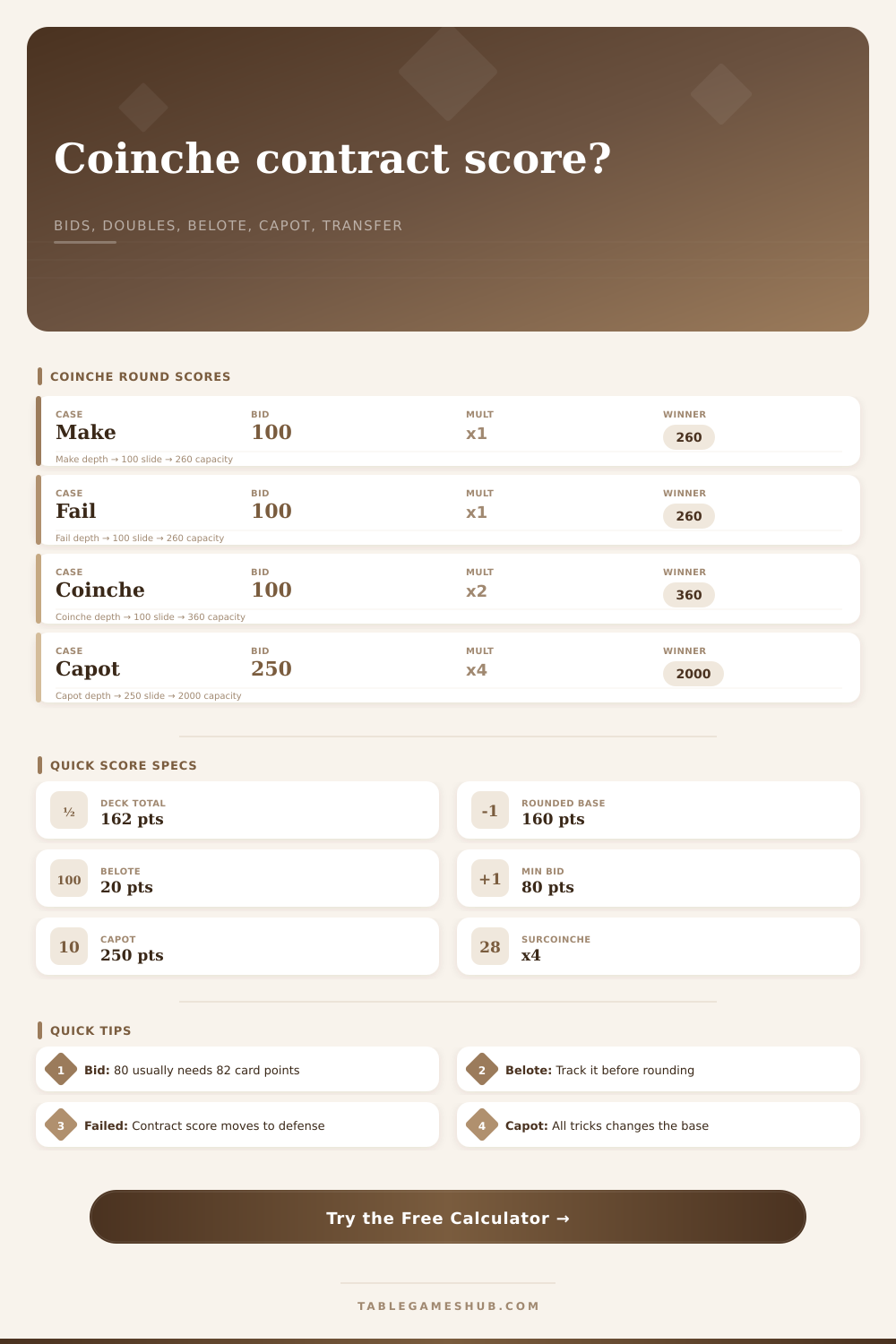
Enter the taker team's card points from tricks, including the last-trick 10. The defender trick points are calculated as 162 minus the taker points unless capot is selected.
Plain Contract
A 100 bid with 106 trick points is made. Score the taker tricks, add the 100 contract, then give defense its tricks.
Team Transfer
If the takers reach only 96, their trick score is transferred into the defense result with the failed contract bonus.
Doubled Contract
With bid-only scoring, the bid component doubles. With winner-round scoring, the winner's full round score doubles.
All Tricks
A declared capot uses 250 for the contract and 250 for the capot base; failure sends that value to defense.
| Situation | Made contract team | Failed contract team | Defense score |
|---|---|---|---|
| Normal bid, no coinche | Rounded tricks + bid + own belote | Own belote only | Own tricks if made; 160 + bid if failed |
| Coinche / contre | Bid x2, or winner round x2 by variant | Own belote only | Failed contract and hand points move to defense |
| Surcoinche / surcontre | Bid x4, or winner round x4 by variant | Own belote only | Same transfer pattern at the larger multiplier |
| Announced capot | 250 contract + 250 capot, then multiplier | Usually no taker score if missed | 500, or 1000/2000 if doubled/redoubled |
| Bid shown | Typical check target | Score component | Calculator handling |
|---|---|---|---|
| 80 | 82 trick points in many tables | 80 added to made score | Checks 82, scores 80 |
| 90 to 150 | Named bid value | Bid added or transferred | Compares taker total against bid |
| 160 | All ordinary points, not necessarily all tricks | 160 contract component | Still separate from capot selection |
| 250 capot | All eight tricks required | 250 contract plus 250 capot base | Requires capot result as taker all tricks |
| Item | Value | Contract check | Score-sheet effect |
|---|---|---|---|
| Belote/rebelote | 20 points | Optional by table rule | Added to declaring team's score |
| Normal failed contract | Transfer | Below bid or not ahead | Defense receives hand base plus failed bid |
| Unannounced capot | 250 base | Contract still uses original bid | Capot team gets 250 instead of trick total |
| Announced capot failed | 500 base | Any lost trick fails | Defense receives the capot contract score |
| Card rank | Trump value | Non-trump value | Scoring reminder |
|---|---|---|---|
| Jack | 20 | 2 | Highest trump point card |
| Nine | 14 | 0 | Second-high trump in classic suit contracts |
| Ace and Ten | 11 and 10 | 11 and 10 | Main non-trump scoring cards |
| King, Queen, 8, 7 | 4, 3, 0, 0 | 4, 3, 0, 0 | King and queen can create belote in trump |
Separate card points from score-sheet points. Count tricks to 162 first, then apply rounding, contract value, belote, and any coinche multiplier.
Agree the coinche variant before the first deal. Some tables multiply only the bid; others multiply the winning team's full round score and give the other side only belote.
Use the capot control for all-trick hands. A 160 bid and a capot are not the same scoring event, even when the takers win every card point.
Failed contracts are score transfers. The contract team normally loses its trick score, while the defending team receives the failed contract value plus the hand base.
In Belote, order comes from the score sheet. One moment you’re debating what should be in a trick, and then next you’re counting the cards’ value. Then you must decide whether you’ve won or lost the advantage for your team. Seems magical, but it’s just arithmetic wrapped in tradition. And there’s layers of arithmetic. You add raw point value of cards to the bid value. Then you adds any declared belotes and possibly a coinche multiplier. Keeping track of that in head leads to errors. That’s why a quick check on the math matter.
Now, back to the bid: Never bid amount of tricks you think you’ll win; bid the points that you think you’ll be able to take. That’s where beginners stumble. By choosing a contract value, you’ve triggered the calculator. It then perform the math. From there, it will tally the actual points from your trick and compare that total to the one which you bid. So if you bid eighty and took eighty-two in points, you made it. You get your bid points plus the points from those tricks. The defense recieve their points as well.
How to Score Belote
The trade-off is simple until bidding battle begins. Someone calls coinche. The stakes double. You can call surcoinche and it quadruples. At this point casual players freeze. They shouldn’t. Knowing which multiplier to use for each variant are important. There’s no universal standard, just like with the rules.
In fact, app lets you toggle between showing only the bid component or the whole round. Before first card is dealt, everyone needs to be clear on the rule at their table. Otherwise, you pick wrong multiplier and get confused. Think you’re ahead by two hundred points? Wrong. You’re really behind by four hundred. That destroys a fun night.
There is another wrinkle called belote. Holding king and queen of trump earns an additional twenty points. You get twenty points outside of tricks. It’s not part of the trick count, but rather fixed bonus awarded regardless. That’s where many player go wrong. Does it get checked as part of bid? Do we discuss it? Can I decide if it goes into the contract or does it just happen automatically? The calculator asks who declared it, allowing that choice. It’s a little thing, yes, but it makes all difference. Twenty points could mean a made contract or a failed one which leads to a huge points transfer to the defense.
The final swing is Capot. On a successful capot, where you win every single trick, it alters starting score of one hundred and sixty-two to two-hundred and fifty. When you announce a capot and make it the score shoots up considerably. However, if you lose even a single trick, the penalty are harsh. The points go over to the opposing team… Sometimes multiplied. This means that it is high-reward/high-risk shot.
The table makes this clear. Each scenario show the shift in scores. You can see what cost of a failed capot is at various multipliers. It helps visualize the risk before taking the shot.
But this is not about aggression, but about accuracy. If you bid high but don’t have points, you will lose. And that’s why the score system work: it turns anxiety into data so you stop guessing. With the calculator, you can check how well you did with your instinct. What would happen if you declared a belote? A coinche? Use the calculator to run numbers on a tight decision. You’ll go from anxious abstraction to solid data. You will go from guesswork to certainty. Which is why playing feels like fun instead of stressful.
Reading the cards… that’s Belote. Your opponents… that’s Belote too. Scoring… that’s what makes it all meaningful. Without the scoring, there’s no strategy. You have to trust the numbers or decisions don’t count.
Clean up the score sheet. Get an agreement on the rules at the start. Let the math carry the load. When everybody believe the total, the game runs smoother. You should of checked that first. It makes things naturaly easier.