Phase 10 Skip Calculator
Count skipped players, skip cards played, skip cards left in hand, wild penalties, phase progress, and round score in one clean Phase 10 scoring pass.
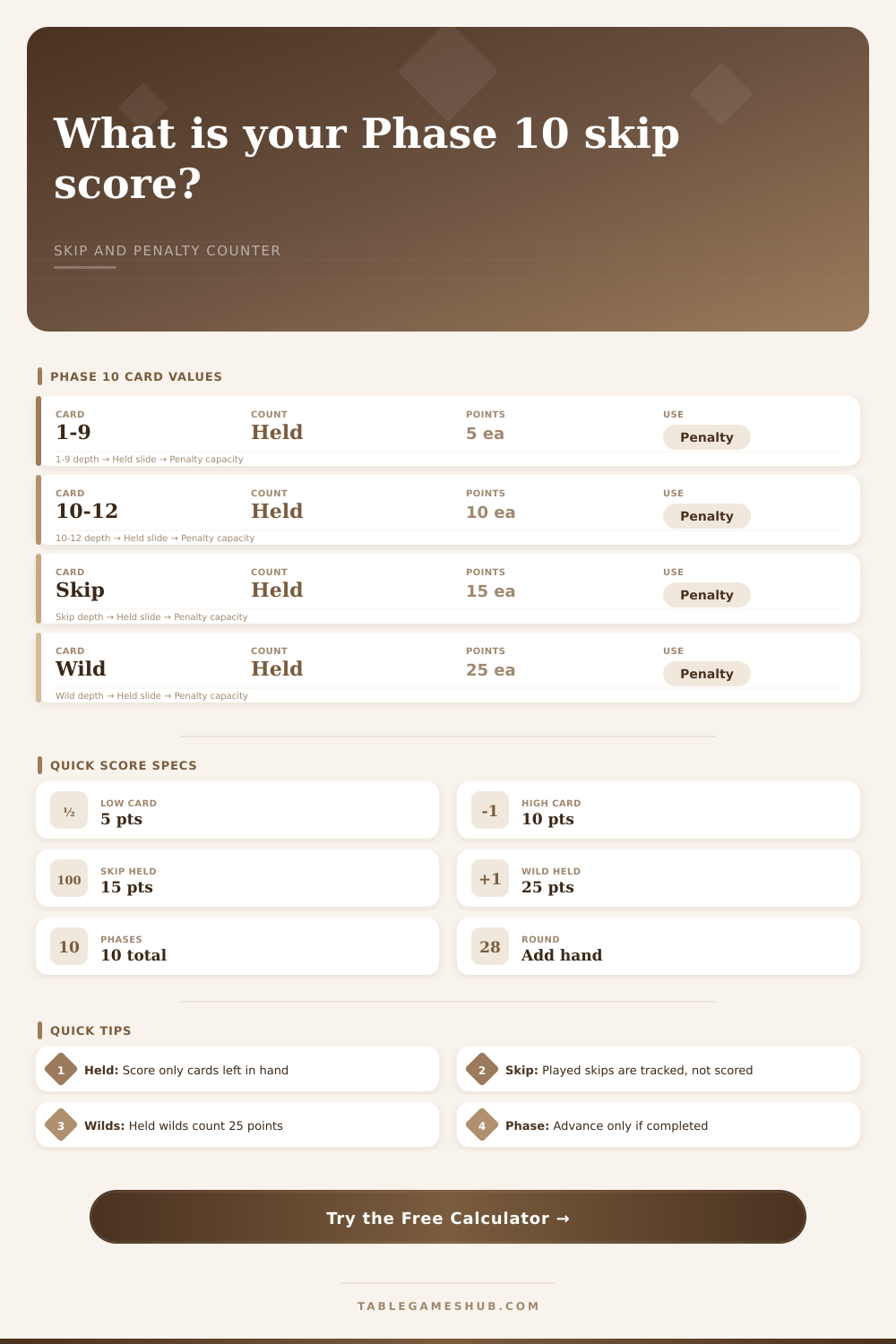
| Card group | Penalty value | Count when | Calculator field |
|---|---|---|---|
| Number cards 1-9 | 5 points each | Left in hand at round end | Cards 1-9 left in hand |
| Number cards 10-12 | 10 points each | Left in hand at round end | Cards 10-12 left in hand |
| Skip cards held | 15 points each | Unplayed and still in hand | Skip cards left in hand |
| Wild cards held | 25 points each | Unplayed and still in hand | Wild cards left in hand |
| Skip state | Score impact | Round log use | Common record note |
|---|---|---|---|
| Skip played to discard | 0 penalty points | Add to played skip count | Tracks skipped turns only |
| Skip left in hand | 15 penalty points | Add to held skip count | Counts with other leftover cards |
| Multiple skips used | 0 if none held | Count every skip card played | Useful for round summaries |
| Skipped player events | 0 penalty points | Count affected turns | May differ from cards played |
| Current phase | If completed | If not completed | Score entry |
|---|---|---|---|
| Phase 1-4 | Advance one phase | Repeat same phase | Add hand penalty |
| Phase 5-8 | Advance one phase | Repeat same phase | Add hand penalty |
| Phase 9 | Move to Phase 10 | Repeat Phase 9 | Add hand penalty |
| Phase 10 | All phases complete | Repeat Phase 10 | Add hand penalty |
Clean Out
No cards left means 0 hand penalty. The phase status still depends on whether the phase requirement was completed before going out.
Skip Held
Each skip card left in hand adds 15 points, separate from skip cards already played during the round.
Wild Held
Wilds are the heaviest leftover cards in this calculator at 25 points each, so they can dominate the hand score.
Phase Missed
The penalty is still added, and the next round repeats the same phase instead of advancing.
When the deck is gone and players are down to counting cards, Phase 10 gets interesting. No longer is it about dumping cards but about adding up point. Looking around at the cards that is still in your hand, you glance at all the wild card and skip cards. You know what they’re worth. That’s how many points you’ve paid, which can add up quicky.
And then there’s a special way to keep score, eliminating arguments and forgetting who owes whom how many point. If you don’t consider these card values, the rules are pretty strict. You’re aware the number cards tally into your score. What many people don’t know is how fast special card can raise your score.
How to Count Points in Phase 10
Having just one wild card sitting in your hand will cost you twenty-five points. That’s a big hit to your score on a single turn. The calculator above do the math for you. When you start racking up some penalty cards, it removes mental strain and let you separate game’s distractions from its score.
A lot of folks mistake held skip card with played skip card. Playing a skip card count zero points, even if you play it just to get rid of it. It’s out of your hand! But holding a skip card at the end of the round will cost you fifteen points. That’s one thing most people gloss over.
All skip cards are terrible right? Wherever you hold them? The tool keeps track of played and held skips as two distinct values. That way your log represents the action, but won’t ding you for skipped card you threw away.
Another element to strategy is phase progression. Let’s say you get rid of all the cards in your hand, but fail to meet the phase requirements so you remain on same phase. In this case, score still counts. Even though you didn’t move phases, those penalty points keep coming. Those little penalties add up over time, over multiple rounds.
You may have a player who think having three lower value card is better then one higher value card. Nope, it’s not. The five point penalty per lower value card starts to really pile up. Little by little, it cost you and hurts your chances of winning.
Wild cards should of used with care. Wild cards should be used with care. Wild cards are a dangerous liability to have in hand; they can helps you out of tricky situations, but they can also cost you serious penalty points. However, it’s risky business because they’re a liability too: each wild card is worth twenty-five points.
If you’ve got additional high-number cards in your hand, having at least one wild card double the points deducted from your final score. It’s tempting to hold onto them for the following round, but the price is steep. Consider whether it’s worth it or not. Will it gain you enough strategy points? Or will discarding the wild card now save you a lot more points later on? Even if you don’t quite have that ideal meld, sometimes discarding the wild card is the right play.
If you look at the page, you’ll see the reference table that shows how much of your score comes from each grouping of cards. You are not simply adding up scores. There’s a risk component here as well. A round is an opportunity to improve your score or add more penalty points… but keep in mind the penalty structure!
Each round starts fresh on the calculator. You won’t have to guess when analyzing your rounds after the fact. Enter the cards you have left and it will tells you where you stand. It is about damage control.
Phase 10 isn’t so much a scoring game as it is a liability game: recognizing and preventing your own hand’s weaknesses from causing harm. Fifteen points if you have a skip card; twenty-five points if you hold a wild card. Remember this while playing.
It’s easy math with high stakes. You’ll be glad you know exactly how many points you have when your opponent finds out after that last card hits the table.