Magic Hexagon Calculator
Check puzzle order, cell count, consecutive number range, target line sum, filled values, line totals, deviations, and remaining numbers.
Classic normal
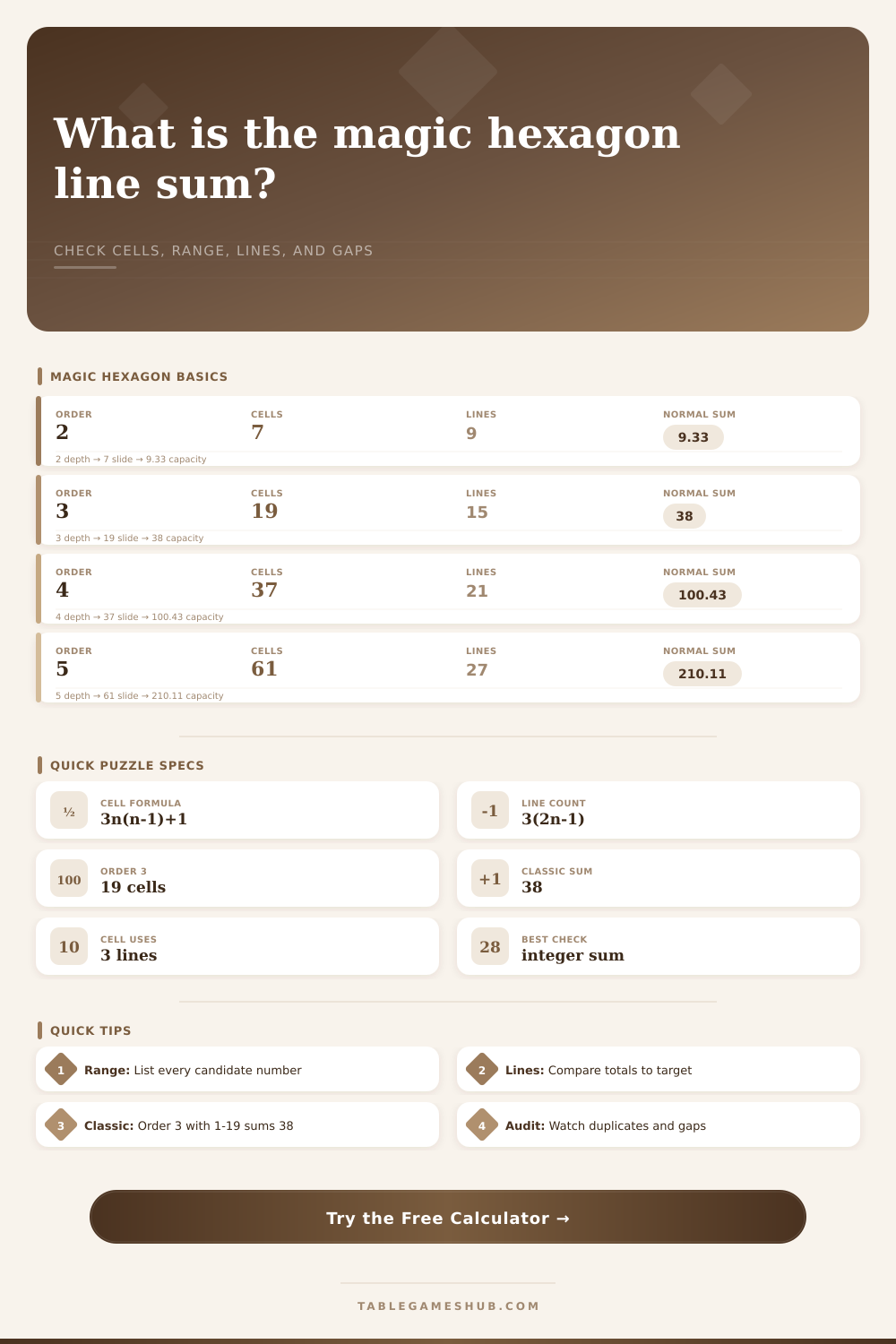
Order 3 with numbers 1 through 19 gives total 190 and target 38, the famous balanced case.
Shifted range
Changing the first number shifts every value and changes the target while preserving the cell geometry.
Stepped range
A step greater than 1 spaces the candidates evenly; the same average-value formula still applies.
Draft audit
Entered line totals do not prove placement, but they quickly reveal over-sum, under-sum, and exact lines.
| Order | Cells | Rows Across | Total Lines | Normal 1..N Target |
|---|---|---|---|---|
| 1 | 1 | 1 | 3 | 1 |
| 2 | 7 | 3 | 9 | 28 / 3 = 9.33 |
| 3 | 19 | 5 | 15 | 190 / 5 = 38 |
| 4 | 37 | 7 | 21 | 703 / 7 = 100.43 |
| 5 | 61 | 9 | 27 | 1891 / 9 = 210.11 |
| 6 | 91 | 11 | 33 | 4186 / 11 = 380.55 |
| Formula | Expression | What It Counts | Use In Puzzle Check |
|---|---|---|---|
| Cell count | 3n(n - 1) + 1 | All hex cells | Sets range length |
| Middle row | 2n - 1 | Longest line | Divides total sum |
| Total lines | 3(2n - 1) | All three directions | Audit capacity |
| Target sum | Total / (2n - 1) | Each line total | Must be integer for exact normal use |
| Range total | N(2a + (N - 1)d) / 2 | Arithmetic series | Handles shifted or stepped values |
| Range Style | Order | Numbers | Total | Target |
|---|---|---|---|---|
| Classic | 3 | 1 to 19 | 190 | 38 |
| Zero-based | 3 | 0 to 18 | 171 | 34.2 |
| Shifted | 3 | 10 to 28 | 361 | 72.2 |
| Odd values | 3 | 1 to 37 step 2 | 361 | 72.2 |
| Teaching mini | 2 | 1 to 7 | 28 | 9.33 |
| Line Check | Deviation | Meaning | Next Count |
|---|---|---|---|
| Exact | 0 | Matches target | Lock that line |
| Under | Negative | Needs more total | Use larger remaining values |
| Over | Positive | Too much total | Use smaller remaining values |
| Mixed | Both signs | Balance is uneven | Compare shared cells |
| No totals | Blank | Range-only audit | Start with target sum |
It’s a simple form but it hides complex mathematics. To most, it seems like you just put the numbers in place and there you have it: solved. Wrong. The math have no flexibility and geometry is fixed.
The system is one of equations where each number touches multiple lines. Placing tiles isn’t about laying things on a gameboard. It’s about balancing a system of equation.
How the Magic Hexagon Works
There are tools available to help in calculating the solution. For instance, calculator above will run the math for you. Instead of hours of manual addition it gives you immediate feedback. Is what you’re seeing possible?
Before forcing numbers, however, you should of be aware of the hexagon’s order. Standard order is three. This is the only order that provides an exact solution using numbers one through nineteen. Higher orders such as four and five will frequently has fractional sums. There will not be an exact solution using plain integers in these instances.
To see what I mean, take a look at the reference table on the page. That’ll show you nicely how the number of cell grows with each increase in order. Going up a level from three to four almost doubles the number of cells. At that point you’re dealing with lots more cells to handles.
When filling cells, the order matter less different than the distribution of values. Every line need to balance high and low numbers. Having a few large numbers clustered in a single corner make things imbalanced. That’s difficult to fix.
The tool can helps you identify those clusters. It measures how far away the sum deviates from the target value. A small deviation might look acceptable at first glance, it usually means there’s some underlying flaw in the puzzle. In the last few rows it could snap.
You can even play around with different ranges. By adjusting the step size and/or starting number, you change the arithmetic. For instance, if you use only odd numbers then that will impact your target sum. If you shift the range so it starts at ten, it preserves the same relationship between the numbers (by ratio). That’s handy if you want to create a customized puzzle for kids or just test your logic with different numbers. Easily adjust those parameters in the input fields. See the effect on the constraints. No need to start over calculating everything.
Don’t forget that each cell is owned by up to three lines. The tip and the center are their own; but all other cells is owned by two (or three). When you put a number down, it doesn’t just impact one sum. It impacts three. That’s what makes this puzzle challenging. You can’t take a line-by-line approach, you need a big-picture perspective on the board. You’re thinking in three directions.
Now we come to the other useful part of the display, which shows the rest of the values. It tells you what number(s) still need to be placed. When you’re stuck, you look at this list. You know your line is short on something, so you look through the unused numbers. Do they have the right combo? You can see whether they do or don’t. If not then you know you’ve already misplaced something. That’s fast feedback and speeds up the solve.
This teaches you to be patient with puzzles. It forces you to recognize the relationship of numbers. Numbers aren’t just numbers. They are values within that puzzle. When you solve it, there’s satisfaction in seeing the chaos resolve itself to symmetry. All of the lines sum to the same number. Each number take its place. There’s a small victory in it all. And the structure holds because the logic behind it is sound.
A lesson in constraints, the magic hexagon has a fixed grid and a fixed box of numbers to work within. How do you get from A to B? Where’s the freedom here? In navigating the given constraints.
What does the calculator do for me? It takes away the drudgery of checking my sums. It allows me to focus on strategy. It handles the arithmetic. It lets me handle the puzzle. Let me try things out, play around with patterns, test hypotheses. Find the balance that makes the system click. That’s where the fun lies.