Killer Sudoku Region Sum Calculator
Check cage sums, allowed digits, no-repeat rules, required or excluded numbers, possible combinations, min/max ranges, and the grid total left outside the cage.
| # | Digits | Sum | Notes |
|---|---|---|---|
| Ready | Set inputs | - | Results appear after calculation. |
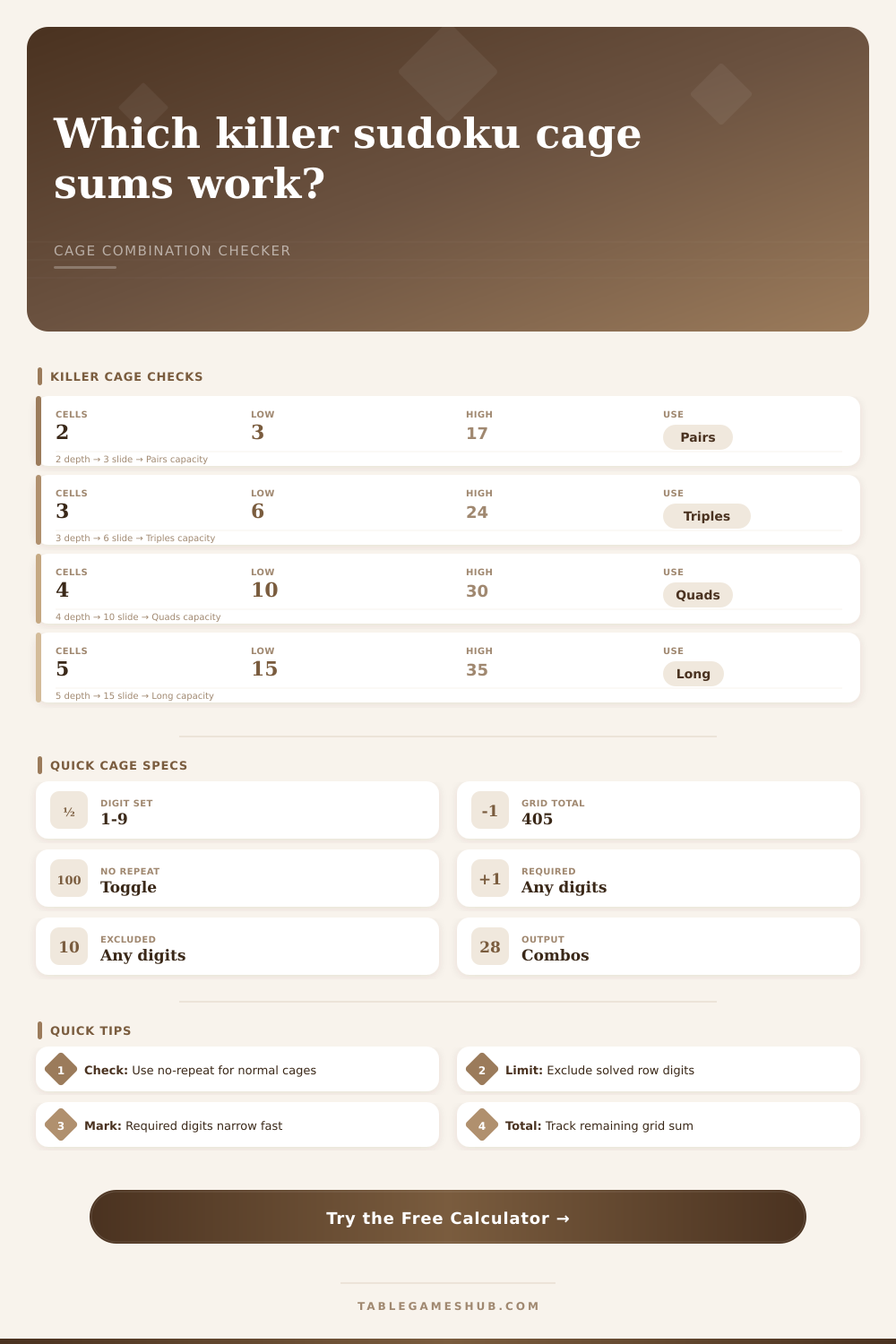
| Cells | Minimum sum | Maximum sum | Most useful clue style |
|---|---|---|---|
| 1 | 1 | 9 | Direct single digit. |
| 2 | 3 | 17 | Pairs such as 3, 4, 16, and 17 are highly restrictive. |
| 3 | 6 | 24 | Extreme triples narrow quickly; middle triples need cross-checks. |
| 4 | 10 | 30 | Balanced cages usually need row, column, or box exclusions. |
| 5 | 15 | 35 | Long cages often become useful after required digits are known. |
| 6 | 21 | 39 | Low and high six-cell totals create strong digit pressure. |
| 7 | 28 | 42 | The omitted digits often matter as much as included digits. |
| 8 | 36 | 44 | Only one standard digit is omitted in a classic no-repeat cage. |
| 9 | 45 | 45 | A full 1-9 set sums to 45. |
| Cage pattern | Target total | Combination count | Solving read |
|---|---|---|---|
| 2 cells | 3 or 17 | 1 each | Only 1+2 or 8+9, so the pair is fixed. |
| 2 cells | 10 | 4 | Middle pair with several alternatives. |
| 3 cells | 6 or 24 | 1 each | Only 1+2+3 or 7+8+9 in classic cages. |
| 3 cells | 15 | 8 | Classic flexible total; exclusions are important. |
| 4 cells | 10 or 30 | 1 each | Extreme totals identify all digits immediately. |
| 5 cells | 25 | 12 | Balanced long cage; required digits help most. |
| 6 cells | 21 or 39 | 1 each | Extreme six-cell cages force low or high sets. |
| 8 cells | 36 or 44 | 1 each | Find the single omitted digit from 45. |
| Puzzle format | Allowed digits | One set total | Full grid total |
|---|---|---|---|
| Classic 9x9 | 1-9 | 45 | 405 |
| Mini 6x6 | 1-6 | 21 | 126 |
| Tiny 4x4 | 1-4 | 10 | 40 |
| Variant 10 digits | 0-9 | 45 | Depends on grid shape |
Unlike regular sudoku, killer sudoku is all about deduction, no guesswork. You’re presented with a grid similar to regular sudoku (with its usual rules), but with clues provided as sums instead of digits. Numbers is obscured so it’s a mess initially. You have these targets such as fifteen or twenty-two, and your job are to figure out what digit can fit within them.
This is where the trick lies. Since there is limits on how many you can use, each cage acts like a small logic puzzle, and solving one will change possibility elsewhere in the grid. Most people gets stuck because they don’t rule combinations out early enough.
How to Use the Killer Sudoku Calculator
For the difficult part of figuring out all the combinations of numbers that sum to whatever amount you want, there’s the calculator (above). No need to write them all down; it does that for you. All you have to do is put in how many cell and what the sum should be. That sets everything up.
Where it gets realy useful are the filters: If two or more cells is on the same row as each other or on the same column as each other, then under standard rules of killer sudoku, you don’t use the same digit twice in a cage. You can turn that filter off here, which is sometimes helpful. For ordinary puzzles, leaving it turned on, don’t use the same digit twice in a cell… Is typically right. Turning it on will cut way back on valid options. If you have a three-digit cage with a sum of 15, there might be eight possible combinations without any restrictions on repeated digits. But if you can’t repeat digits, there will be fewer.
That is when the solving begins. And don’t forget to look at edges of your puzzle: The extreme clues are best. If there is a sum of 3 in a two-cell cage, that can only be one and two. If it’s a total of 17 in a two-cell cage, then they must be eights and nines. It’s easy to see from the reference table on the page that extremes, minimums and maximums, determine rigid combos as pairs and triples. Once you spot those extremes, you’ll know exactly where to put the digits right away, and not have to entertain any alternatives. So looking for highest and lowest totals is key early on. Those numbers tie down the grid.
Some of the digits will force themselves into a cage as you fill the board with other exclusions. For example, if you have a five and a four in one row, you’ll also be able to put that information into the excluded digits section because you’re certain the particular cell can’t contain a four or a five. That’s when the solver comes into play. Rather than keeping track of every constraint in your head, you simply feed the solver what you do know so that it can eliminate what isn’t possible. You provide the solver with what you believe to be true, and it responds with what must be true. It transforms fuzzy guesswork into definite removal.
Another small but incredibly useful function is the leftover grid total feature. By default the 9 x 9 grid add up to four hundred and five. Once you solve half the puzzle, add the sum of the filled-in areas to the surrounding total area. The calculator will then display how much of that value still needs to be worked out. This lets you find mistakes before you reach a dead end. When you have a big cage and there isn’t a valid combination of numbers that add to the current amount left, you would of identified an error somewhere along the way. It’s a built-in solver path checker.
So in the end, it all comes back to information management. A killer sudoku begins with a blank slate and a few numeric clues. Add some numerical clues. Then apply arithmetic to figure out which combinations is possible, and logic to rule them out. The calculator makes that arithmetic faster, leaving you free to concentrate on the logic part. Now keep an eye out for hidden singles and intersecting constraints. And finally… Because it no longer generates combinations… You can cut down on mental fatigue and prevent dumb mistakes from creeping into calculations. It doesn’t make the puzzle any different than just how you attack it. You move from guessing to proving.