Dominoes Hand Value Calculator
Total a domino hand, check doubles, read exposed pips, flag spinners, estimate block penalty, and compare score chances for common domino sets.
Domino Hand Count
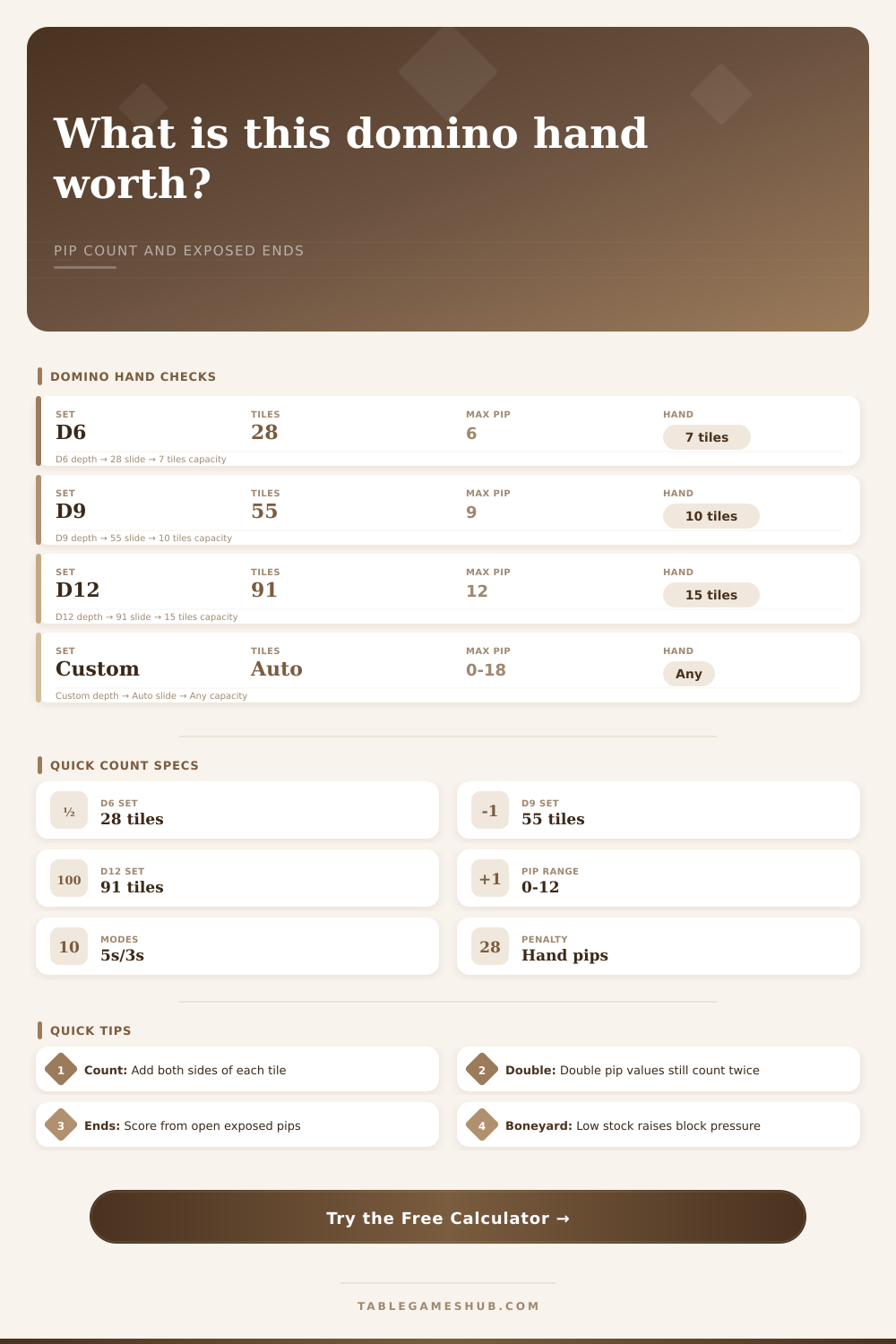
| Set Type | Total Tiles | Highest Pip | Common Hand Size | Full Set Pip Sum |
|---|---|---|---|---|
| Double-six | 28 | 6 | 7 tiles | 168 pips |
| Double-nine | 55 | 9 | 10 tiles | 495 pips |
| Double-twelve | 91 | 12 | 15 tiles | 1092 pips |
| Double-fifteen | 136 | 15 | 15 to 16 tiles | 2040 pips |
| Double-eighteen | 190 | 18 | 18 to 20 tiles | 3420 pips |
| Hand Signal | Double-Six | Double-Nine | Double-Twelve | Count Meaning |
|---|---|---|---|---|
| Very low hand | 0 to 16 | 0 to 30 | 0 to 55 | Small penalty if blocked |
| Average range | 17 to 32 | 31 to 55 | 56 to 95 | Normal pip exposure |
| Heavy hand | 33 or more | 56 or more | 96 or more | Large penalty if blocked |
| Double-heavy | 3+ doubles | 4+ doubles | 5+ doubles | More matching constraints |
| Scoring Mode | Board Count Used | Score Trigger | Best Input To Check | Calculator Output |
|---|---|---|---|---|
| Blockout penalty | Hand pips | Round ends blocked | Hand tiles and boneyard | Penalty value |
| Open-end multiples of 5 | Exposed pips | Total is 5, 10, 15, 20 | Exposed ends plus hand | Scoring plays |
| Open-end multiples of 3 | Exposed pips | Total is 3, 6, 9, 12 | Exposed ends plus hand | Scoring plays |
| Fives or threes | Exposed pips | Total divisible by 5 or 3 | All open arms | Combined score chance |
| Layout Item | How To Enter It | What It Changes | Counting Note |
|---|---|---|---|
| No spinner | Only open ends | Normal exposed count | Example: 6, 4 |
| Two-arm spinner | Include both arms | More matching points | Example: 6, 6, 4 |
| Four-arm spinner | Include every arm | Higher exposed sum | Example: 6, 6, 6, 6 |
| Low boneyard | 0 to 3 remaining | Greater block pressure | Penalty pips matter more |
Penalty Count
Best when a blocked round or empty hand awards the remaining pips against the holder. The calculator uses the hand total as the penalty value.
Open-End Count
Best for games where exposed ends score only when their sum reaches a target multiple. The calculator tests playable hand tiles against those ends.
Spinner Count
Best when a double opens extra arms on the layout. Enter each arm in exposed pips so the total and matching chances reflect the real board.
That’s where the dominoes hand value calculator comes in; it does the math for you. It’s one thing to know what the numbers are, and another to play consistentely well with them.
Most casual players think of game as just matching. Discard a tile first, then worry about the number count at the end of the round when blocking occurs. Ouch!
How the Calculator Helps You Win
If you understand weight of your hand, you’ll think different than every move. You’re holding seven tiles in a standard double-six set. That’s up to sixty-six pips in your hand. In reality, it’s probably around twenty-four. Anything over the high thirties (or so) represent risk. Having too many pips in your hand is a disadvantage. When the game stalls out, it will get heavier. The calculator tallies this risk. It adds up the pips in your hand and warns you about any doubles you may be holding.
Doubles are tricky. They appear powerful, but can limits your options down the road. Three or more doubles becomes a bottleneck. Maybe you’ll begin with strength. Then when the open ends don’t line-up with your doubles, you have no choice: you must either draw or pass. Either way, those high-value tiles remain in your hand.
When holding the tiles in your hand, you consider the value of the tiles but also exposed ends on the board. For example, with games such as Threes and All Fives, you are looking to score as many points as possible from that configuration. Minimizing the number in your hand isn’t what you’re trying to do. Spinner flags is accounted for by the tool. Many newbies ignore this detail. Multiple arms are created by a spinner. That means more opportunities for you to get threes or fives. And if you don’t take into account all these additional open arms, you could be missing high-scoring play. The page has a reference table that spells this out. The table shows how various configurations of spinners affect the total number of exposed pips. It isn’t about simply summing up what you see. It’s about knowing which of those add to the triggering number.
If you view the boneyard from context, it changes everything. With an empty stock, thirty pips in your hand spells danger. How will you get rid of that? What are you going to do with those tiles? With ten tiles left in the draw pile, a thirty-pip hand isn’t such a big deal. You’ll be able to trade away heavy tiles for something lighter. The calculator has a field where you enter how many tiles are still in the boneyard. It uses that to calculate how much trouble you’re in. When the draw pile gets dry, each and every one of those pips in your hand represent a possible penalty. Savvy players don’t just focus on what they need to play next; they start paying attention to the stock. The game becomes about damage control, and it’s not about matching anymore.
The rules for play determine whether to use open-end scoring or block-out penalty mode. For a block game, you try to get rid of all the tiles in your hand. You force opponents to take pips. The calculator calculates the penalty amount according to the blocked tiles left in their hands. For an All Fives game, it’s turned upside down. Regardless of what you hold, expose ends that total multiples of five. The tool turns around and shows which ones score, not avoid penalties.
Lots of groups mix up house rules or games during a round. Use the tool to test different scenarios without resetting the whole count.
If you’re playing double-nines (or double-twelves), it’s a whole other ballgame. There are more tiles on the table. The pip sums is exponentially bigger. What seems like an okay hand in double-six can feel shockingly light in double-nine. For those bigger games, the tool includes some benchmarks in its reference section. This helps adjust your intuition. It reminds you that what seems like a light hand in a big set is a heavy burden in a regular game. Adjusting to how different groups want to play comes from this mental switch.
In short: Dominoes is an information management game. Trade tiles for points. Trade space for time. Trade risk for reward. The math come from the calculator. Your job is to provide the strategy.
Be aware of the boneyard. Be aware of the doubles. Always consider the pip count. Once you get past looking at the dominoes as nothing but blocks, you’ll begin to see them as weighted assets. Then it’s no longer as much about luck and more about making calculated moves.
The pip count is the ledger. You are the accountant. Balance your books. The points will take care of themselves.