Rating Floor Calculator
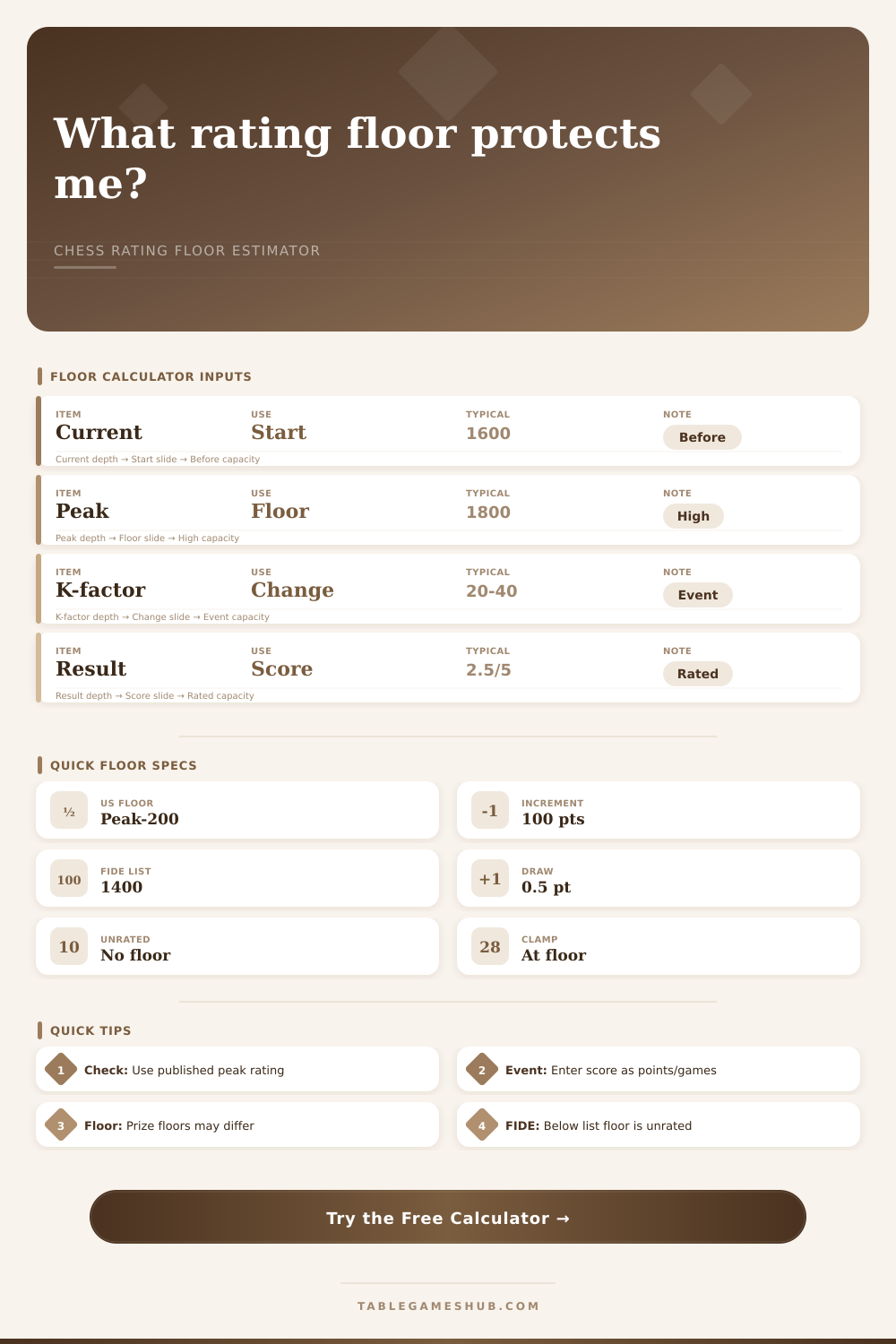
Estimate a chess or table-game rating floor, event rating change, rating drop exposure, protected-floor clamp, provisional status, and next floor threshold.
| Rating System | Floor Concept | Calculator Treatment | Official Check |
|---|---|---|---|
| US Chess established | Class floors tied to peak rating | Peak minus 200, rounded down to increment, common cap 2100 | Verify against latest US Chess supplement and floor notes |
| US Chess protected title | Fixed protected floor may override class floor | Protected mode displays 2200 in the US Chess model | Organizer or federation record controls |
| FIDE standard/rapid/blitz | List floor and unrated status threshold | Below 1400 is shown as unrated in current handbook model | FIDE Handbook B.02 effective March 2024 |
| Club or league | Local floors vary by section | Uses custom increment and peak minus two increments | Use league bylaws before publishing sections |
| K-Factor Case | Typical K | Rating Swing | Floor Note |
|---|---|---|---|
| FIDE new to list | 40 | Large | Used until rated events with at least 30 games |
| FIDE under 2400 | 20 | Moderate | Common established-player coefficient |
| FIDE reached 2400 | 10 | Small | Remains lower after reaching 2400 |
| Custom club rating | 16 to 32 | Local | Use the published club formula |
| Event Result | Input Format | Score Value | Floor Effect |
|---|---|---|---|
| Five-round even event | 2.5/5 | 50 percent | Usually near expected score |
| Bad four-round event | 1/4 | 25 percent | Can trigger floor protection |
| Strong upset run | 4/5 | 80 percent | May move peak toward next floor |
| Incomplete event | 1.5/3 | 50 percent | Count only rated games |
| Floor Band | Peak Needed | Protected Rating | Planning Use |
|---|---|---|---|
| Class C style | 1400 to 1499 | 1200 | Section eligibility checks |
| Class B style | 1800 to 1899 | 1600 | Near-floor drop monitoring |
| Expert style | 2200 to 2299 | 2000 | Master-candidate logistics |
| Maximum common class floor | 2300 plus | 2100 | Use official record for exceptions |
You enter a tournament, lose some games you shouldn’t, and see your rating decrease. But when you look at official list, nothing has changed much. Chances are you’re on a rating floor, a safety net in the chess rating system designed to keep players numbers from crashing during a poor run.
Knowing about rating floors will change your perspective on ratings. Your rating isn’t a fixed gauge of ability. It’s an asset with protection that needs to be managed strategicly.
How Rating Floors Protect Your Score
The idea of a rating floor comes from the fact that Elo scores is merciless when left raw. You play a bunch of games, get crushed in every round, and suddenly the numbers says you’re down a hundred points. That doesn’t make sense. It’s saying you somehow lost all of your skill at once. A rating floor stops this by limiting how far it’ll show you fell.
For instance, in US Chess, the floor is connected to your best-ever rating. Specifically, it’s your highest known rating with some sort of safety margin. What this means is that your previous successes actualy safeguard your current score.
Simply plug in your event result, your current rating, and your peak into the calculator on the page. It’ll do the math, and give you precise location of that floor. That doesn’t mean this is an infinite protection mechanism. It depends on your best play level. So if your best play is 1500, as a Class C player, then your protection floor is probably somewhere in the 1300s range. That’s assuming youve got increments set right.
Yes, you might lose some games and still be above that number. No, you can’t lose so many that you’re under it. The catch: You know what happens when your peak goes up? Your peak does too. When you win more often and raise your peak, then you raise your floor. Sounds great! Except now there’s a funny mental dynamic at work here. Now the net will rise as you go higher. There’s no sliding back into the land of easy protection.
How do other orgs deal with this? For example, the FIDE system operate on a list floor rather than a class floor. If you are below a certain level (typically around 1400), you will be listed as unrated. That’s a different type of protection: it masks the bottom instead of capping the fall. The page has a reference table that explains this. It juxtaposes the FIDE list model vs the US Chess model and custom club structures. It’s worth looking at what system applies in your case.
Implications for sectioning tournaments can vary wildly. Your displayed rating will determine your section in a US Chess event; but your actual calculated rating; hidden or not, will determine your pairing in a FIDE event.
The K-factor is one of the most important inputs players often overlook. The k-factor determines the magnitude of your rating change per game. The higher your K-factor, the faster it will move. Newer players on list have high K-factor. That’s because this lets them quickly settle into their rating. Provisional players typically lack a protected rating bottom, however. So while you’re a provisional player, you’re kind of flying blind… at least until you’ve played enough to set a base.
This is where the provision/rating-unrated mode come in. It removes the floor logic from the tool and shows you raw effect of your results.
The problem is, many players do not pay attention to their peak rating. They look at the one they have now. In class-based systems though, the peak determine the floor. So, let’s say you have a rating of 1600 right now, but your highest ever was 1800. Your floor is determined by the 1800. That means you’ve got a bigger cushion from a drop in rating. But if you allow your rating to fall to 1600 and fail to regain it, then the floor remains up there. Good. But if you get your rating all the way up to 1900? Well, guess what? The floor goes back up again. You’re always caught between wanting to raise your rating, but also not wanting to expose yourself too much.
The thing that’s helpful to realize about the floor: The floor is like a ceiling on your downside risk. You can’t go below it. You can go above it. That’s an asymmetric way of playing the game. It is asymmetric so the player stays in the game. Even if they have a terrible weekend, they know their rating’s still good by Monday morning. And that allows them to keep coming back. A lot of people wouldn’t play the game if they didn’t feel this safety net, because they’d get out after one horrible tournament.
So what’s the trick? Plan around these thresholds. What’s the number you want to avoid dropping below? For example, you might say, “I’m at 1800 and I don’t want to go lower than that.” This gives you an answer. How many more points do I have room to drop before hitting the floor? The tool answers this and it will show you the adjacent threshold. Where does my peak have to go so that the floor moves into a better band? It isn’t just about winning games. It’s about playing the system. You play the game.
Ultimately though, the rating’s nothing more than a number. It is a flawed measure of strength. Yet it matters. It determines what you’ll be paid. Who will you play. The floor acts as a buffer against the randomness of competition. It lets you take in some bad luck while still keeping you from being penalized forever. You may have lost the game, but you didn’t lose your rating. That’s the trade-off. You take the shield and you take the rules that accompany it. The floor protects you, but it also marks the boundaries of how far down you can fall.