Knockout Seeding Calculator
Plan single-elimination bracket size, byes, seed pairing slots, rounds, bracket halves, rematch protection notes, and table or board waves.
First-round slot preview based on standard bracket placement: highest seed opposite the lowest live seed or bye slot.
| Match Slot | Top Seed Slot | Bottom Seed Slot | Bye or Match Status |
|---|---|---|---|
| 1 | Seed 1 | Seed 32 | Bye if seed slot exceeds entrants |
| Round | Matches in Round | Tables Used | Waves | Estimated Clock Block |
|---|---|---|---|---|
| Round 1 | 8 | 8 | 1 | 40 min |
Power-of-two bracket sizes and logistics pressure points.
| Entrant Count | Bracket Size | Bye Range | Rounds | Common Use |
|---|---|---|---|---|
| 2 to 4 | 4 slots | 0 to 2 byes | 2 | Finals pod, small club night |
| 5 to 8 | 8 slots | 0 to 3 byes | 3 | Single table playoff or finals cut |
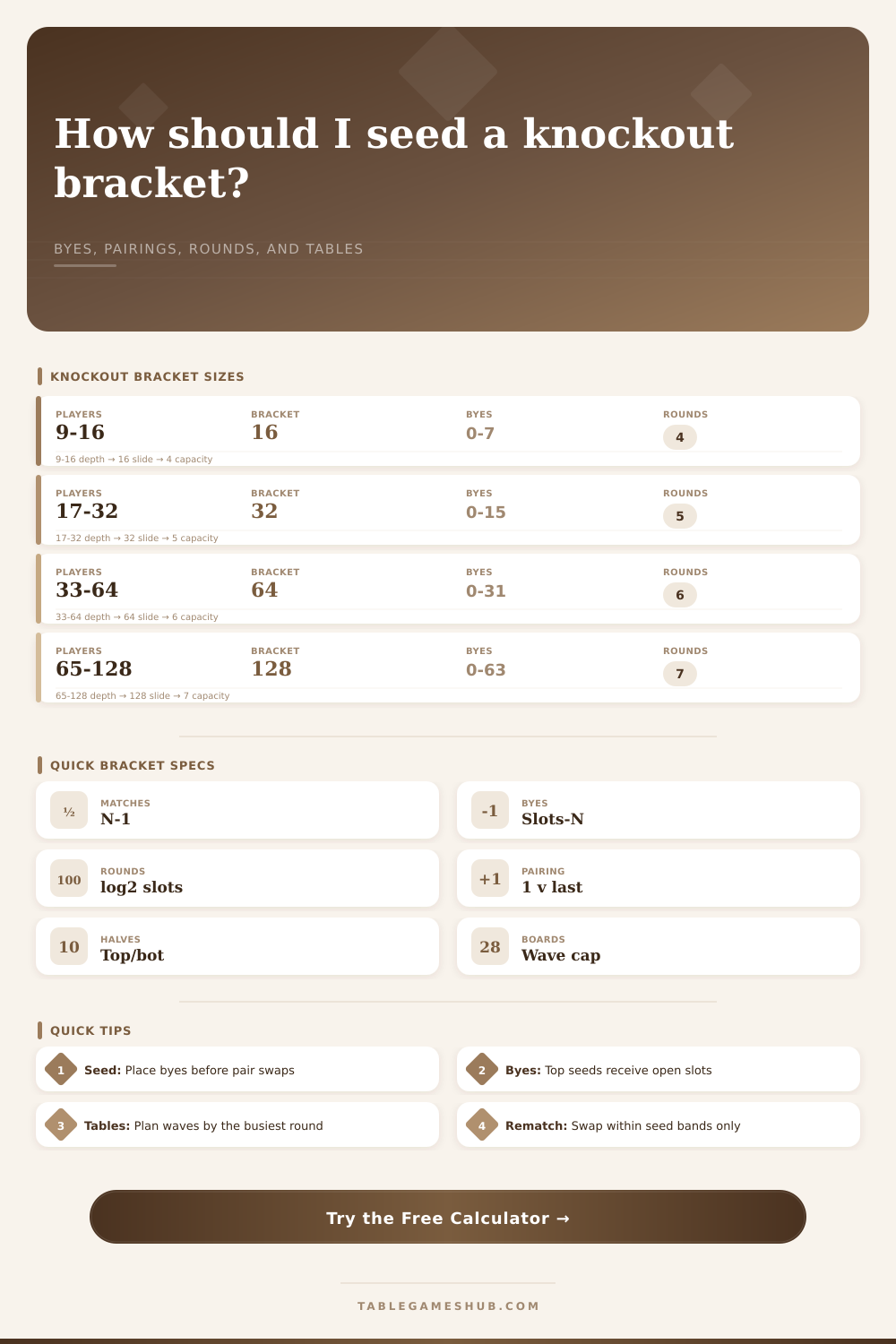
| 9 to 16 | 16 slots | 0 to 7 byes | 4 | Local knockout, school bracket |
| 17 to 32 | 32 slots | 0 to 15 byes | 5 | Regional tabletop event |
| 33 to 64 | 64 slots | 0 to 31 byes | 6 | Convention cup or large club day |
| 65 to 128 | 128 slots | 0 to 63 byes | 7 | Grand final bracket with zones |
Seeding policy effects for single-elimination logistics.
| Policy | Best For | Bye Handling | Pairing Risk | Organizer Check |
|---|---|---|---|---|
| Ranked seed list | Ratings, standings, qualifier points | Highest seeds first | Low | Confirm seed order before slots publish |
| Pool winner separation | Group stage into knockout | Pool winners first | Medium | Avoid same-pool first-round matches |
| Seed bands plus draw | Mixed skill or invited brackets | Top band first | Medium | Draw inside bands, then inspect halves |
| Random draw | Casual club knockout | Random or manual | High | Publish draw rules before shuffling |
Table and board count pressure by bracket size.
| Bracket Size | Peak Round Load | Comfortable Tables | Minimum Tables | Logistics Note |
|---|---|---|---|---|
| 8 | 4 matches | 4 | 2 | Two waves max before semifinals |
| 16 | 8 matches | 8 | 4 | One full first-round wave is clean |
| 32 | 16 matches | 12 to 16 | 6 | Watch late first-round finishes |
| 64 | 32 matches | 16 to 32 | 8 | Use table zones for top and bottom halves |
| 128 | 64 matches | 32 to 64 | 16 | Score desk and round calls become critical |
Common first-round bye interpretation.
| Entrants | Bracket | Byes | First-Round Matches | Seeds Usually Receiving Byes |
|---|---|---|---|---|
| 12 | 16 | 4 | 4 | Seeds 1 to 4 |
| 24 | 32 | 8 | 8 | Seeds 1 to 8 |
| 28 | 32 | 4 | 12 | Seeds 1 to 4 |
| 48 | 64 | 16 | 16 | Seeds 1 to 16 |
| 96 | 128 | 32 | 32 | Seeds 1 to 32 |
All Tables
Fastest schedule when every board can host the current round.
One Buffer Table
Slower by design, but useful for disputes, late results, or featured setup needs.
Split Halves
Top and bottom halves stay in separate areas until semifinals or final.
Once the registration period ends, it’s time to start bracketing. Now you’re looking at a list of people’s names and trying to slot them into some kind of format that will accommodate a certain number of participant.
It’s not just a mathematical problem; it’s also a logistics one. It is a logistics one. You want the underdog to believe he has an opportunity, while the top seed feels safe. And you want everything to wrap up in a reasonable amount of time.
How to Set Up Your Tournament Bracket
After you enter your tables and your player, the calculator does its thing. It spares you from having to guess about how many waves can be run before running out of room. How long you should allow for a break between. Still, you need to know what those figures represent. What makes this a pro event as opposed to a crazy one.
Single elimination mean that there’s no second chance. When you lose, you’re done. And as far as fairness goes, seeding carries the weight of fairness and byes protect high seeds. That means when you’ve got twenty-four players, you don’t squish them all into a grid with twenty-four slots. You stretch to thirty-two. Then you add eight byes. Why? It makes sense: twenty-four plus eight equals thirty-two. But people miss it. Who gets those byes? The top seeds, of course. The rest they get for being consistent. A minor prize for staying on point. And it’s good because it preserves the integrity of the bracket.
Spread those byes at random, and the guy who was seeded number one could end up playing twice in Round One. The number three seed might get a bye. People mess this up. They believe fairness means even play. In knockout events, you must protect the ranking.
Now onto tables. Depending on the game, you’ll need some sort of board or screen. That’s when the physical world and the abstract bracket meet. Maybe you got that perfect seed list. Perhaps you only have four tables for a thirty two player bracket. That means the first round’s gonna be a doozy.
Based on the number of tables you inputted into the tool, it determines the waves. And now you have to read between the lines. How much time does each wave represent? If the average match drags out, then one extra wave pushes the event beyond closing time. Do you leave an open table as a buffer in case there’s disputes? Or do you use every available surface to maintain momentum? It’s an operations tradeoff, but it impacts the whole afternoon.
Finally, there’s rematch protection, something that no one wants to deal with but most organizers overlook. Two guy who played each other in their pool get rematched in Round 1 and cry foul. They think it’s fixed. And maybe the math checks out, but still. Having the calculator lets you write down matches between players where rematch is known. Before you publish your pairings, make some quick swaps inside seed bands. It is a minor adjustment on paper. At the score desk, however, there’s no big headache.
You’re shaping the story of the tournament. You don’t want the finals predetermined by poor draw luck. You want to see the final teams earn it.
For bigger tournaments, I think this is made clear by the reference tables on the page. When you’re over 64, you’re entering unknown territory. You’ve gone from being able to manage things to needing them managed. Here, you’re dealing with a flow of players moving around. For larger events with over sixty-four entrants, your bracket’s going to have to be separated physically between the bottom and top halves. Otherwise, there will be bottleneck issues. Seems rigid, but trust me, there’s a reason why it happens that way.
When there aren’t any physical limits, your players becomes lost. Scores get confused. What was meant to be a competition becomes a crowd control problem.
The bracket makes that promise. It is the promise of the best rising to the top. Of the structure holding up under them.
And how do you create that structure? By honoring the byes. Planning the waves. You watch the clocks. Get the seeding correct. Let the event run itself. Step back. Leave the players to their own devices. Let the drama play out.
That is how it should of been. That’s what you want. More than a winner. A story that rings true at the end of the last match.