Accelerated Pairing Calculator
Estimate Swiss acceleration bands, pairing-only points, scoregroup pressure, top-half and bottom-half pair counts, floaters, byes, and pairing room workload.
| Method | Band idea | Pairing-only points | Logistics consequence |
|---|---|---|---|
| Baku-style acceleration | Top half is treated as an accelerated group. | Full points first, then half points in later accelerated rounds. | Creates separate high and low pairing brackets for early rounds. |
| Standard added point | Top half is paired as if it has an extra point. | Usually 1 point for the first two rounds. | Often produces top-half games sooner than a normal first round. |
| Sixth-band opening | Players are divided into six rating bands. | Top bands are steered against adjacent bands. | More bands mean more checks, especially after upsets and draws. |
| No acceleration | Normal scoregroups by actual score only. | None. | Lower review load, but large sections may keep many perfect scores. |
| Scheduled rounds | Accelerated rounds | Full-point rounds | Half-point rounds |
|---|---|---|---|
| 5 rounds | 3 early rounds. | Rounds 1 and 2. | Round 3. |
| 7 rounds | 4 early rounds. | Rounds 1 and 2. | Rounds 3 and 4. |
| 9 rounds | 5 early rounds. | Rounds 1, 2, and 3. | Rounds 4 and 5. |
| 11 rounds | 6 early rounds. | Rounds 1, 2, and 3. | Rounds 4, 5, and 6. |
| Pairing term | Operational meaning | Calculator estimate | Arbiter check |
|---|---|---|---|
| Scoregroup | Players sharing the same actual or pairing score. | Uses completed rounds, draw pressure, and virtual-point split. | Confirm actual standings before pairing the next round. |
| Pairing bracket | The working group being paired, including incoming floaters. | Odd scoregroups add floater review units. | Check repeat opponents and color preferences. |
| Downfloater | A player moved to a lower bracket for a legal pairing. | Estimated from odd brackets and band imbalance. | Track repeated floats across rounds. |
| Pairing bye | One unpaired player in an odd section. | Odd player count adds one bye pressure point. | Apply the event's bye eligibility order. |
| Signal | Supports acceleration | Caution signal | Document before round 1 |
|---|---|---|---|
| Entry count versus rounds | More than 2 to the power of rounds plus 1 is a common warning line. | Small sections rarely need artificial early separation. | State whether acceleration is used. |
| Rating spread | Large top-to-bottom spread makes band separation more meaningful. | About 100 rating points or less across the field weakens the case. | State the rating list and seeding order. |
| Unrated or provisional share | Low uncertainty keeps seeded bands trustworthy. | Many unreliable ratings can create wrong early pressure. | State how unrated players are ordered. |
| Pairing room staffing | Enough time to review floaters, colors, and repeats. | Short round turnover can make manual override risky. | State software and rule set used. |
For tournament directors with limited rounds to play out big fields, it is a stressful time. With only 5 rounds for 90 players, a problem arise: traditional Swiss pairings cause the field to split rapidly into either zeros or perfect scores. There is no middle ground. Before top players stabilize into their proper places, they face off against one another.
With accelerated pairings, you can prevent the field from collapsing. That’s good news. But it does increase the logistical burden. Many tournament director fail to realize just how hard that can be. They might make mistakes in round three.
How to Run a Better Tournament
It’s a pretty easy idea. Imagine that top half of field gets a virtual headstart. Pretend that they each has secured a win. Let’s keep ’em out of bottom part of the bracket.
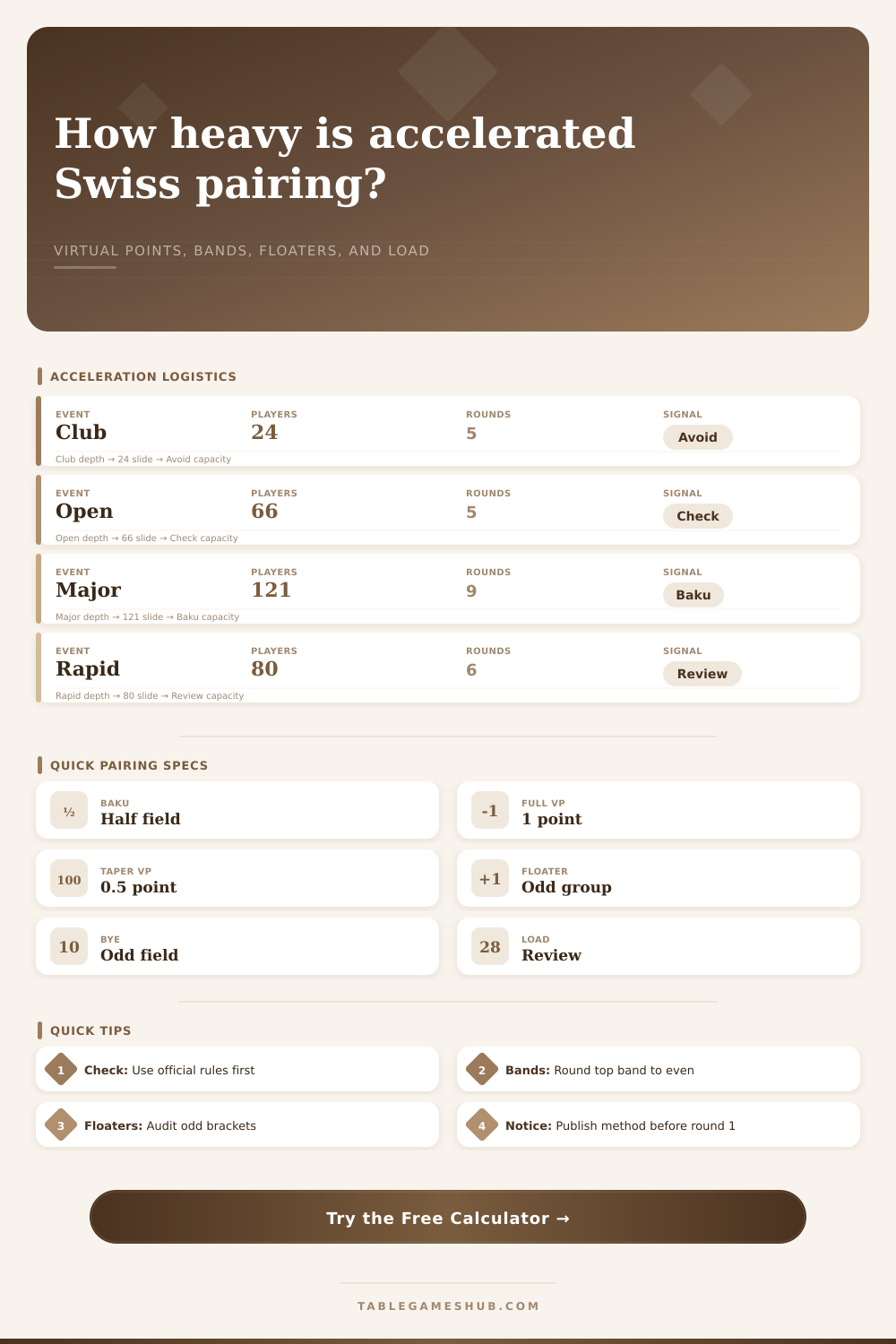
Enter your number of entries and how many rounds you’ll be running. The calculator does all the work for you. It’ll tell you about the workload intensity. It will predict number of floaters. It will tell you whether or not increased complexity is worth it based off field size.
Plan here usually breaks down when it comes to choosing a method. Aggressive, Baku style acceleration: Virtual points is used, tapering off over several early rounds. Keeps top in bunch. Top rated players challenge each other. The rest catch on naturaly. A simple method is to add one point for the first couple of rounds. It is easier for the arbiter. Doesn’t always split the best in deep fields.
The way rounds accelerate changes depending on total number of rounds. See the reference table. Shorter events of nine rounds need more acceleration. There is less in longer marathons (eleven rounds). Fewer games = pressure to separate top tier.
First, consider the inputs. It’s easy to think that it doesn’t matter what input is used. But some rating spreads makes separation easier. For example, there is a big gap between the lowest seeded player and the highest rated. And if acceleration helps maintain that gap, so much the better. If the field is closely rated, then virtual points look like something made up by computer. Players who might of been 8th but got 16th instead feel their ranking is getting gamed by something.
The beauty of tool is letting you move the band share around. How does it change number of pairings? See where top-third control puts most players into brackets vs. Top-half split? The tighter you make the band, the more floaters there will be. Floaters are players who would ideally end up in full brackets but get kicked down to pair against someone else. In an accelerated Swiss, these is problematic. These need to be reviewed manually. The system needs to check color balance. It needs to ensure no one plays the same person twice.
Other pressure comes from odd numbers of players. Every round, somebody gets a bye in an odd field. In some systems, this is considered a pairing point (a bit like a win, but not really). To account for this bye pressure, the calculator estimates it. It alerts you when repeated byes are probable. That’s a fairness matter. It is often ignored.
Players don’t care about losing to a tough competitor. They do care about sitting out twice while their competitors moves up the leaderboard. It is a little thing. But it matters in the event’s social dynamic.
That’s acceleration. Practical playability beats statistical purity. We give up perfect random pairings in favor of good old-fashioned fun. We ensure the best players has to face appropriate competition. The tournament is exciting for both the participants and the spectators.
There’s no way to eliminate all friction. But we can predict it. We don’t want a perfect algorithm. We want a manageable one. So we publish pairings with confidence, not apology.
We know there’s a band on those weights. We know there’s a floater in the mix. And we’re done fighting the software. It’s time to steer the tournament.
The board is set. The bands are split. Now let’s play ball.