Verdant Plant Scoring Calculator
Estimate Verdant plant points from verdancy progress, light matches, room type, furniture bonuses, pot tokens, item adjacency, objective cards, and remaining turns.
1Verdant Plant Presets
2Plant, Room, Pot, and Objective Inputs
| Source | Raw Points | Turn Risk | Calculator Read |
|---|
3Verdant Spec Grid
4Verdant Reference Tables
| Verdancy Icons | Completion State | Base Read | Best Use |
|---|---|---|---|
| 0 to 1 | Starter plant | Low score | Only chase with strong room support |
| 2 to 3 | Growing plant | Tempo line | Add light match before committing |
| 4 to 5 | Near complete | High leverage | Prioritize if turns are limited |
| 6 | Completed plant | Banked points | Attach pot or objective value |
| Input Choice | Light Value | Room Value | Calculator Effect |
|---|---|---|---|
| No matching light | 0 | Mixed room | Plant score carries the row alone |
| Partial light help | 1 | Cozy room | Useful when furniture also matches |
| Correct light match | 3 | Sunny or plant room | Strong midgame placement signal |
| Correct light plus token | 5 | Complete room set | Premium finish with low risk |
| Source | Small Line | Strong Line | Endgame Note |
|---|---|---|---|
| Pot tokens | 1 to 2 pts | 3 to 5 pts | Best after a plant is complete |
| Item adjacency | 1 link | 3 or 4 links | Good tie breaker for room lanes |
| Furniture bonus | 2 to 4 pts | 8 to 12 pts | Chains need enough turns to finish |
| Objective cards | Partial | Complete | Do not ignore a finished objective |
| Preset | Main Lever | Risk | Expected Read |
|---|---|---|---|
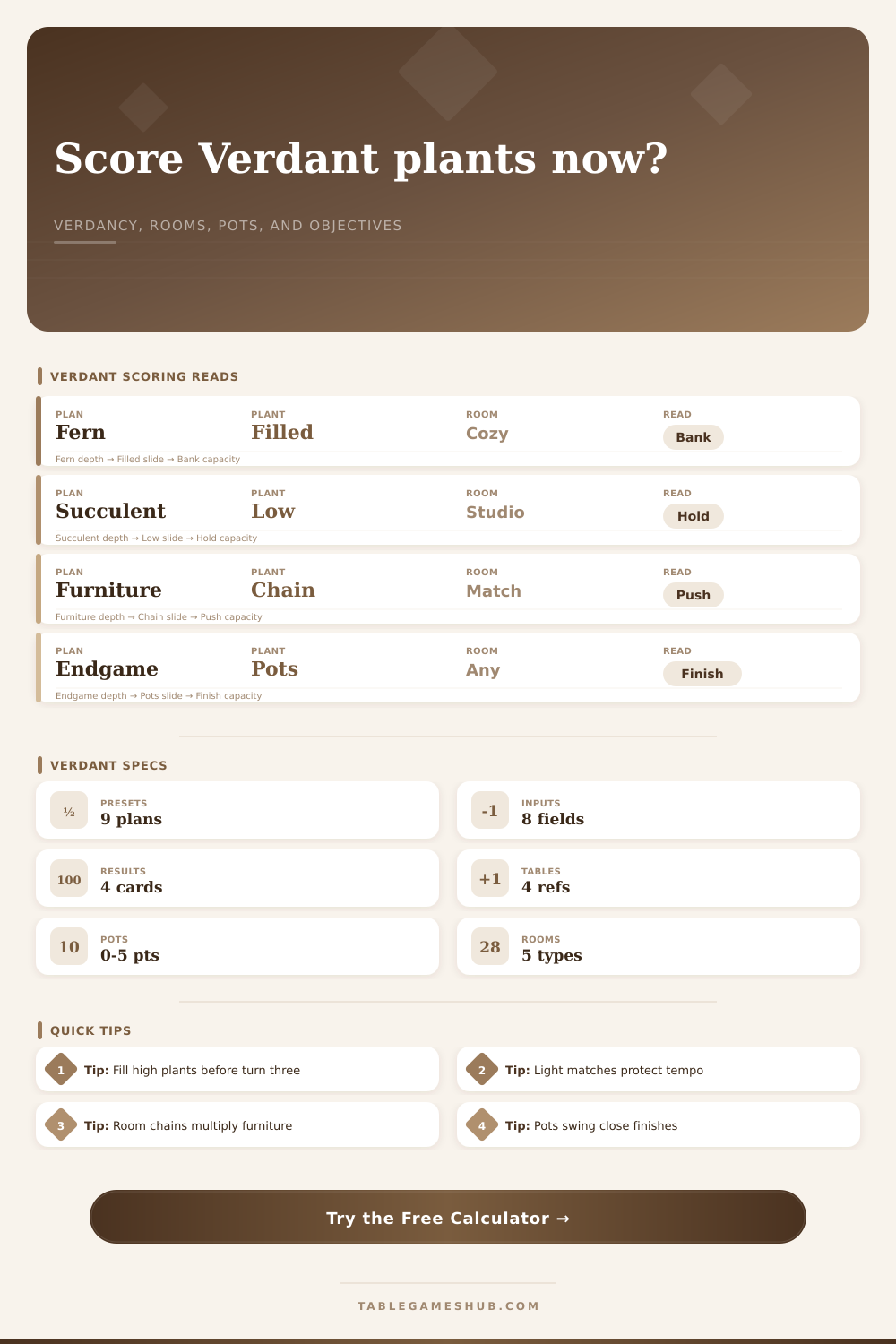
| Cozy Fern Corner | Room color and light | Medium | Finish if plant reaches five icons |
| Low-Light Succulent | Shade match | Low | Good slow lane with pot support |
| Furniture Match Chain | Display room furniture | Medium | Strong if two turns remain |
| Pot Token Finish | Completed plant plus pot | Low | Bank points before chasing extras |
5Verdant Scoring Tips
Finish the plant before decorating. A nearly full verdancy track usually beats a speculative furniture chain when only one or two turns remain.
Count light twice. A correct light match improves the plant now and keeps the room line from needing a perfect final card draw.
And then there’s the tension at the end of Verdant. Good furniture chains is calling to you on one side, and almost-completed fern lines are on another, but there are not enough turns left in your counter. The board is full of possibilities, but vulnerable; every choice will cost you something. Pull the wrong thread and those possible points might turn into liabilities.
It’s easy for intuition to misfire here… Why would you worry about incomplete business? Points is sitting right in front of you, aren’t they? You are missing the turns required to capture them. That’s where people go wrong. They grab for big money instead of the percentage they know they can get. This leave them open when time runs out.
How to Make Good Choices at the End of the Game
Thankfully, there’s a tool (above) that will do that calculation for you. It’ll help you balance out raw point potential with the odds that you’ll still have time to finish it up before end of game. You’re not concerned about how good a plant line might be on its own, you’re trying to decide whether it’s viable considering the time/resources you has left. That difference should make a big difference: A high-scoring goal that needs another turn or two might be worth less then a meh pickup you could snag right now.
The tool considers that truth, taking into account the number of turns left to play and therefore lowering the value of unfinished lines. So it forces you to face the gap between possibility and reality. Take, for example, the verdancy progress input. Four icons out of six looks substantial, but without a light match or room synergy, it is just a partial score waiting for a card draw that may never come. Without both, it’s a half-score waiting on a potentially never-arriving card draw.
But the interface has some reference tables that explain the system’s hierarchy: they’ll show you what happens as you tack on context to the base value. Adding a right match doesn’t merely increase the point total. It locks things into place, erasing future requirements for perfect adjacency placement. It makes it safer, it buys you time. That’s what you’re doing when you plug in all those variables: You’re calculating if it’s worth spending a turn to get the damn thing set up, or not.
Sometimes the answer is absolutely yes! Often, though, the math will tell you that you’re going down a partial-completion rabbit hole that eats up turns while giving you poor return. Pot tokens are like this: Diminishing returns apply as you go farther out. Sure, one display room full of identical pieces can go off like a bomb. But you need enough turns to pull together all those matching piece, and only then will it become worth anything at all. The calculator splits them apart, so you can tell which piece is advancing your cause and which one is slowing you down.
A big drop in your projected score once you account for turn risk mean you’re overextended. Maybe you should of settle for a lower-level gain instead of doubling down on a complicated interaction that puts you at risk from bad dice rolls or opponent moves. Its presets offer a helpful set of benchmarks, ranging from a snug corner of ferns to a narrow watering strategy around the end game. These aren’t just examples; they are decision-making templates. They show how different combinations lead to a final conclusion.
For example, if this low-light succy looks shaky on its own but has full objective plus some good pot tokens supporting it, it’s suddenly a solid scoring machine. It means understanding which paths will be most productive for spending the time you have left. Verdant is a game of predicting future outcomes across several turns; it’s hard to play well unless you can break out of the mindset of making a move and instead think about what your board might look like at the end of the game.
Verdant’s calculator gives you a framework to translate those vague “feels” about the board state into real numbers. It allows you to figure out what plants to leave for the other player and which ones to finish off. Each turn becomes a limited resource that needs to be spent carefully, and rather than running around collecting points, you’re suddenly playing with an eye on managing risk.
The best players will tell you that they know where to draw the line between building and banking; where an over-ambitious line built on a ticking clock fails, and a solid but modestly-bonused build stands strong. The calculator takes the emotion out of this process. It helps you make clear decisions about exactly how much of your build to commit to.
This turns frantic end-rounds into something you can control, making each point you score is a point you can hold onto. By taking what’s yours instead of attempting to take all there is, you’ll come away with more.